
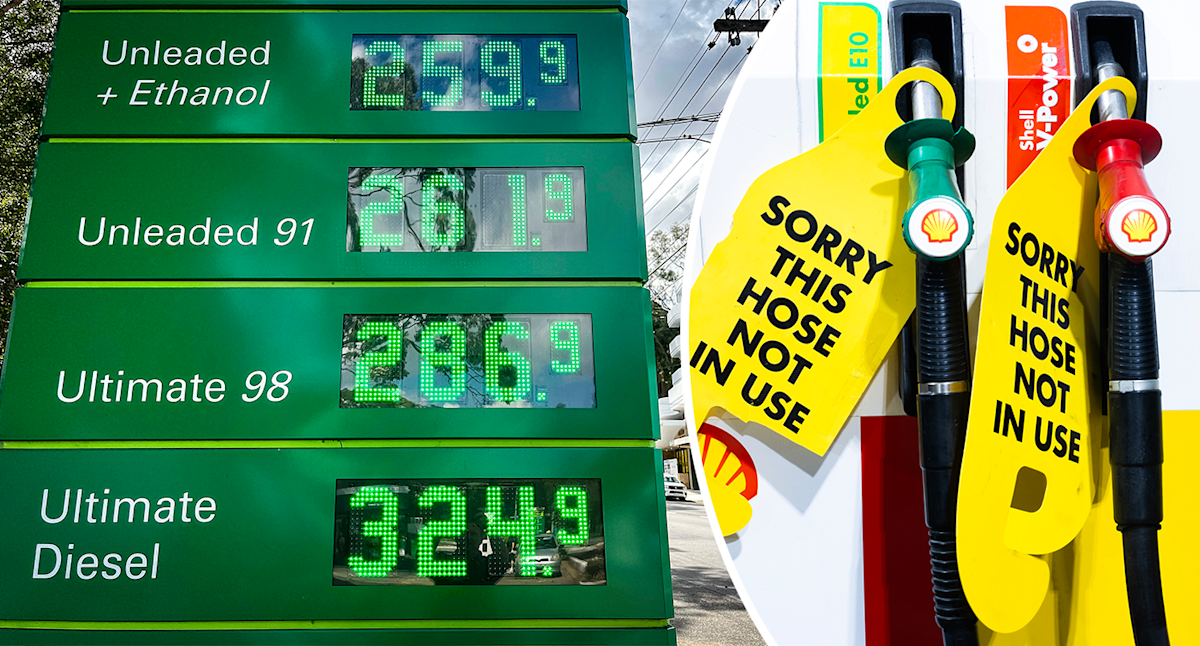
 For better or worse, Australia is a deeply diesel reliant economy and attempts to reduce consumption would throw up challenges. (Source: Getty)
As the war in the Middle East continues to rage and the flow of traffic through the Strait of Hormuz remains at a relative trickle compared with its pre-war volumes, billions of people across the world have been left wondering how this will feed through to impact their daily lives.
In this, Australia is no different and is arguably more exposed than almost any other nation in the developed world, due to holding only a little over a month’s worth of fuel on hand.
Amidst this challenging set of circumstances, the Albanese government has drawn up plans for a layered response based on the level of fuel left in the nation’s stockpiles.
RELATED
According to reports from the ABC, based on modelling outlined in a document produced by the Department of Prime Minister and Cabinet, voluntary conservation of petrol was assumed to begin when the level of stock fell to 15 days, with rationing assumed to begin when stock levels fell to 10 days’ worth of consumption.
In more normal times, attempting to grasp exactly what major fuel conservation efforts could look like would be a far more abstract prospect, but thanks to pandemic-era data, we have hard numbers on exactly the reduction of fuel consumption seen in a real-life major crisis.
Given that there are significant seasonal variations in fuel consumption, which will be assessed through the lens of federal government figures on total monthly sales of fuel by type, the figures today will be compared with the same month in 2019.
Today’s analysis will focus on diesel and petrol consumption, due to the impact of closed borders and pandemic-related restrictions on jet fuel usage.
As one might imagine, it was petrol consumption that bore the brunt of the drop in demand during the height of the impact of the pandemic.
The absolute peak in reduced petrol demand at an aggregate level came in April 2020, with total monthly sales down by 42.7 per cent compared with April 2019.
The next worst month for 2020 came in August 2020, when monthly sales were down by 19.7 per cent compared with that time in 2019.
 (Source: Avid Commentator/Yahoo Finance)
During 2021, the two worst-performing months for petrol came in August and September, down 28.8 per cent and 23.5 per cent respectively compared with those months of 2020.
(Source: Avid Commentator/Yahoo Finance)
In terms of diesel consumption, things are dramatically different.
Story continues
There is a similar shock effect to consumption in April 2020, with total diesel consumption falling by 9.8 per cent relative to the same month of 2020.
While 2020 also held several months of major drawdowns in diesel consumption of a smaller magnitude, most notably May and August, the magnitude of falls in diesel consumption was dramatically smaller than what was seen in the realm of petrol.
(Source: Avid Commentator/Yahoo Finance)
In 2021, the respective tales of diesel and petrol diverge even further, with even the hardest hit months of lockdown, such as the August period, which saw petrol consumption fall by almost 29 per cent, producing growth in diesel consumption relative to the same time in 2019.
Across 2021, the average rate of growth in diesel consumption relative to the same month in 2019 was 4.6 per cent, a major divergence to a year of falls in petrol consumption for every month relative to pre-pandemic levels.
(Source: Avid Commentator/Yahoo Finance)
Where the broader issue really comes into focus is how total combined diesel and petrol consumption fared during the pandemic.
During 2020, the height of the pandemic impact saw total combined consumption fall by 22.0 per cent in April, followed by May and August as the worst months for year, down 13.4 per cent and 11.0 per cent respectively.
(Source: Avid Commentator/Yahoo Finance)
But 2021 held quite a different story.
Even at the absolute height of the impact of the 2021 lockdowns on fuel consumption, total combined consumption fell by just 9.3 per cent.
On an average monthly basis for the year, the lockdowns and various pandemic-driven restrictions saw consumption fall by just 1.0 per cent compared with the same respective months in 2019.
(Source: Avid Commentator/Yahoo Finance)
As the figures from the pandemic illustrate, reducing fuel consumption dramatically in an economy like Australia is an extremely challenging prospect.
Even when petrol demand collapsed during the 2021 lockdowns by nearly 30 per cent, the actual reduction in overall consumption of diesel and petrol only fell by 9.3 per cent.
For better or worse, Australia is a deeply diesel-reliant economy, by some metrics the most diesel-reliant economy in the world in per capita terms.
(Source: Avid Commentator/Yahoo Finance)
With well over half of Australia’s fuel imports refined from oil that transited the Strait of Hormuz prior to the war, a scenario in which rationing was required is unfortunately an entirely plausible one.
Ultimately, the data illustrates that demand for petrol and diesel in Australia overall is fairly inelastic at an aggregate level, and that even attempts to reduce consumption by a relatively small proportion, such as 10 or 15 per cent, would swiftly throw up significant challenges.
Get the latest Yahoo Finance news – follow us on Facebook, LinkedIn and Instagram.