
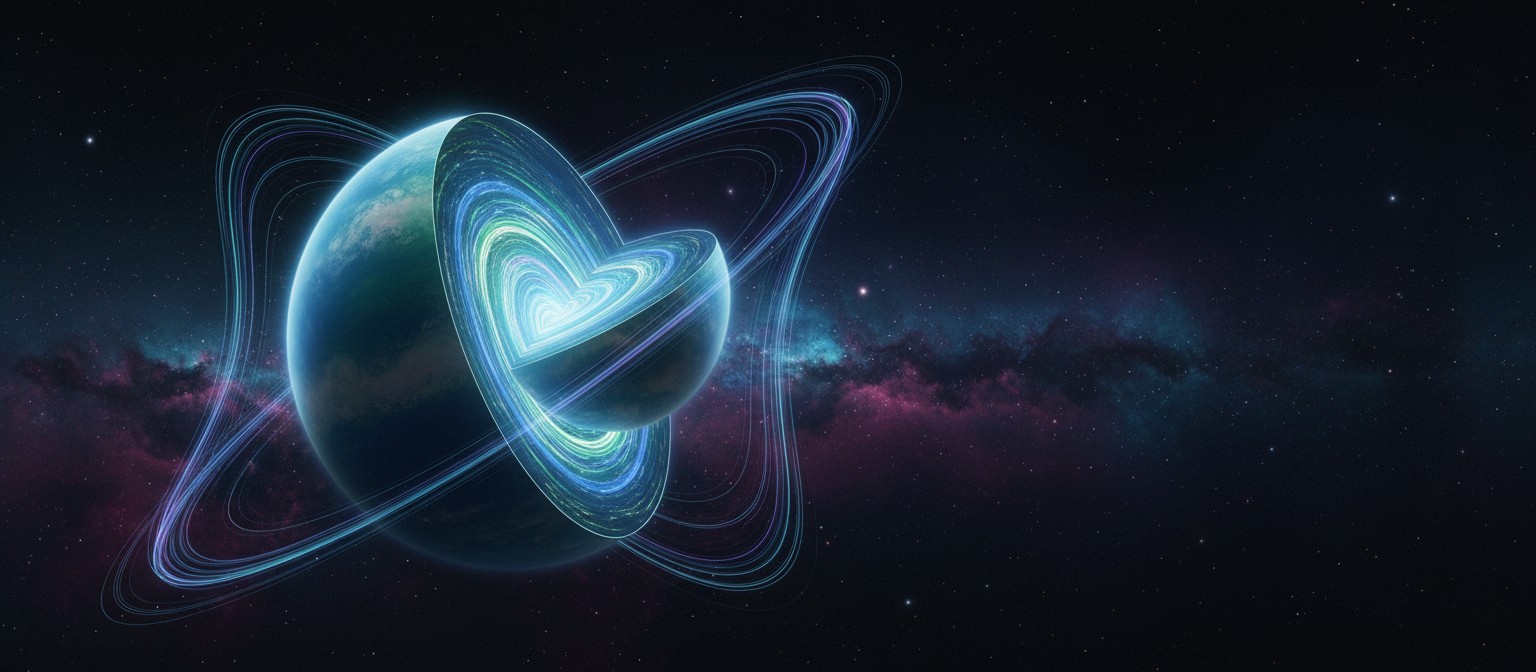
 A dramatic visualization of extreme-pressure interior physics that may help explain Uranus and Neptune’s irregular magnetic fields. Designed to feel like real science photography while hinting at directional heat and electrical transport. (Credit: Intelligent Living)
Visualize environments where the fundamental building blocks of matter defy standard categories. Experts in computational mineral physics have now identified a startling possibility regarding the Uranus and Neptune interiors. Deep within these ice giants, carbon and hydrogen may assemble into a chiral lattice, creating a superionic state of matter where atoms behave as a hybrid between a solid and a liquid.
Machine-accelerated simulations reveal that hydrogen threads through tight helical corridors within a rigid carbon scaffold. This directional hydrogen motion forms what researchers call a quasi-1D superionic CH phase. Researchers argue in the quasi-one-dimensional superionic CH phase prediction that directional bias changes how heat and electrical currents can travel, scaling a tiny atomic preference into massive planetary-sized consequences.
Faraway planets present significant challenges for physical analysis, as extreme pressures make the deep interior impossible to sample directly. To solve this, a research team utilized density functional theory to look through the haze of these frozen worlds. Their data, published in Nature Communications, provides quantitative insights into how extreme pressure effects on planetary ices influence magnetic field geometry.
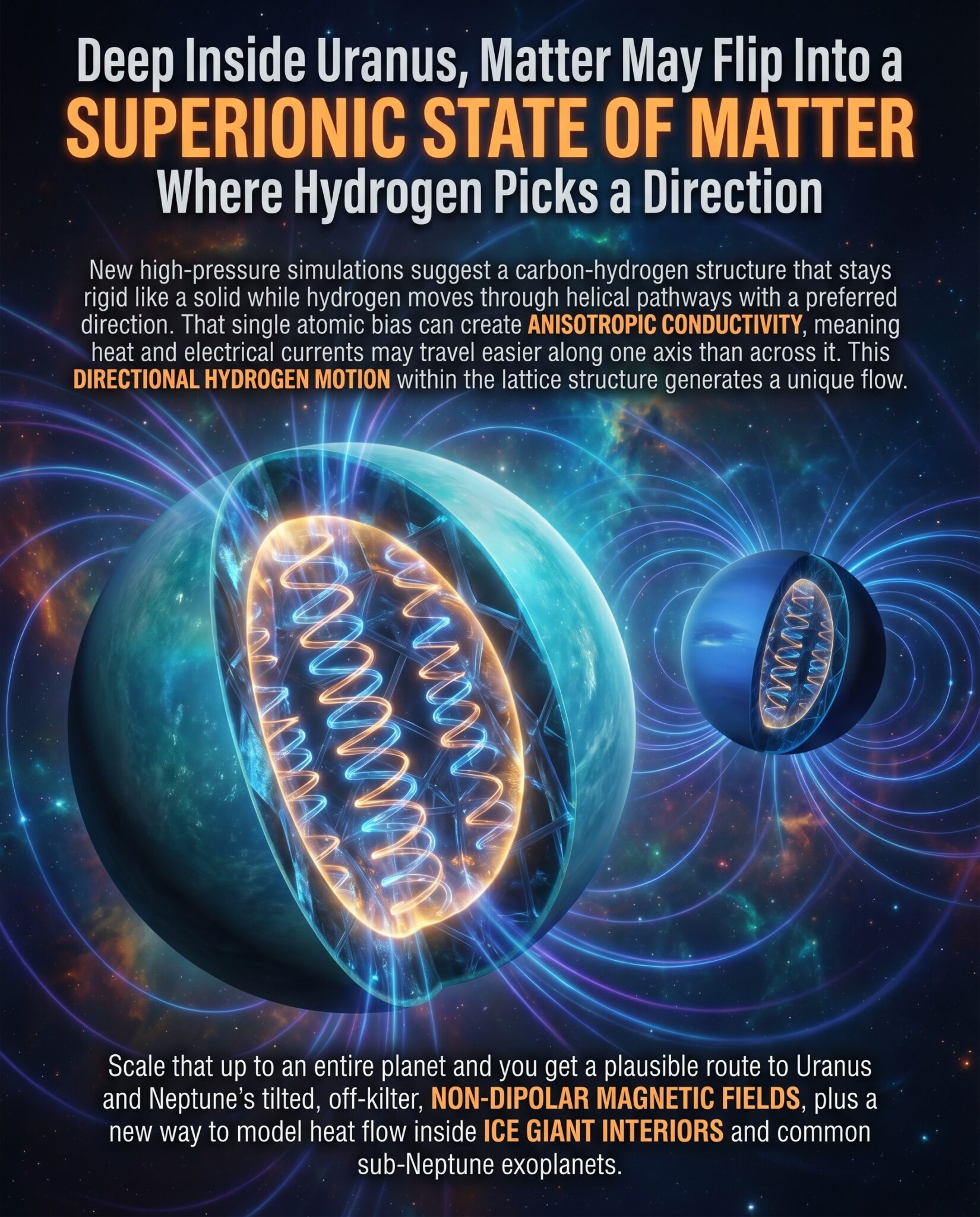 Deep inside Uranus and Neptune, simulations predict a superionic carbon-hydrogen structure where hydrogen moves in a preferred direction, potentially reshaping ice giant heat flow and magnetic fields. This image turns anisotropic conductivity into an instantly graspable visual story. (Credit: Intelligent Living)
Extreme Pressure Effects: A New Superionic State of Matter Inside Ice Giants
Fast Facts: Understanding the Quasi-1D Superionic CH Phase
Predicted phase: a simulated quasi-one-dimensional superionic CH phase where carbon stays ordered while hydrogen becomes mobile in helical pathways, so the material acts solid and fluid at the same time in different roles.
What “superionic” means: one set of atoms forms a solid lattice while another moves through it like a liquid, a hybrid regime explored in superionic ice phases where protons remain mobile inside an otherwise ordered structure.
Interior-like conditions: conditions involving extreme pressures and temperatures of 500 to 3,000 gigapascals and 4,000 to 6,000 kelvin define where this phase emerges.
Key consequence: transport becomes anisotropic, meaning heat and charge can move more easily in one direction than another.
Why this is viral science news: a subtle bias in atomic motion scales into global consequences, fundamentally altering our understanding of ice giant evolution.
What Researchers Say is Happening Deep Inside the Ice Giants
Calculations based on first-principles and machine-accelerated simulations map possible structures of carbon-hydrogen mixtures under extreme compression. The headline result reveals a chiral carbon framework that holds carbon atoms in place. Meanwhile, hydrogen forms spiral pathways through the lattice. Rather than diffusing equally in all directions, hydrogen mobility becomes strongly favored along a single axis.
Daily experiences rarely prepare us for how constraints force matter into counterintuitive behaviors. Water can even act solid when it should be boiling in tightly confined environments, a clean way to picture how pressure can make familiar ingredients behave like a different substance.
Ab initio Modeling and the Superionic Phase Evolution Sequence
The team combined density functional theory with fast interatomic potentials to probe stability and transport. By mapping these extreme environments, they identified a computed phase ladder that defines the planet’s internal structure.
Solid phase at lower temperatures.
Quasi-1D superionic state where hydrogen helical corridors form.
Isotropic three-dimensional superionic regime.
Fluid state at the highest temperature ranges.
Each transition rewrites what counts as an easy path for energy and charge. This structural evolution explains how heat moves through the hydrocarbon-dominated layer. Machine-learning potentials enable extended molecular dynamics sweeps beyond the limits of pure ab initio sampling. Consequently, open tools like DeepMD have become central to modern research into extreme materials.
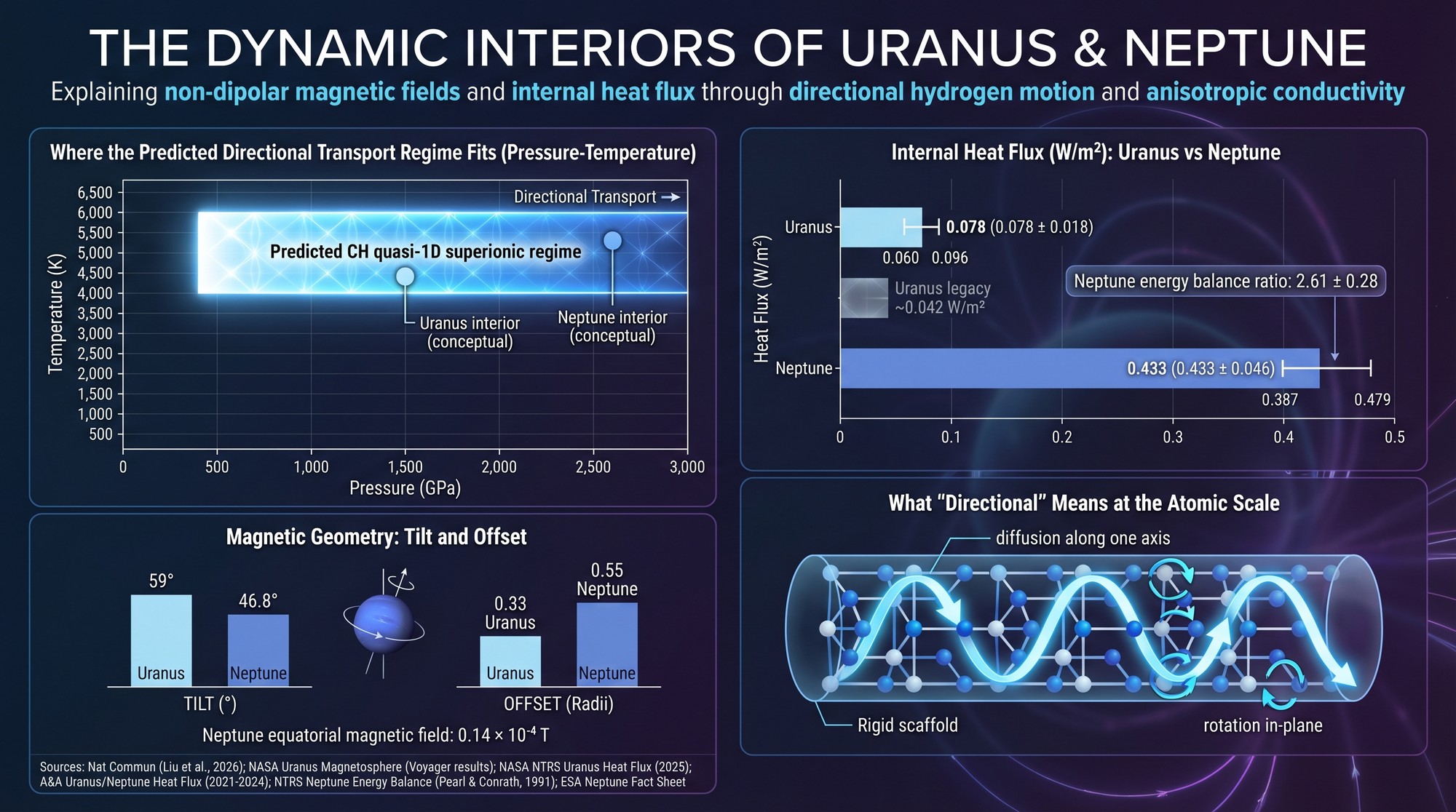 This graphic links the predicted directional transport regime to real measured ice giant magnetic geometry and heat output differences. It turns “anisotropic conductivity” into visible comparisons: where it might happen, and what it could influence. (Credit: Intelligent Living)
How Directional Hydrogen Could Affect Ice Giant Heat and Magnetism
The Twist: Hydrogen Moves like it Has a Preferred Direction
Hydrogen helical corridors ensure that atomic motion is far from random. The predicted hydrogen helices create channels where mobile hydrogen can slip along a narrow route while the carbon skeleton remains comparatively static. This implies directional conductivity: heat and charge could travel more efficiently along the corridor direction than across it.
Consider a city where a single express line remains clear while all other routes stall; the entire transit network naturally reorganizes around that primary corridor. Planetary interiors behave similarly when atomic motion adopts a favored direction. The potential to harness electricity from planetary rotation illustrates how subtle directional effects can influence massive electrical currents.
Why Uranus and Neptune are the Perfect Place for Weird Physics?
Uranus and Neptune already challenge simple interior models. Their magnetic fields do not resemble neat dipoles. Instead, they appear tilted, offset, and irregular. This odd geometry suggests that the electrically conducting region driving the dynamo is arranged differently than in Earth or Jupiter.
Their Magnetic Fields Look Off-Kilter for a Reason
A classic proposal, the thin shell dynamo geometry for ice giant magnetic fields, models a thin convecting shell surrounding a more stable interior. This specific setup naturally produces the tilted and offset fields observed today.
Layered Interiors Make Room for Directional Conductivity
Directional conductive phases in carbon-hydrogen chemistry offer plausible microphysics ingredients rather than complete solutions to the Uranus and Neptune puzzle. Recent ab initio modeling explores the phase separation of planetary ices into distinct interior layers, potentially concentrating dynamo action in the upper regions.
Magnetism Becomes Understandable When it Turns Visible
Magnetic fields represent the tangible geometry of moving charge rather than mystical auroras. Researchers utilize high-strength steady-field magnets to quantify moving charges in teslas.
When that field stirs charged particles in an atmosphere, it paints the sky. These auroras, as a visible magnetosphere effect, make the invisible geometry of the magnetosphere feel real in everyday terms.
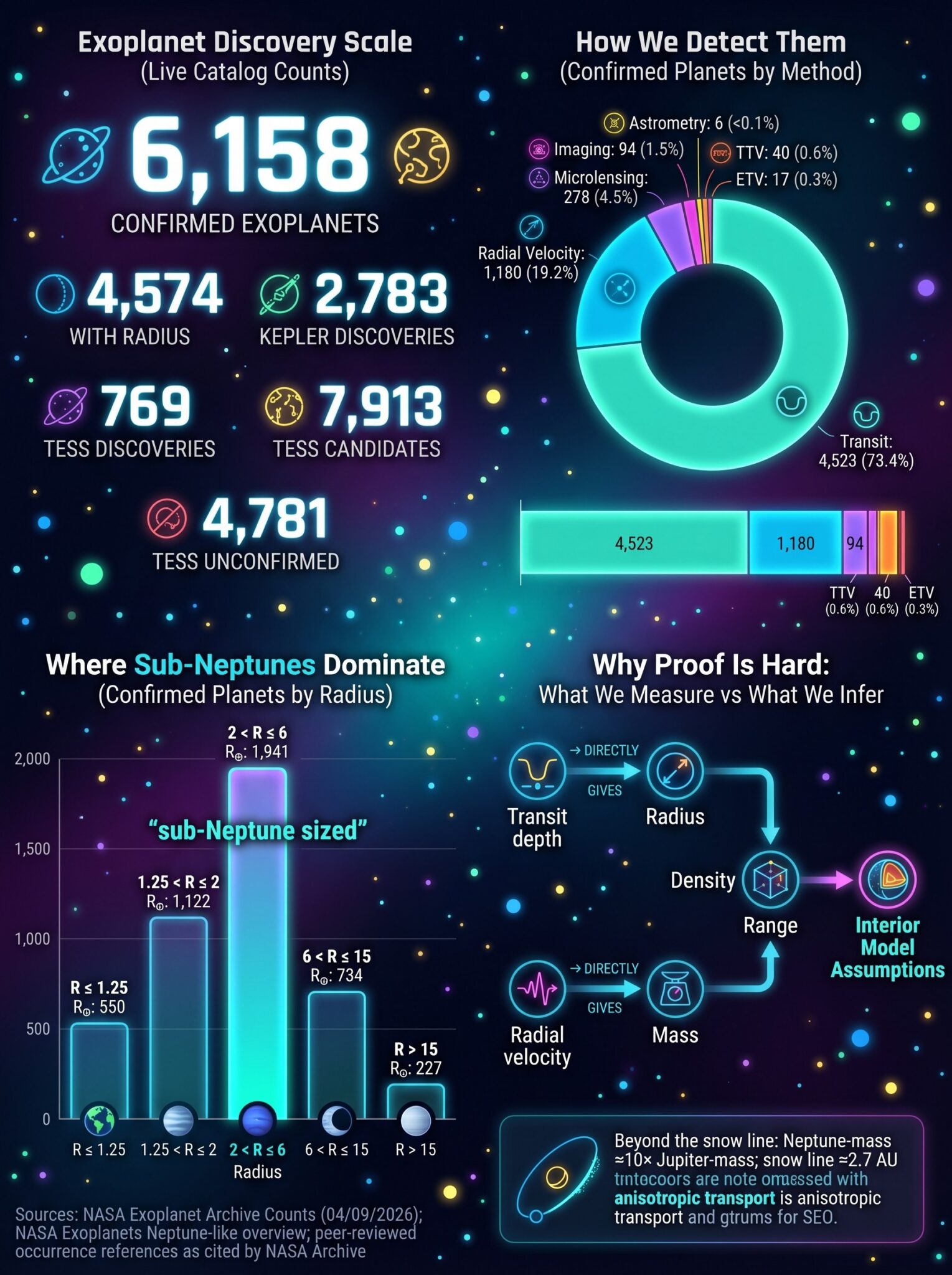 Sub-Neptunes dominate modern planet catalogs, but most worlds still come with incomplete measurements that force modeling assumptions. This graphic shows the scale of discovery and why interior physics claims must be treated as testable predictions, not direct observations. (Credit: Intelligent Living)
Beyond Uranus: Sub-Neptunes, Modeling, and the Limits of Proof
This is Not Just a Uranus Story; It is an Exoplanet Modeling Story
Internal physics shifting heat and charge transport can shift mass-radius relations and thermal evolution tracks across thousands of observed worlds. NASA observations confirm that sub-Neptune worlds are the most common exoplanet type discovered so far. Webb spectra are also starting to separate which sub-Neptunes keep lightweight hydrogen envelopes from those wrapped in thicker haze and heavier molecules, a distinction that feeds straight into interior density and formation models.
Rapid discovery cycles maintain high stakes for planetary modeling. The NASA archive’s confirmed planet count keeps climbing, and each new world adds pressure on models that try to infer interiors from sparse external clues. If certain hydrogen-carbon chemistries prefer directional transport under extreme conditions, theorists may need to treat anisotropy as a realistic interior option rather than an edge case.
Computational Prediction Constraints and Laboratory Validation Challenges
Simulation Claims Regarding Hydrocarbon-Dominated Layer Stability
Computational predictions involve a central caveat: this phase requires precise chemistry and CH compound abundance at specific depths. It must also survive mixing and reaction over geologic time.
Laboratory validation under comparable conditions is difficult but increasingly plausible. As high-pressure facilities improve, researchers can better test these extreme pressure effects on planetary ices. Extreme compression experiments have successfully observed diamonds forming in compressed hydrocarbons, proving that these mixtures reorganize under intense pressure.
Why New State of Matter is a Shortcut Phrase
Contextualizing the phrase ‘new state of matter’ remains essential for accurate reporting. Many headlines use it as a drumbeat, but the actual story is usually about a new regime of structure and motion. The study of liquid glass as a proposed new state of matter provides an example where unusual constraints create behavior that defies simple categorization.
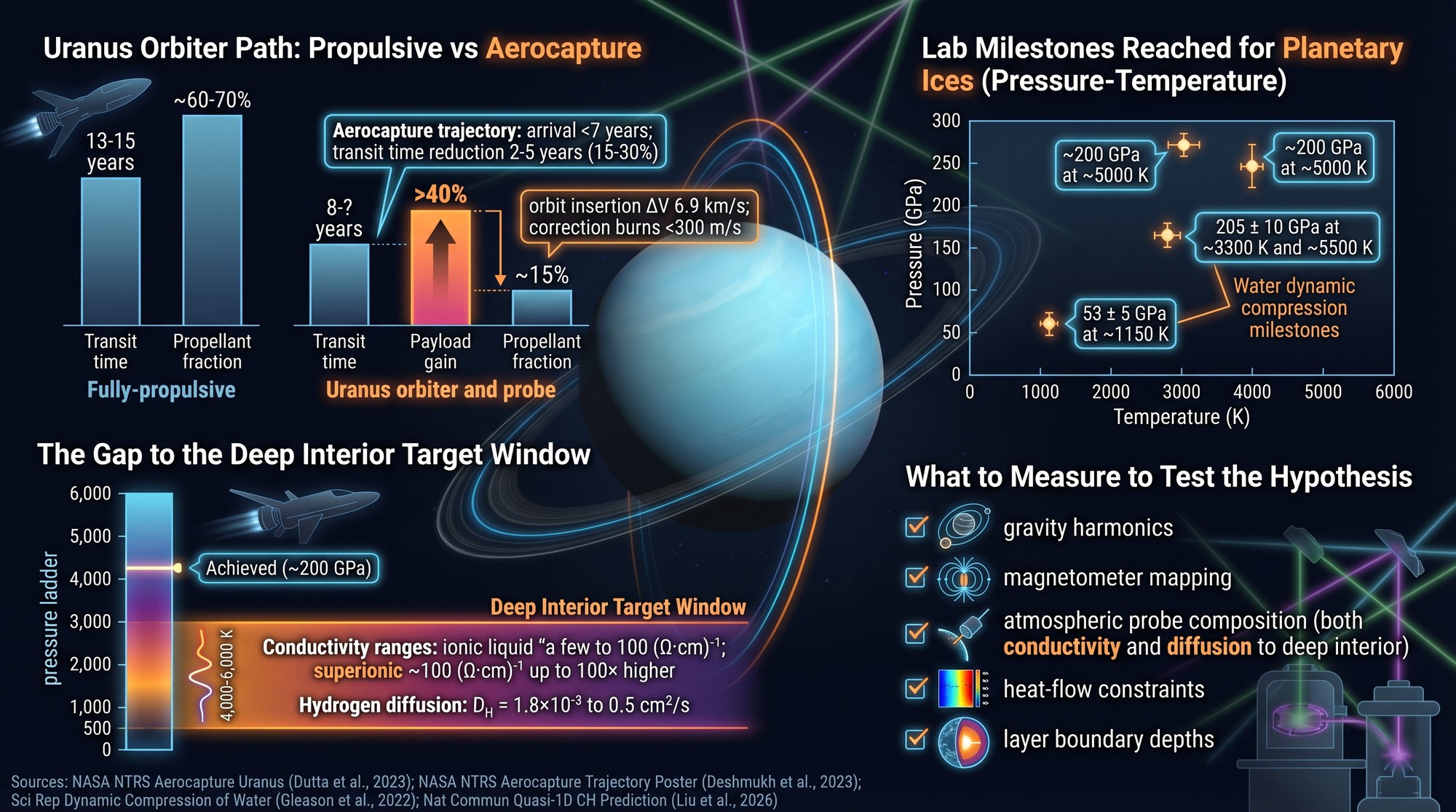 This visualization turns “future verification” into a measurable plan: mission design tradeoffs, the fastest paths to orbit, and the lab pressure-temperature milestones already achieved. It connects the predicted deep-interior regime to the real experiments and missions that can confirm or falsify it. (Credit: Intelligent Living)
NASA Mission Priorities and Future Experiments for Planetary ices
Strategic Shifts in Ice Giant Dynamo Interpretation
The emergence of superionic phases forces researchers to rethink the fundamental mechanisms driving planetary evolution. By identifying these directional channels, scientists can now refine their expectations for how energy moves through frozen worlds.
Update interior transport models: treat directional heat and charge flow as an option in ice giant evolution calculations, especially in light of double superionicity in icy H C N O compounds that could add layers and alter convection.
Refine dynamo interpretations: revisit which layers can plausibly carry currents and redistribute heat without assuming symmetry, since the magnetosphere of Uranus is uniquely tilted and offset, suggesting a complex interior structure.
Adjust sub-Neptune priors: test whether anisotropic phases shift predictions for thermal histories and magnetic signatures, using NASA definitions for Neptune-like planets to improve our understanding of diverse planetary interiors.
Push targeted experiments: look for transport fingerprints that would distinguish quasi-one-dimensional superionic behavior from more isotropic superionics, building on lab work that measured the elasticity of superionic ammonia under conditions mimicking ice giant interiors.
Clarify mission measurement priorities: tie gravity, magnetic mapping, and atmospheric probe data to interior layer constraints, drawing on objectives defined for the Uranus Orbiter and Probe mission concept.
This shift in interpretation moves the conversation from speculative models to testable hypotheses. As mission data arrives, these strategic refinements will allow for a more precise mapping of the ice giant interiors.
Emerging Ground Truth from Remote Sensing and Future Missions
Validation in the Lab
Experimental and exploratory efforts provide the most critical validation paths. On the lab side, dynamic compression and laser-heated diamond anvil setups are inching closer to measuring directional transport in relevant chemistries, because conductivity and diffusion can leave different fingerprints when motion is channeled instead of free.
Ground Truth from Missions and Remote Sensing
On the mission side, the Uranus Orbiter and Probe has been identified as a top flagship priority for upcoming planetary strategies. A NASA technical study, the Uranus probe entry and descent mission concept, sketches how an atmospheric probe could survive entry heating long enough to return in situ measurements that tighten the interior story.
Independent of future missions, near-term remote sensing is starting to sharpen the boundary conditions. Recent Webb telescope imaging reveals auroras shaped by the planet’s tilted magnetic field.
Aerocapture and Entry Engineering
Specialized mission studies further explore ways to shorten travel time and increase delivered mass by using the planet’s atmosphere as a brake. A technical overview of aerocapture for a Uranus orbiter and probe describes how atmospheric deceleration can significantly reduce propellant demands for deep-space missions.
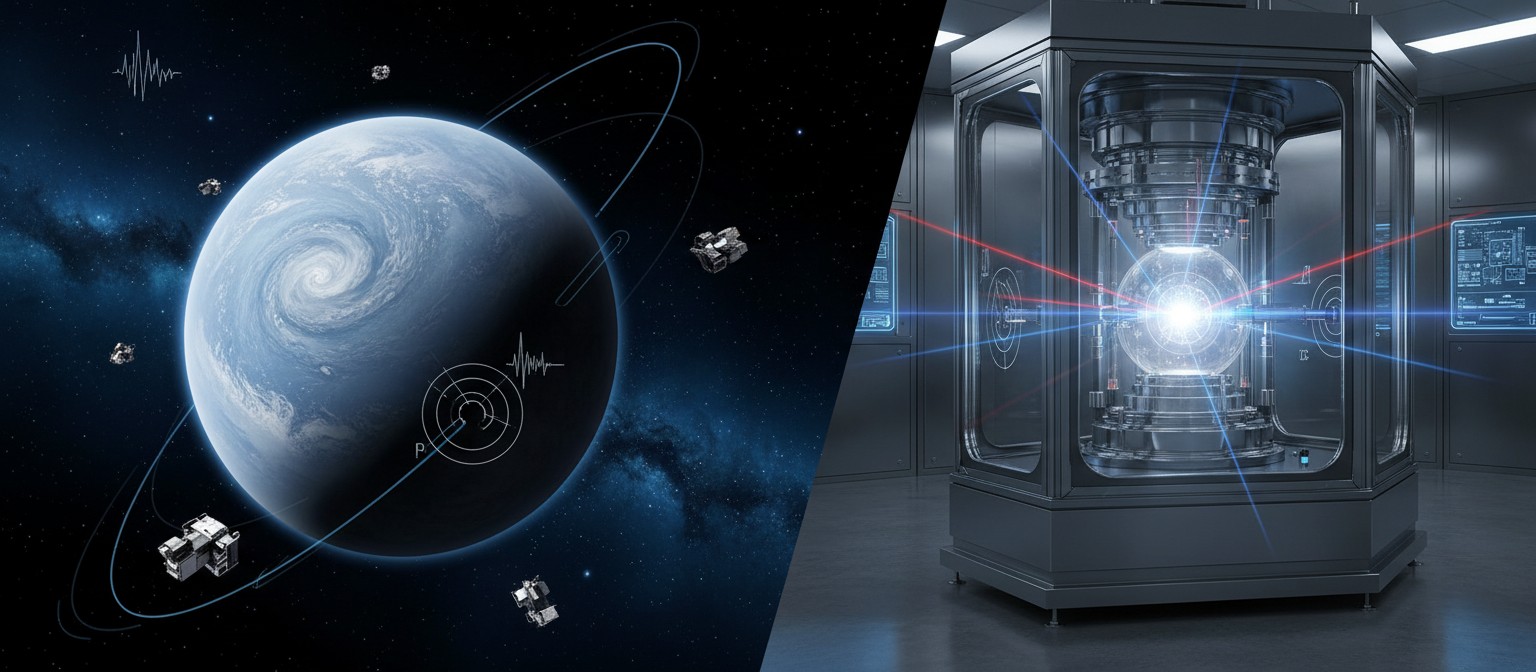 The closing image connects prediction to verification: missions, measurements, and laboratory extreme-pressure experiments. It frames the story as a roadmap from simulations to real data about ice giant interiors and sub-Neptune worlds. (Credit: Intelligent Living)
Conclusion: A New State of Matter Inside Uranus Could Change Ice Giant Physics
The idea of a quasi-1D superionic layer sounds exotic, but the mechanism is grounded in a chiral carbon scaffold. This unique structure provides a microscopic route for anisotropic heat transport and the planet-scale asymmetry seen in ice giant magnetic fields. Confirmed accuracy in these predictions would provide a definitive roadmap for modeling the thermal and magnetic evolution of giant planets.
Atomic structures frequently organize into unexpected regimes when subjected to extreme compression. From superionic water ice to this new hydrogen-carbon lattice, the centers of ice giants are proving to be the ultimate laboratories for extreme mineralogy. Future NASA mission priorities will likely focus on confirming how these hidden states of matter drive the non-dipolar magnetic fields that make Uranus and Neptune so mysterious.
FAQ: Understanding the Superionic Interior of Uranus and Neptune
What is a superionic state of matter?
A superionic state occurs when one set of atoms forms a rigid crystalline structure while another set flows through it with liquid-like mobility.
Is there really a new state of matter inside Uranus?
Computational mineral physics suggests a quasi-1D superionic CH phase exists deep within the Uranus and Neptune interiors.
Why are ice giant magnetic fields so messy?
The directional hydrogen motion in superionic layers creates anisotropic conductivity, leading to tilted and off-kilter magnetic fields.
Can scientists recreate these conditions on Earth?
Researchers use dynamic compression and laser-heated diamond anvil cells to mimic the extreme pressure effects on planetary ices.
What will the NASA Uranus probe discover?
The upcoming NASA Uranus Orbiter and Probe will map gravity and magnetic signatures to confirm the presence of layered interiors.