
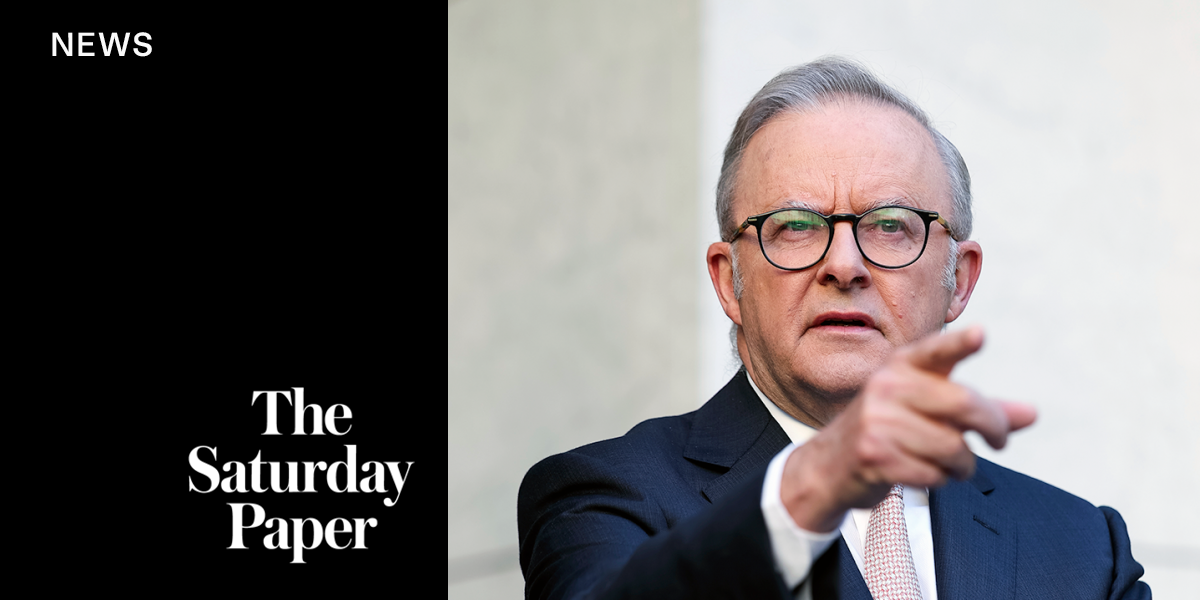
The prime minister wants Australians to know that his is a government ready to take action on the harms of gambling addiction – but good reform takes time and a total ban isn’t the solution.
“It’s terrible if people get addicted to gambling,” Anthony Albanese tells The Saturday Paper. “The solutions aren’t always just to ban things. So it’s about just getting it right, and I think we’ve got it right.”
In an interview after announcing plans to partially restrict gambling advertising, Albanese says: “There’s criticism from both sides of the debate, but I think Australians overwhelmingly want to watch the footy. Some people don’t want to see any advertising at all. This will provide them with the opportunity to do so with opt-out, all of that.
“For those people who want to know what the odds are – in part, for their footy tipping or what have you – then they’re able to do so.
“But you’ve got to treat people like adults as well.”
He says he protects the right of people to “have a punt”, adding that “over half of problem gambling issues are about pokies – and none of this was ever about pokies”.
“The problem is the extent of advertising. I think that annoyed people,” the prime minister says. “And how do you break a nexus, which is there over a period of time, developed between sport and gambling?”
Labor’s plan has underwhelmed reformers, who also say it is too lenient on the sporting codes, media organisations and the gambling industry – what veteran social justice campaigner Tim Costello calls the “three big gorillas”.
“We have an opportunity to actually meet this crisis head-on,” Costello tells The Saturday Paper. “The crisis is the greatest gambling harm in the world, the greatest gambling losses in the world, and timid half measures [are] a good start, but they will not protect kids in the next generation.
“We need the full Murphy ban and a regulator.”
Rejecting accusations that lobbying and donations slowed progress on the reforms, Albanese says gambling reform is a “complex issue” and was always a matter of “having the time and the space”.
“After BetStop and all the other things we’ve done – credit card banning, everything we did in the first term – this adds to that.”
Albanese says the long-awaited plans to curtail gambling TV, radio and online ads and ban online Keno – which were announced in the back half of a National Press Club speech last week – were ready and slated to be announced at the start of the year but were shelved due to the Bondi terror attack in December.
“A lot of things got put off – my National Press Club speech was going to be in January – … because of December 14 and because of circumstances,” he says.
“We wanted to consult properly, get it right, and do it in a way that didn’t have this big cost to the budget. I think that we got it right.
“I was always planning for more reform this term. As I said in the speech, we did the most reform ever last term, and now we’ve taken it another step further this term.”
Crossbench sources say the spur to action is damage control by a prime minister facing Labor’s national conference in July, because “he knows ‘gas, gambling and Gaza’ are going to be the three things that he’s going to get hammered on.”
Senior Labor sources dismiss this accusation, saying it discounts the “untouchable” authority of a prime minister with 94 seats in parliament – a massive majority.
“The ad ban, I think, is a piecemeal approach that all the evidence says is not going to work. We’re seeing this incrementalism in so many parts of how this government is approaching difficult issues, and I think the community is sick of it.”
Albanese sums up his meetings with Costello and others, including Labor caucus members, “who had views – people came from different perspectives”.
The Saturday Paper understands a dedicated group of caucus members felt strongly about tackling problem gambling and had been working on change internally. Albanese’s unexpected offering of “further reforms” in “key priority areas” in an answer to a crossbench question in Question Time on March 25 signalled a plan was finally close.
“The hairs on the back of my neck stood up. I was like, ‘Hello!’, this is movement,” Labor MP Jerome Laxale tells The Saturday Paper. “I’ve listened intently to the answers on gambling for the last four years, right?”
Other caucus members, such as the member for Macnamara, Josh Burns, say they have been satisfied the plan protects young people.
In the wider labour movement, the head of Unions NSW, Mark Morey, led the pressure group Labor for Gambling Reform. “It’s such a constant stream of revenue for everybody,” Morey says. “The one thing that no one says is ‘where’s that money coming from?’ And it’s not coming from millionaires. It’s coming from working people and people who can’t afford to gamble.”
The total gambling drain in Australia was last estimated in 2022-23 by the Australian Institute of Health and Welfare to be $31.5 billion annually – about $1527 per person – and is expected to be more now as “total gambling expenditure has generally continued to increase over time”.
Where that gambling industry money is going, in part, is to political parties. Australian Electoral Commission data for the last financial year shows more than $3 million in donations. Both Labor and the Coalition accepted significant donations from the online betting giants Tabcorp and Sportsbet.
Communications Minister Anika Wells acknowledges to The Saturday Paper that “pressure was brought to bear from all sides” and that the process has meant navigating “diabolically” divergent views. She also pointed to the leaks that thwarted the “friendless” work on gambling last term under her predecessor in the portfolio, Michelle Rowland.
Wells has served for four years as minister for sport, building relationships with powerful sports industry figures such as Australian Rugby League Commission boss Peter V’landys and AFL chief executive Andrew Dillon.
Under Labor’s proposal, gambling advertising will be banned during live sports broadcasts and capped at three an hour between 6am and 8.30pm. There will be no radio ads during school drop-off and pick-up times. To see an online gambling advertisement, the user must be 18 and not already opted out of seeing such advertisements. Gambling ads on player uniforms and around stadiums such as venue perimeter boards will be banned, as will ads featuring celebrities and sports stars.
Independent MP Kate Chaney was part of the Murphy-led committee that sought to address gambling harms. She regards Labor’s offering as “incremental” and says it must be improved as it passes through parliament.
“The ad ban, I think, is a piecemeal approach that all the evidence says is not going to work,” she tells The Saturday Paper, referring to the manual “opt-out” element, which she says does not treat gambling as a public health issue.
“We’re seeing this incrementalism in so many parts of how this government is approaching difficult issues and I think the community is sick of it. You can’t always be about compromise.”
The loss of the central Labor figure Peta Murphy to cancer in late 2023 was a blow to the party, and added impetus to the anti-gambling campaign. That the popular MP’s legacy has been used to criticise a Labor government has been a source of intense frustration, says Wells.
“There is white-hot anger in the government about these politicians that would never have spent an hour alone with Peta, who then self-selected as the moral arbiter of her legacy,” she says.
The domestic gambling industry, represented by Responsible Wagering Australia (RWA) and including Tabcorp and Sportsbet, is seeking details from the minister, saying it had been cut out of the latest consultations.
Wells did not meet directly with the gambling bodies, leaving those interactions to staff and department officials, building on the exhaustive original work of the parliamentary committee.
Some moves were draconian, said RWA. Others had never been considered before federally, such as the stadium and jersey bans.
They are looking for some negotiation ahead of the full reform package, which will be tabled when parliament returns for the May budget.
“They don’t need to agree with us, but we expect that we will be consulted so we can at least hopefully inform some policy settings and ensure these measures can actually be implemented,” RWA chief executive Kai Cantwell tells The Saturday Paper.
“That’s why I say the details now are going to be critical, and the timing moving forward, because we’re working towards, by the sounds of things, a January 1 implementation.”
He says the industry has responded to community outrage, voluntarily reducing its advertising spend on free-to-air television by 71 per cent over the past five years.
“We acknowledge there has been too much advertising in the past, and that’s why we’ve not been opposed to making these kinds of reforms,” he says.
The Australian Communications and Media Authority estimated that the gambling industry spent more than $160 million on free-to-air television advertising in the 2022/23 financial year.
The Seven Network is among the media companies eyeing compensation for lost revenue. “We anticipate the government will introduce appropriate mitigation measures that address any loss of revenue and implementation costs of the proposed reforms,” a Seven spokesperson tells The Saturday Paper.
The NRL is negotiating the rights for a new broadcast deal which, before the gambling reforms were announced, was expected to exceed $4 billion.
Albanese isn’t committing to compensation. “We’re thinking about implementing a policy and with notice for people, so that they can have planning,” he says.
He expects the media companies and sporting codes will find other sources of revenue, as “there’s lots of opportunities out there. There’s lots of time for that to occur.”
Attention now shifts to how the reforms will progress through parliament, as Labor does not have a majority in the Senate.
Both the Greens and the Coalition have indicated support for gambling reform. The latter, under Peter Dutton, came out first three years ago for an ad blackout one hour before, during and one hour after live sport.
That proposal was stronger than where Labor has now landed.
Labor has noted a preference to work with the Coalition as a party of government, though some insiders favour a deal with the Greens given the opposition’s divisions.
Like the contentious environmental law reform that passed last year with Greens support, all options are on the table.
“I’ve reverted back to aged care a lot with this – you want parties of government to agree on this so that it sticks,” Wells says, pointing to her role last term in leading reforms as minister for aged care.
The Greens regard the gambling industry as “vultures” and want a complete ban on gambling advertisements and other protections.
“I don’t think anyone’s arguing for it to be weakened, so it’ll either pass as is or have a few amendments on the way through,” says Jerome Laxale.
“It’s progress, and this is the constant battle for progressives, right? You have got to take every win you can, because they’re hard fought for.”
One Nation’s position on the government’s reforms is still unclear, but the party has taken on gambling interests before.
In 2017, One Nation joined a newsagent industry campaign against Gibraltar-based Lottoland, an online platform for betting on overseas lottery draws. A year later, it was banned by the Turnbull government.
“For One Nation, this is their core business,” Tim Costello tells The Saturday Paper. “Sportsbet, registered in Ireland – it’s called Flutter – it’s the biggest. It takes $2.2 billion out of Australia without one shop or outlet. Its CEO is paid over $6 million a year. A foreign multinational, grooming our kids and acting in a predatory way to Australian citizens. One Nation should support a complete ban.”
A One Nation spokesperson tells The Saturday Paper the party is waiting to see the details of the proposed reforms.
Mark Morey says a bipartisan approach will be critical.
“I just think it is across all voters, no matter what political persuasion, who support these reforms, and I don’t think it’s any different from the Liberal Party to the Greens to Labor and even talking to some people in One Nation, I don’t think it will be hard to get a consensus position on this,” the senior union figure says.
“That’s the only way you’re going to get it through, and that’s the only way you’re going to stare down the media companies and the gambling companies – if there’s a united front on this.”
This article was first published in the print edition of The Saturday Paper on
April 11, 2026 as “Albanese on gambling: ‘You’ve got to treat people like adults’”.
For almost a decade, The Saturday Paper has published Australia’s leading writers and thinkers.
We have pursued stories that are ignored elsewhere, covering them with sensitivity and depth.
We have done this on refugee policy, on government integrity, on robo-debt, on aged care,
on climate change, on the pandemic.
All our journalism is fiercely independent. It relies on the support of readers.
By subscribing to The Saturday Paper, you are ensuring that we can continue to produce essential,
issue-defining coverage, to dig out stories that take time, to doggedly hold to account
politicians and the political class.
There are very few titles that have the freedom and the space to produce journalism like this.
In a country with a concentration of media ownership unlike anything else in the world,
it is vitally important. Your subscription helps make it possible.
Send this article to a friend for free.
Share this subscriber exclusive article with a friend or family member using share credits.

Used 1 of … credits
use share credits to share this article with friend or family.
You’ve shared all of your credits for this month. They will refresh on May 1. If you would like to share more, you can buy a gift subscription for a friend.
SHARE WITH A FRIEND
? CREDITS REMAIN
SHARE WITH A SUBSCRIBER
UNLIMITED
Loading…
Comment
A thousand days of inaction on gambling reform