
A volcano that can change the climate of the entire planet sounds like something from a movie. But supereruptions are real, and Earth has experienced them before.
Scientists continue to study these powerful events to understand how such massive eruptions begin deep underground.
What makes supereruptions so dangerous?

Supereruptions are the largest volcanic events on Earth. These eruptions release more than 1,000 cubic kilometers of magma, ash, and rock.
Such an event can block sunlight, cool global temperatures, and disrupt life for years. Because of this risk, scientists want to understand how supervolcanoes behave below the surface.
A research team from the Institute of Geology and Geophysics of the Chinese Academy of Sciences has taken a major step in this direction.
The team built a detailed three-dimensional model of western North America. This model shows how Earth’s outer layers move and interact.
A new way to look at magma storage
For a long time, scientists believed that supervolcanoes stored magma in large liquid chambers under the crust. According to this idea, magma slowly builds up pressure until the crust breaks and causes an eruption.
Recent studies challenge this view. Scientists now think magma does not sit in one large pool. Instead, magma spreads out in thick zones called magma mush systems.
These zones contain partially melted rock rather than pure liquid magma. This structure changes how scientists understand volcanic eruptions.
Mantle winds move through layers
To understand this process, it helps to know about Earth’s layers. The lithosphere forms the outer shell of the planet. This layer includes the crust and part of the upper mantle. It is solid and rigid.
Below the lithosphere lies the asthenosphere. This layer is softer and flows slowly over time.
Many scientists believe the magma that feeds supervolcanoes comes from this deeper layer. As the molten material rises, it mixes with surrounding rock and forms a thick, sticky magma mush.
This magma mush behaves very differently from liquid magma. It moves slowly and resists flow. This makes it harder for magma to rise quickly and erupt.
Yellowstone offers key clues
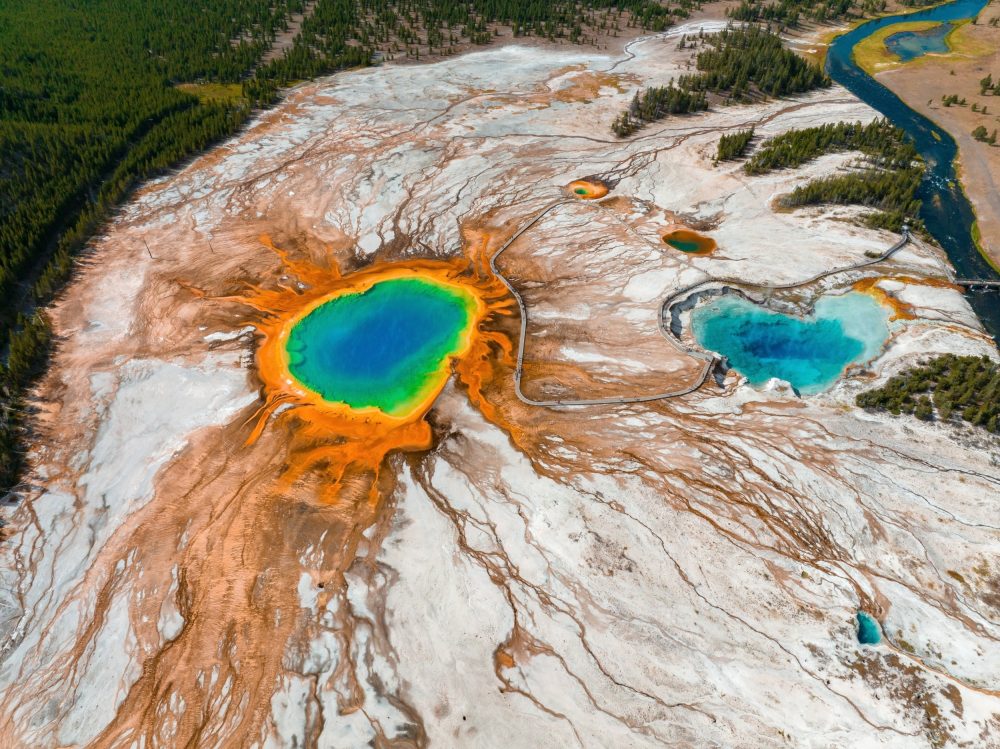
Yellowstone National Park in the United States is one of the most famous supervolcanoes. It has produced two supereruptions in the past 2.1 million years.
Scientists use Yellowstone as a natural laboratory because of the large amount of data available.
Studies show that Yellowstone contains a wide magma mush system that stretches through the lithosphere. A liquid-rich magma body forms only for a short time before an eruption. This suggests that eruptions do not rely on a single large magma chamber.
However, one important question remained unanswered. What forces create and maintain this complex system underground?
The role of the mantle wind
The new model from the Chinese Academy of Sciences offers an answer. The research shows that Yellowstone’s magma comes from the shallow asthenosphere rather than a deep mantle plume.
Instead of rising straight up from deep inside Earth, hot material moves sideways in what scientists call a mantle wind.
This flow happens because of the movement of tectonic plates. In this case, the subduction of the Farallon Plate drives the motion.
This mantle wind pushes hot material toward the Yellowstone region. As the material moves, it rises and melts due to reduced pressure. This process creates magma in a different way than scientists once believed.
How the lithosphere gets torn
The mantle wind does more than move heat. It also creates stress in Earth’s outer layer. The eastward flow pushes against the lithosphere on one side, while forces from the west push in the opposite direction.
These opposing forces stretch and weaken the lithosphere. Over time, this process creates a channel-like pathway beneath Yellowstone. This pathway allows magma to move upward more easily.
This tearing effect explains the unique shape of Yellowstone’s magma system. It also matches observations from geological and chemical studies.
Mantle winds and supervolcanoes
This research offers a new way to understand supervolcanoes around the world. It connects magma formation deep in the asthenosphere with the spread of magma in the lithosphere.
The study also explains how large magma mush systems can exist for long periods. These systems do not need a single large chamber to stay active. Instead, constant movement and pressure from below keep them alive.
This new model helps scientists improve predictions about volcanic activity. Better understanding can lead to better safety planning in the future.
Supereruptions may be rare, but the impact can be global. With studies like this, scientists move closer to understanding one of Earth’s most powerful natural forces.
The study is published in the journal Science.
—–
Like what you read? Subscribe to our newsletter for engaging articles, exclusive content, and the latest updates.
Check us out on EarthSnap, a free app brought to you by Eric Ralls and Earth.com.
—–