
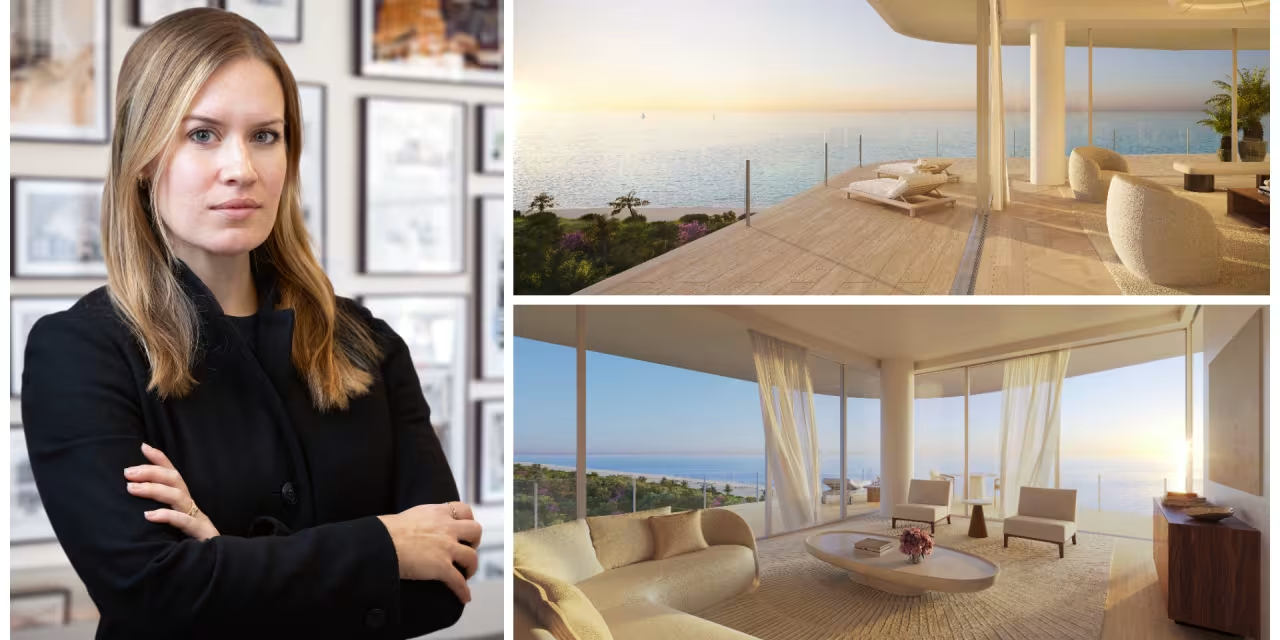
For the first time in its 56-year history, Robert A.M. Stern Architects (RAMSA) is creating interiors for a building it didn’t design, Miami Beach’s Ocean Terrace residences. It’s a signal that RAMSA is doubling down on its interiors practice; now, the firm has tapped a new leader for it.
Christina Victori, RAMSA’s New York-based head of interior design, apprenticed with the late French designer Thierry Despont while still a student at New York’s Fashion Institute of Technology. Along with stints at New York’s Gachot Studios and Chicago’s Kara Mann, she also helped lead Manhattan-based Roman and Williams Buildings and Interiors, where she rose to head the RW Guild homewares line.
“We’re unique in that we operate like an independent studio within RAMSA,” Victori said. “Along with the institutional and residential work, we have owners of classic RAMSA homes who want them recustomized. That’s exciting.”
MORE: Beachfront Compound With Two Cottages to List in the Hamptons for Nearly $6 Million
Victori talked to Mansion Global about the trip that “melted her mind,” the book she can’t live without, and why luxury means seeing yourself in your surroundings.
Mansion Global: Do interiors clients come to RAMSA just wanting things to look like other projects by the firm?
Christina Victori: The RAMSA portfolio is so vast. Within the New York City market, some might want to pursue what they believe the RAMSA aesthetic to be. But the firm’s ethos, and mine, is all based on location. A project in Peru won’t look like a project in Korea or on the South Fork of Long Island. Everything has a sense of place, and reflects both the demands of clients and their surroundings.
MORE: This Harry Gesner-Designed Home in Beverly Hills Is on the Market for Almost $28 Million
Thierry Despont and Roman and Williams are very different. What did you take from your years working for both?
Roman and Williams taught me about a narrative-driven approach, which came from their experience in TV and film. Thierry would [immerse himself] in his library early in the process. He gave me access to that library, which was wonderful. There were books and monographs on designers of the past. It was a place I hadn’t yet traveled. From both firms, there’s an appreciation of European design, especially French, and bleeding into Italian.
What was your favorite book in Thierry Despont’s library?
It was a book on [French interior designer Paul] Dupré-Lafon, “Dupré Lafon – Décorateur des Millionnaires.” It’s a prized book in the industry, and it’s out of print. It’s all about scale and proportion, and it’s iconic. When I was building out my own library, I hunted down a copy.
Mansion Global Boutique: Beyond the Souks: Bringing the Magic of Tangier Home
Which places around the world have inspired your designs?
A trip to Spain when I was 19 probably had the most profound effect. I was exposed to non-Classical architecture in Barcelona and Madrid, and to spaces I hadn’t experienced—[architect] Antoni Gaudi melted my mind. Travels through Italy and the south of France have also been inspiring.
What does your own home look like?
My home is eclectic. My husband and I purchased an 18th-century farmhouse on an acre in Essex County, New Jersey. It was falling down, and we’re still renovating. The interiors are a mix of Liaigre with Italian-modern furniture with pieces from my grandfather, who also had an 18th-century home on Long Island’s North Fork. I’ve also brought pieces from projects and vendors. I’ve been collecting objects and furniture since I was 20, and my husband and I collect emerging contemporary art. I’m a bit of an “I’ll-find-a-place-for-it” kind of person. At a Paris flea market years ago, I bought three sconces before I had a home to put them in.
MORE: A Brooklyn Brownstone Designed By a Renowned Gilded Age Architect
Is social media still influencing how clients make decisions?
Increasingly, designers have to help organize what can otherwise be a series of non-connected “likes,” We’re becoming the curators of a really wide net the client throws at us. For me, it’s a fun challenge.
How much do you pay attention to design trends?
I still get excited about a new material from a favorite fabric house, or a new cut of stone. I only respond to trends in that regard. But I try not to consume too much of it. There’s a tendency for it to bleed into your subconscious. For example, everyone might be putting silver travertine in mountain homes, but it doesn’t translate to every location.
MORE: Trusts vs. LLCs: How to Figure out What’s Right for You
How is AI changing your profession, and your process?
Right now, it’s a tool. It cuts down on admin, so we can spend more time designing. It’s been invaluable for photo editing; if a client can’t picture this red-upholstered chair in a different color, let’s make it blue. At Thierry’s, I’d spend hours photoshopping a reference image to expand it into something else. With AI, it takes minutes, not hours. I still don’t think you should use AI to solve a design project, though.
When do you say ‘no’ to a client and their ideas?
A designer has to balance the client’s investment with their personal style, and their wanting it to feel personal. Wanting to make it a space neutral for fear of resale is tricky, and it can feel impersonal.
Mansion Global Boutique: Make it Tea Time All the Time
What’s your definition of luxury?
Luxury is when a client can feel the craft and the hand of the pieces they’re surrounded by. And it’s when they can see themselves reflected in the space they’re living in.
This interview has been edited for length and clarity