
Back to Article List
Io and its shadow transit the face of Jupiter from east to west, visible together in front of the giant planet for an hour tonight.
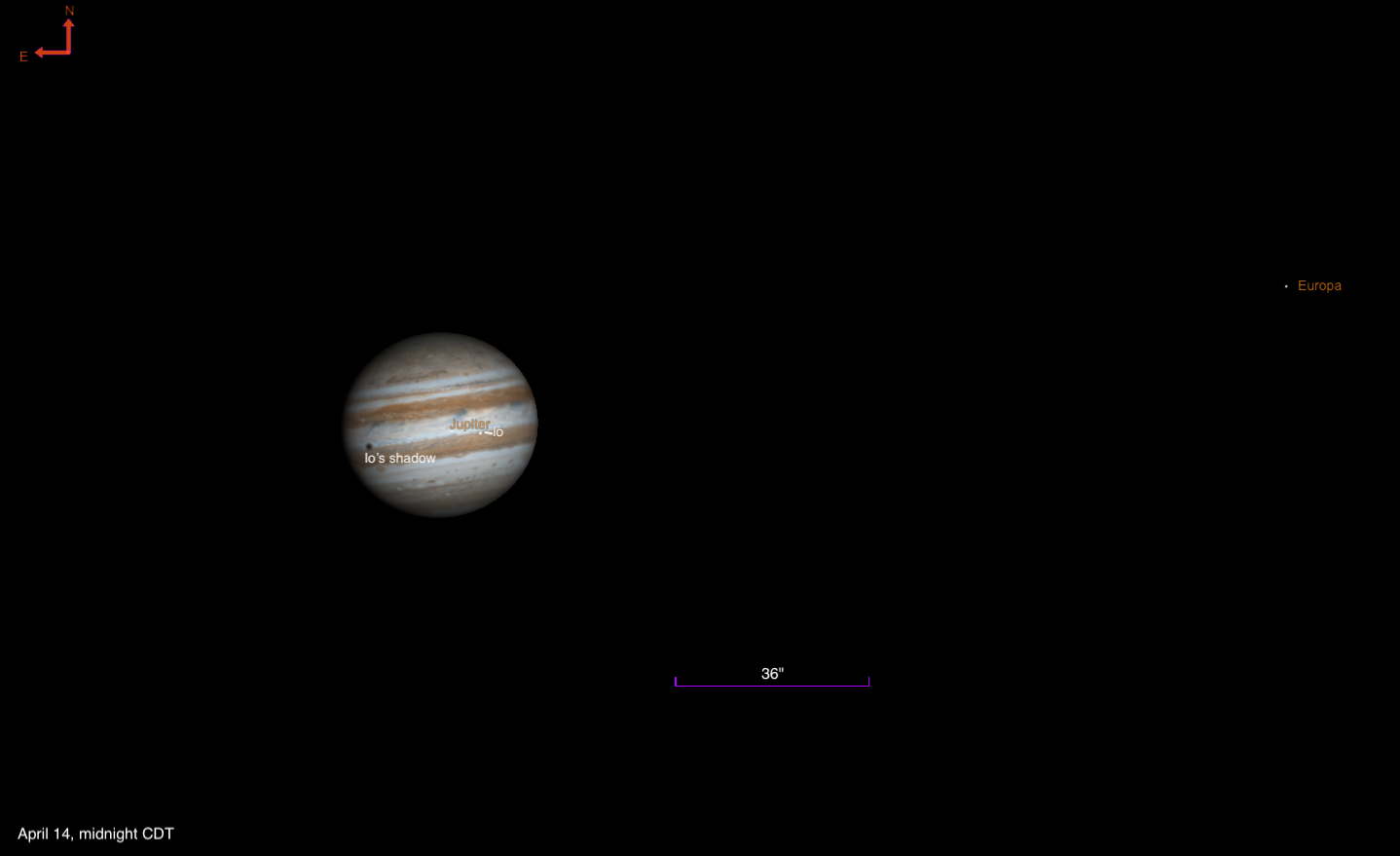
Io crosses the disk of Jupiter with its shadow overnight on April 14/15. Ganymede and Callisto lie to the east, outside this field of view. Credit: Alison Klesman (via TheSkyX)
Looking for a sky event this week? Check out our full Sky This Week column.
April 13: Io and Europa cross paths
Following the events of last night, Io has passed behind Jupiter and come back around in its tight, 1.77-day orbit to follow in Europa’s footsteps, transiting the disk this evening along with its shadow.
Look again toward Gemini in the western sky after sunset to locate Jupiter — the brightest point of light — with a telescope. The planet hangs beneath the constellation’s alpha and beta stars, Castor and Pollux. Prior to the transit, Europa is alone to the planet’s west, with Io, Ganymede and Callisto east of the giant world, in that order from closest to farthest.
Io’s transit begins at 11:25 P.M. EDT. It’s just over halfway across the disk, closer to the western limb than the eastern one, when its shadow appears at the eastern limb shortly after 12:40 A.M. EDT (now early on the 15th in the Eastern time zone). The two travel together for another hour, until Io’s transit finally ends. After that, both Io (closer) and Europa are west of Jupiter, again moving toward each other (although their paths won’t cross this time until after the planet has set across the U.S.). Io’s shadow continues its transit, finally ending at 1 A.M. MDT on the 15th, after Jupiter has set for the eastern half of the country.
Sunrise: 6:23 A.M.
Sunset: 7:38 P.M.
Moonrise: 4:50 A.M.
Moonset: 4:41 P.M.
Moon Phase: Waning crescent (8%)
*Times for sunrise, sunset, moonrise, and moonset are given in local time from 40° N 90° W. The Moon’s illumination is given at 10 P.M. local time from the same location.
The Moon passes 5° north of Mercury at 3 P.M. EDT on April 15. Although the pair rises only shortly before the Sun, the Moon’s visibility and Mercury’s brightness may allow you to spot them early Wednesday morning.
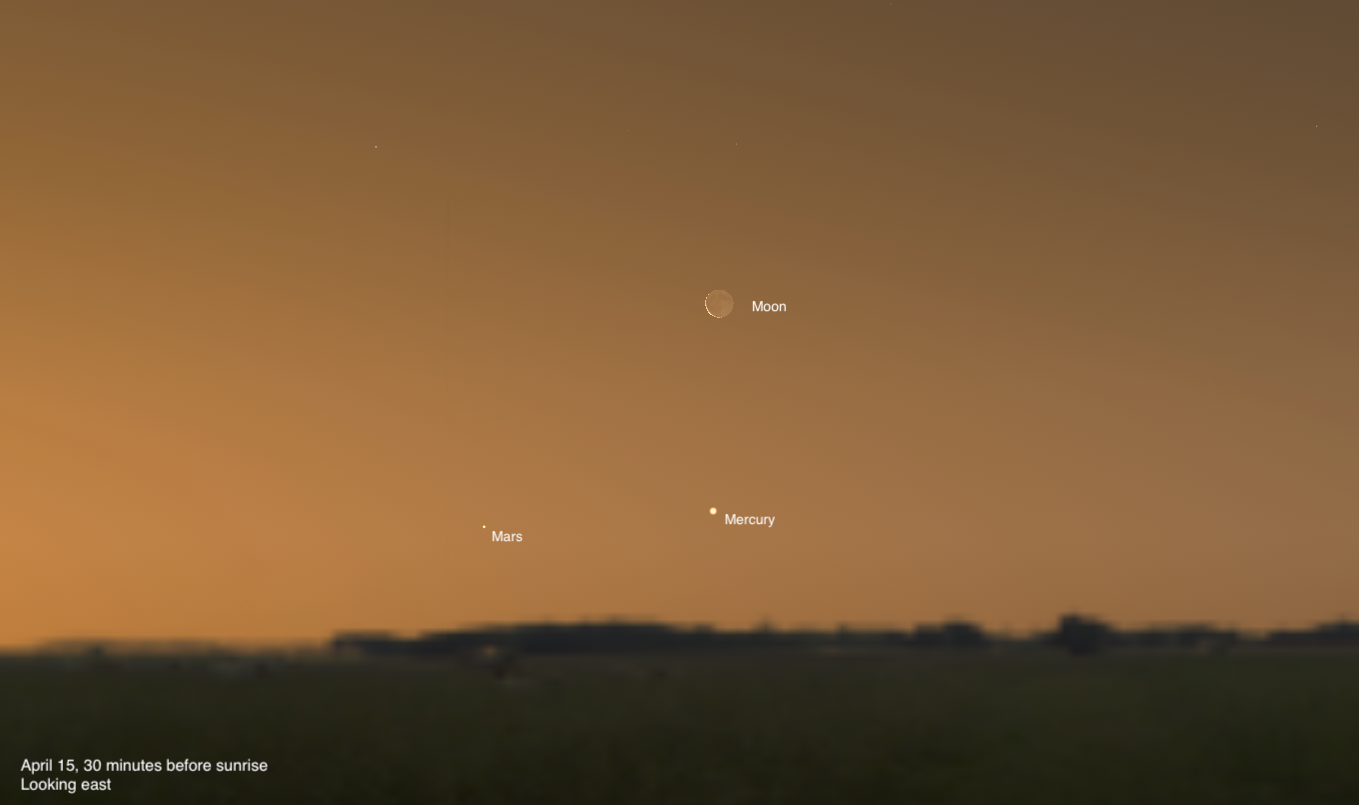
Catch bright Mercury and possibly even fainter Mars hanging below the Moon shortly before sunrise on April 15. Make sure to put away any optics well before sunrise from your location. Credit: Stellarium/USGS/Celestia/Clementine
You’ll only have a short window to do so, however, as the Moon rises roughly an hour before the Sun and Mercury just 40 minutes ahead of sunrise. Try about 30 minutes before sunrise, when the delicate, 6-percent-lit Moon hangs just 6° above the horizon. You may spot earthshine on its darkened portion, as sunlight bounces off Earth to light up this region, already experiencing lunar night.
Mercury is much closer to the horizon, only 2.5° high in the east at this time. It hangs some 4° below the Moon, shining at magnitude 0.0. You should be able to easily spot it through binoculars; with a telescope, you may discern that its 6”-wide disk is some 66 percent illuminated.
You should also try to catch magnitude 1.2 Mars located 4.2° to the left of Mercury in binoculars or a telescope, but it may be challenging.