
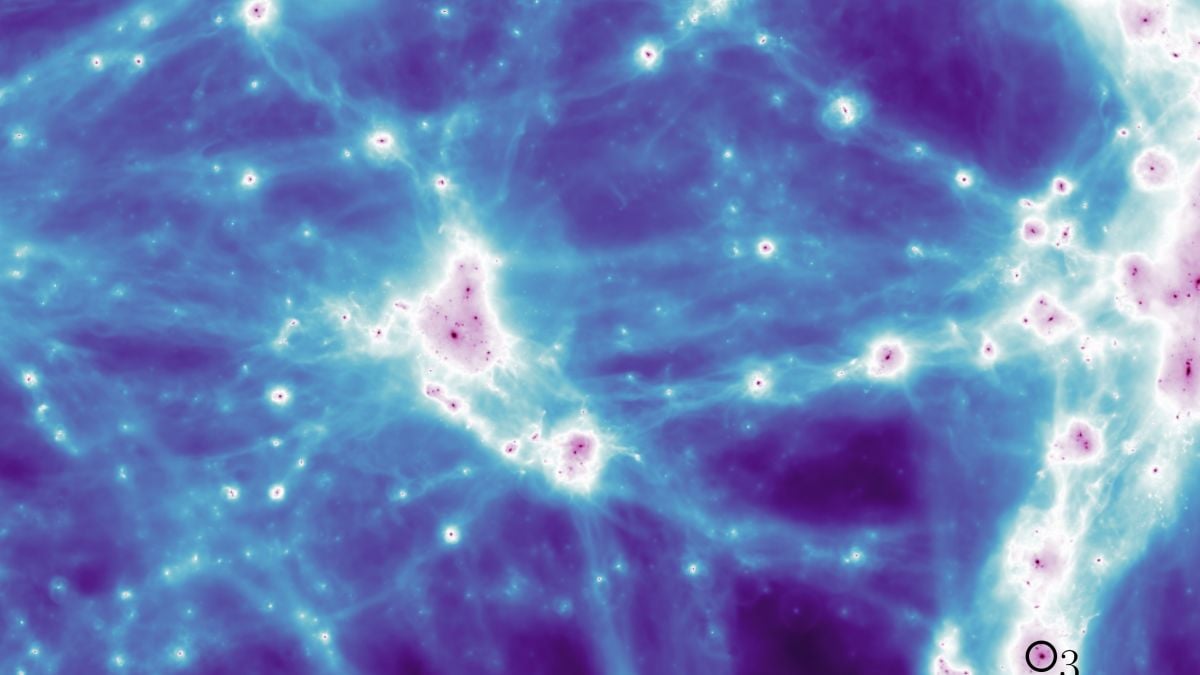
Long ago, a time existed before galaxies had drawn themselves together out of the primordial matter that filled the burgeoning Universe in the wake of the Big Bang.
How this process occurred, and what that matter consisted of, has long been something of a mystery. Now, however, scientists may have brought us closer to understanding how galaxies formed and evolved – through more powerful simulations of the messy chaos of dust, newborn stars, and complex chemistry at the dawn of time.
And the results show that the copious large galaxies observed by JWST earlier in the Universe than we thought possible can form without breaking our current models, if more details are included in the simulations.
“Some early JWST results were thought to challenge the standard cosmological model,” says astronomer Evgenii Chaikin of Leiden University in the Netherlands. “Once key physical processes are represented more realistically, the model is consistent with what we see.”
 frameborder=”0″ allow=”accelerometer; autoplay; clipboard-write; encrypted-media; gyroscope; picture-in-picture; web-share” referrerpolicy=”strict-origin-when-cross-origin” allowfullscreen>
After the Big Bang, space was sort of a hot mess of soupy plasma that took a bit of time – a few hundred million years – to cool and condense enough to form the first stars and galaxies. Exactly how this foundational transformation from soup to stars unfolded is critical to understanding how the Universe got to where it is today.
However, it’s a murky period of cosmic history that is currently impossible to observe directly, so scientists rely on tools such as simulations to try to reproduce the formation and evolution of the Universe.
As you can imagine, this requires a lot of computing power supplied by supercomputers, and to reduce the load, many simulations are based on simplified models of the underlying physics that should still produce reliable results.
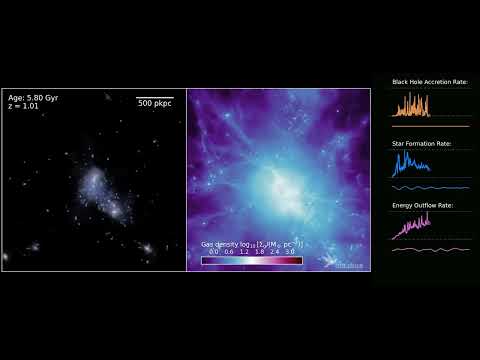
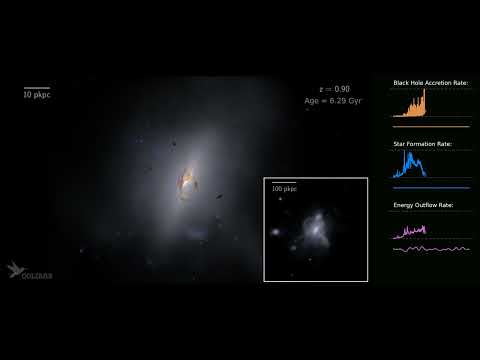
The COLIBRE cosmological simulation project seeks to address some of these gaps, including more detailed physical models of gas, dust, and the powerful outflows driven by stars and black holes, to study the evolution of the early Universe.
 frameborder=”0″ allow=”accelerometer; autoplay; clipboard-write; encrypted-media; gyroscope; picture-in-picture; web-share” referrerpolicy=”strict-origin-when-cross-origin” allowfullscreen>
“Much of the gas inside real galaxies is cold and dusty, but most previous large simulations had to ignore this,” says astronomer Joop Schaye of Leiden University. “With COLIBRE, we finally bring these essential components into the picture.”
COLIBRE is basically a miniature Universe in a virtual box. Scientists put in the ingredients, tell it the rules, and let it run, from before the birth of stars to the current day. If the results at the end of the simulation look like the cosmos around us, then the parameters can be taken as a reasonable facsimile of the processes that actually occurred.
The largest of the simulations required 72 million CPU hours, but the results were worth it. The program was based on the cold gas from which stars are known to form. This is quite complex to model, but the researchers included the additional physics and chemistry needed to make it work.

The simulation also included a dust model where the grains come in three types and two sizes. These tiny grains of dust can influence how the Universe evolves in several ways. Dust encourages the coalescence of free atoms into molecules, for example, and shapes the way radiation propagates by blocking or interacting with specific wavelengths.
In the end, the researchers managed to produce a virtual Universe that looked like a twin of our own.
“It is exhilarating to see ‘galaxies’ come out of our computer that look indistinguishable from the real thing and share many of the properties that astronomers measure in real data, such as their number, luminosities, colors, and sizes,” says physicist Carlos Frenk of Durham University in the UK.
“What is most remarkable is that we are able to produce this synthetic Universe purely by solving the relevant equations of physics in the expanding Universe.”
Related: We Finally Know How The Lights Turned on at The Dawn of Time
Although COLIBRE has brought simulations closer to the real Universe, there are some questions that remain unanswered. One of the biggest mysteries JWST has winkled out of the Cosmic Dawn is a phenomenon astronomers call the Little Red Dots.
Explanations have ranged from giant stars to giant black holes to giant stars with black holes inside them. Whatever they are, they defy easy explanation, and COLIBRE still doesn’t have an explanation for them, either.
The question of the Little Red Dots may form the crux of future investigation. For now, however, the results show that we are getting closer to finding some answers about one of the most mysterious periods in our Universe’s history.
The paper has been published in the Monthly Notices of the Royal Astronomical Society.