
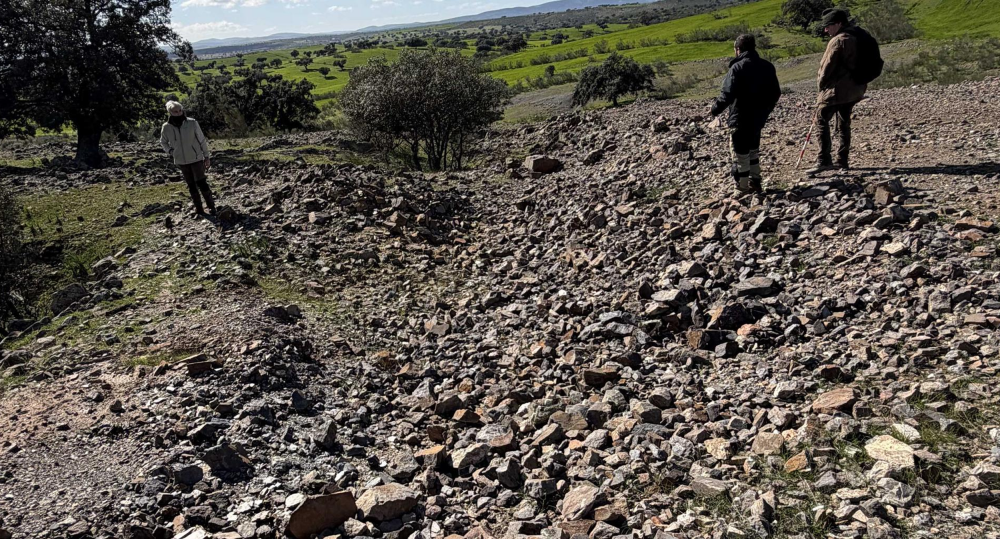
Researchers have identified six Bronze Age mines in southwestern Spain that match the long-suspected source of metal used in Scandinavian artifacts.
The discovery grounds decades of chemical evidence in real extraction sites, tying northern Europe to a vast Atlantic trade network.
Mines in Extremadura

Near Cabeza del Buey, archaeologists recorded six mine workings and found about 80 grooved stone axes beside one smaller trench.
Reading those cuts as ore extraction, Johan Ling at the University of Gothenburg (GU) built a program tracking 14 Iberian sites.
Because the mines held copper, lead, and silver, Ling’s survey supplied the kind of physical setting the chemical evidence had lacked.
So the next question was no longer whether metal traveled north, but exactly where in Iberia it began.
Tracking bronze origins
Years before the Spanish survey, earlier analyses had already shown that Swedish bronze did not match local copper ores.
Researchers reached that result by comparing metal chemistry with ore fields across Europe, then checking whether the numbers lined up.
Later, a follow-up study on 71 Swedish objects pointed especially toward Iberia, Sardinia, and Alpine mining zones.
Spain therefore entered the story as a likely supplier, even though archaeologists still needed more mines on the ground.
Linking ore to artifacts
To pin the sources down, researchers then turned to lead isotopes, tiny variations in lead atoms, because ore bodies keep stable geological patterns.
When a bronze object and a mining district share that pattern, the comparison narrows the list of possible sources.
Chemistry helps again, since trace ingredients can separate two regions that look similar on isotopes alone.
Used together, those clues do not name a single pit with certainty, but they turn broad guesses into testable places.
Evidence of large mining
Fieldwork from the same research program soon widened the picture beyond the February survey in meaningful ways.
At Las Minillas, excavators traced a 650-foot (198-meter) copper vein and logged 21 dates in the mine.
Radiocarbon, age estimates from decaying carbon, placed that work between roughly 1300 and 1000 B.C. and tied it to the later Bronze Age.
Finds like that suggest southwestern Spain hosted industrial mining on a scale the old map never captured.
Signs of planning
The trenches themselves showed that miners were not skimming loose rock from the surface and walking away.
Long, narrow cuts followed the ore body, which meant workers knew where metal-bearing stone lay underground.
Grooved hammerstones and evidence of fire-setting, cracking rock with intense heat, point to repeated labor rather than casual digging.
Those details make the Spanish sites look less like isolated holes and more like nodes in a managed economy.
Routes across seas
Metal still had to travel more than 1,500 miles (2,414 kilometers) to reach Scandinavia, so mines alone could never tell the whole story.
Boats moving along Atlantic coasts probably carried ore, ingots, or worked bronze through several exchange points.
Meanwhile, a broader article on 550 metal analyses showed that Scandinavian supply routes shifted repeatedly over time.
One likely role for Spain was feeding a powerful phase of that traffic, not every shipment or every century.
Demand in Scandinavia
Imported copper changed what communities in the north could make, repair, and display in daily and ritual life.
Once metal arrived, local craftspeople mixed it with tin and recast it into swords, ornaments, and ceremonial gear.
Control over that flow helped ambitious leaders reward followers, stage alliances, and mark rank in visible ways.
Output from a mine in Spain therefore mattered far beyond Iberia, because it could strengthen power far to the north.
What remains uncertain
Even now, the Spanish discoveries do not prove that Scandinavian traders sailed directly to these exact valleys.
Ore could have moved through middlemen, and finished objects may have been melted and recast several times.
Isotopic matches can narrow a search to districts or more families, yet they rarely identify one shaft alone.
For that reason, excavation, dating, and ore sampling still matter as much as chemistry in this case.
The larger map
Ling thinks the newly logged mines are only a fraction of what remains buried across Extremadura and neighboring Andalusia.
“The discovery of the new Bronze Age mines in Extremadura represents only the tip of the iceberg,” said Ling.
He estimated that as many as 150 prehistoric mines in Extremadura and Andalusia may still await documentation.
If that estimate is close, Europe’s Bronze Age metal economy looked denser, harsher, and more organized than the surviving map suggests.
Why these mines matter
Spain’s new mines matter because they finally put real extraction landscapes beneath a chemical trail that once seemed too broad.
Further excavation could show how ore left Iberia, who controlled it, and how much of Scandinavia’s bronze depended on that flow.
—–
Like what you read? Subscribe to our newsletter for engaging articles, exclusive content, and the latest updates.
Check us out on EarthSnap, a free app brought to you by Eric Ralls and Earth.com.
—–