
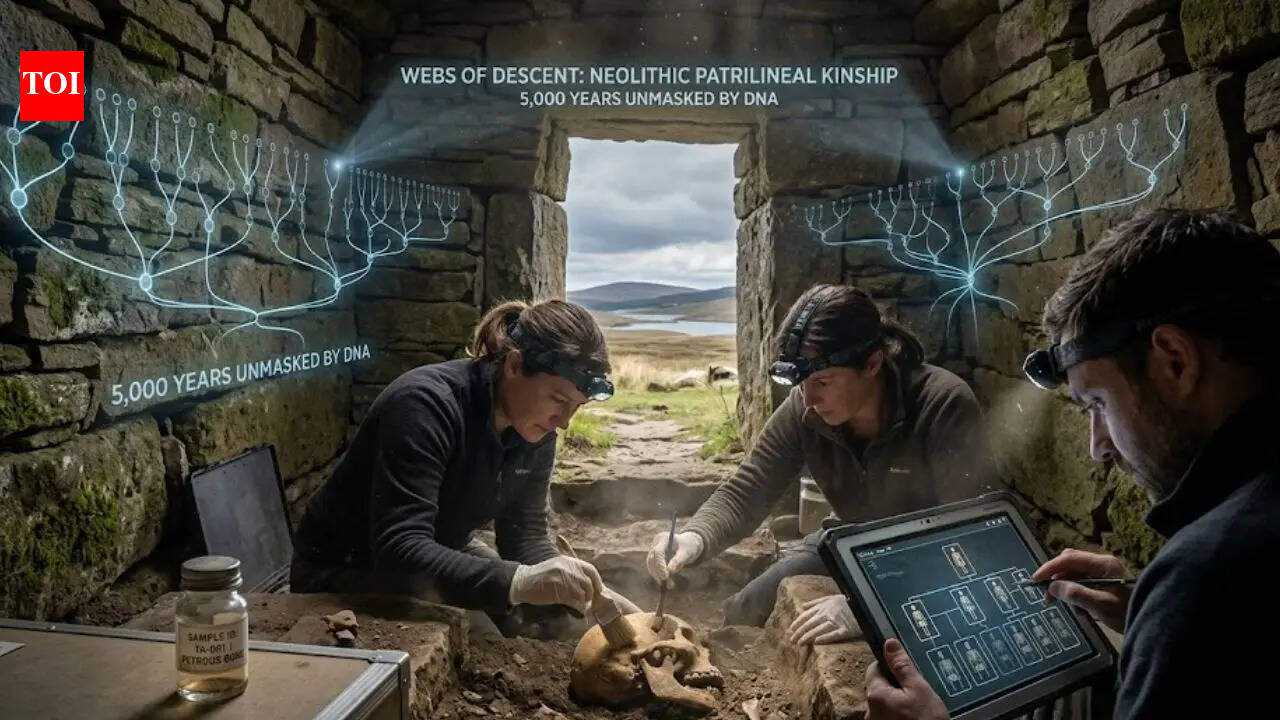
 A new study on the genetics of ancient humans, using DNA extracted from 40 people who were buried in stalled cairns in Caithness and Orkney, has found evidence of a highly structured, male-dominated social system that lasted for more than 500 years. The study revealed a ‘web of descent’ in which men within at least seven generations of male relatives were buried in proximity to one another. The ‘family tree’ generated by this research indicates that men continued to live in their natal communities and women migrated between residences to establish new relationships based on kinship. The results of this research significantly advance our understanding of the biological and social hierarchies of Stone Age Britain; the monumental tombs that were created during this time period served as a sacred, genealogical connection between particular male families.
DNA breakthrough: The 5,000-year-old ‘webs of descent’
The discovery’s primary source of information comes from the high-resolution genetic mapping of people who lived at sites like the Tulloch of Assery B and the Holm of Papa Westray North, as reported in the study in Cambridge University Press. Researchers discovered nine pairs of genetically close relatives, and incredibly, they were all connected through male ancestors. This shows that these ‘stalled cairns’, which are monumental structures left behind by Stone Age people, were not just community burial pits, but were actually sole root vaults for the specific lineages of male ancestors.
How women formed the social web of Neolithic Scotland
The research published in Nature Communications suggests that men lived in a patrilocal way, where they lived with their birth families, whereas women would often move to where their marital community lived. Evidence of this is observed in the amount of diversity in mitochondrial, or maternal DNA, compared to the restricted nature of Y-chromosome or paternal lineages found in tombs. Therefore, the biological evidence suggests that the women’s movement was a major reason for the formation of inter-community networks during the 4th millennium BC.
How stalled tombs mirrored Neolithic social lineages
Archaeologists from the University of the Highlands and Islands and the University of Exeter believe the architecture of these tombs, with their stalls or compartments, mirrors the compartmentalised nature of the social lineages stemming from the male ancestors of those buried in the tombs, as noted in a study on the Archaeological Institute of America. The tombs themselves acted as a physical representation of these social lineages, providing presence for the deceased in order to give legitimacy to those living as descendants of the deceased, in terms of land rights and status.
How advanced DNA sampling revived 5,000-year-old genomes
Researchers utilised advanced approaches to dating and analysing human remains collected at Harvard’s Reich Laboratory, through skulls collected from tombs in Scotland, which were sampled in such a way that high-quality ancient DNA could be extracted. The team was able to obtain usable genomic sequences by utilising a technique called ‘petrous bone extraction,’ which is a type of bone in the inner ear that is suitable for sequential analysis regardless of whether it is from freshly buried remains or highly compromised remains (i.e., those preserved in Scotland’s acidic soils). These methods ultimately resulted in a multi-generational lineage extending over 250 to 300 years at an individual tomb site.