
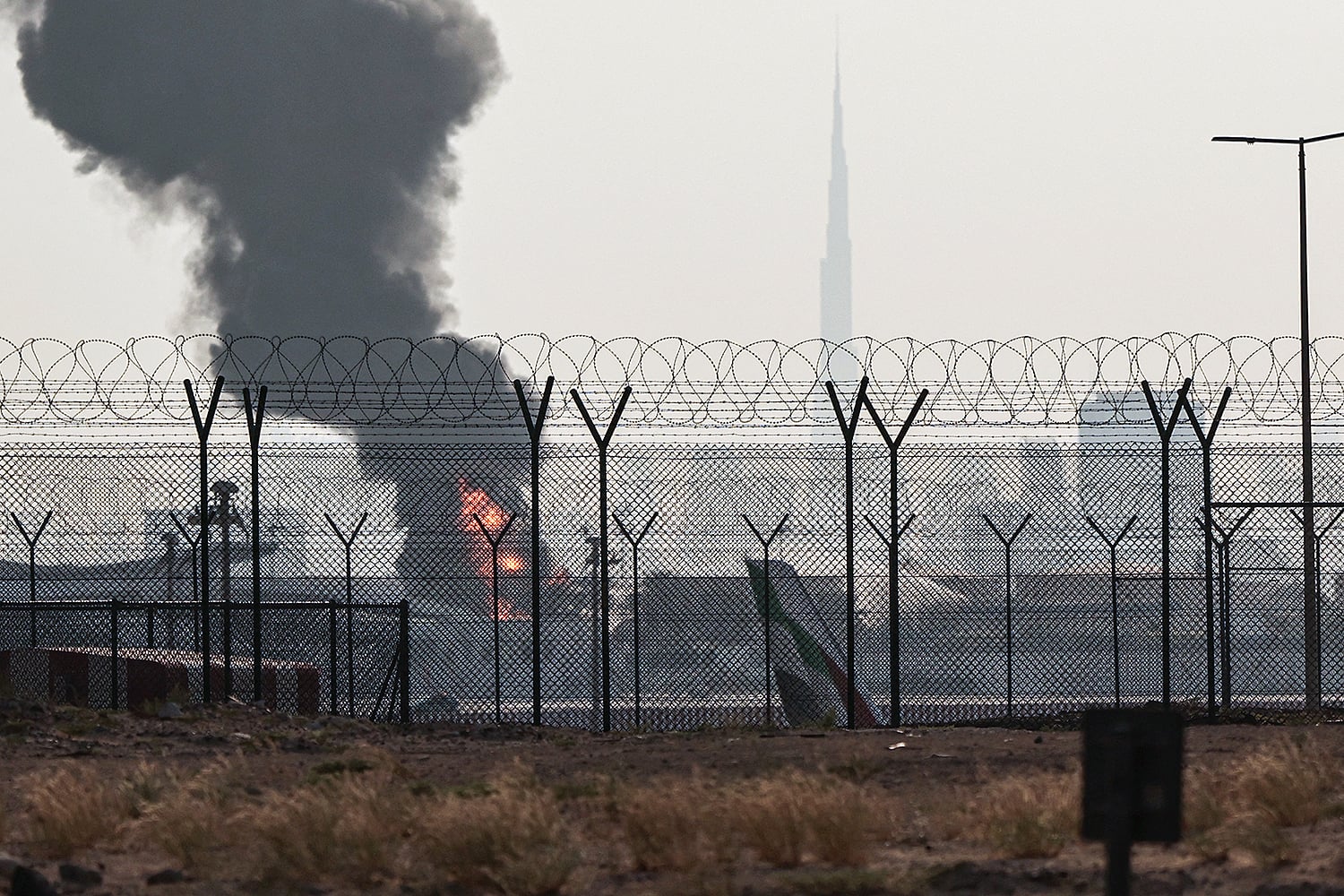
The war in Iran has ended the illusion that Gulf data centers can be treated as insulated commercial assets. In the very early days of the conflict, drone strikes impacted two Amazon Web Services facilities in the United Arab Emirates and one in Bahrain, causing major disruption to cloud services. The Islamic Revolutionary Guard Corps then published a list of 29 technology targets across Bahrain, Qatar, and the UAE, including facilities linked to AWS, Microsoft, Google, and Nvidia. As the war expanded beyond military targets and into economic infrastructure, AI infrastructure has become a target in its own right.
This shift comes at a critical moment for the region. Gulf states are investing heavily in AI infrastructure to move up the value chain, diversify economies long shaped by oil, and secure a place in the future political economy of AI. The attacks will not end those ambitions, because the capital, energy, and political will behind them remain in place. Nor is Washington likely to step back, since the United States wants the Gulf inside a U.S.-aligned AI ecosystem rather than open to deeper Chinese penetration. But vulnerability of this infrastructure to cheap drones has changed the terms of the bargain. Protection is becoming inseparable from access, and future AI deals will increasingly come bundled with security guarantees, defense cooperation, and tighter political conditions.
The war in Iran has ended the illusion that Gulf data centers can be treated as insulated commercial assets. In the very early days of the conflict, drone strikes impacted two Amazon Web Services facilities in the United Arab Emirates and one in Bahrain, causing major disruption to cloud services. The Islamic Revolutionary Guard Corps then published a list of 29 technology targets across Bahrain, Qatar, and the UAE, including facilities linked to AWS, Microsoft, Google, and Nvidia. As the war expanded beyond military targets and into economic infrastructure, AI infrastructure has become a target in its own right.
This shift comes at a critical moment for the region. Gulf states are investing heavily in AI infrastructure to move up the value chain, diversify economies long shaped by oil, and secure a place in the future political economy of AI. The attacks will not end those ambitions, because the capital, energy, and political will behind them remain in place. Nor is Washington likely to step back, since the United States wants the Gulf inside a U.S.-aligned AI ecosystem rather than open to deeper Chinese penetration. But vulnerability of this infrastructure to cheap drones has changed the terms of the bargain. Protection is becoming inseparable from access, and future AI deals will increasingly come bundled with security guarantees, defense cooperation, and tighter political conditions.
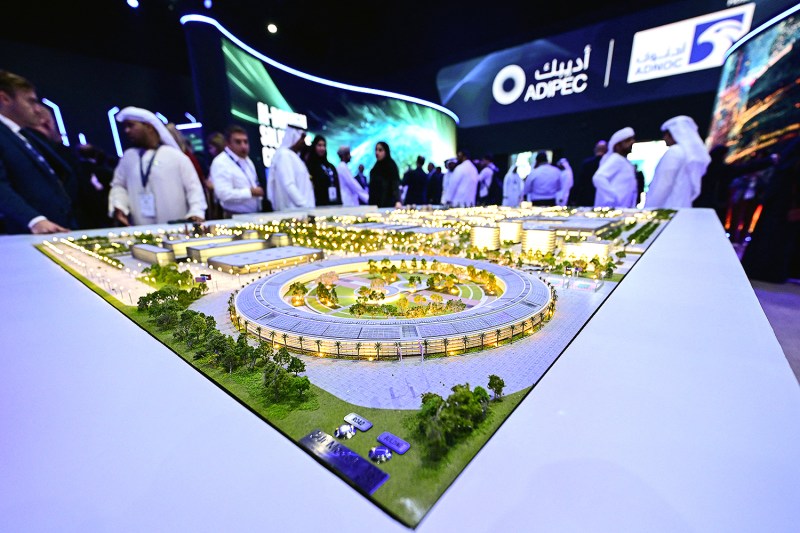
People gather around a table that shows a miniature model of a data center complex.
A model of the largest data center in the United Arab Emirates—under construction in Abu Dhabi as the Stargate initiative—was on display at the Abu Dhabi International Petroleum Exhibition and Conference on Nov. 3, 2025. Giuseppe CACACE/AFP/Getty Images
The significance of those attacks becomes clearer once they are placed against the scale of the Gulf’s prewar AI ambitions. In recent years, sovereign wealth funds, energy abundance, and political will allowed Gulf governments to present themselves as attractive destinations for compute (i.e. high-end chips, data centers, and cloud systems). In Saudi Arabia, Vision 2030 and projects such as Neom frame AI infrastructure as part of a broader transformation that aims to turn hydrocarbon wealth into long-term technological competitiveness. The UAE has followed a similar path by linking state-backed capital with ambitions to become a regional AI hub. Lately, Qatar has also joined this race, signaling that it does not want to remain on the sidelines while its neighbors scale up. Across the Gulf, AI infrastructure is being treated not as a narrow technology project, but as a strategic national investment.
In line with these ambitions, recent deals indicate a sharp expansion in planned capacity, including Stargate UAE’s initial 200 megawatt phase expected this year, with eventual multi-gigawatt ambitions; Saudi Arabia’s forthcoming AWS region backed by a multi-billion-dollar investment; and Qatar’s reported $20 billion AI infrastructure partnership through Qai. Altogether over the next five years, the UAE and Saudi Arabia will stand out as two of the most significant AI compute locations outside the United States.
The Gulf’s AI investments in U.S. companies have a geopolitical nature. From the beginning, they were shaped by the U.S.-China contest over AI supply chains, where access to chips and advanced compute is increasingly shaped by strategic control rather than market openness. Most deals now come with conditions designed to deny China’s access to sensitive compute and to push Gulf partners away from Chinese technology ecosystems.
That logic is now explicit in U.S. policy. Michael Kratsios, the architect of Trump’s AI action plan, recently said that countries should pursue “sovereign AI capability” by rapidly adopting “the best components of the technology stack available” rather than trying to rebuild the full stack from scratch. In practice, fully sovereign AI is harder to imagine and only a few countries will dominate the space. This is why the United States tries to securitize AI and semiconductor supply chains and reduce dependence on China through initiatives such as Pax Silica. Qatar and UAE joining this initiative is an early sign that the securitization was already taking place. Microsoft’s $1.5 billion investment in the UAE’s G42 came with assurances to the U.S. and UAE governments over security, and this deal was praised because it pushed G42 away from Huawei. Taken together, the price of access is now political alignment and security compliance.
As the broader logic of weaponized interdependence becomes visible, states that control key nodes in technology networks can turn that position into leverage. In the AI race, those nodes include advanced chips, hyperscale cloud services, and the governance systems that regulate access to them. As compliance requirements intensify, the risk is that the system moves further toward bifurcation. Gulf states may still want room to hedge, but the structure of the deals is already narrowing that space.
The Iran war revealed that Gulf AI infrastructure is not only strategically valuable but also physically vulnerable. This vulnerability of AI infrastructure (in terms of compute, cooling systems, energy usage) is especially acute in the Gulf because limited strategic depth, dense urban concentration, and the clustering of energy, logistics, and digital assets create an unusually target-rich environment for low-cost attacks. In practical terms, this means that ports, airports, desalination plants, power infrastructure, financial networks, and new data center corridors sit close to one another and close to likely launch areas for drones and missiles. They are not protected like military bases, and unlike military aircraft, these assets cannot simply be dispersed or replaced quickly. They are fixed systems with long construction timelines and costly repair requirements. In an age of easy access to drones for non-state actors, this vulnerability becomes leverage.

A man in a neon vest looks down at a crashed drone on the sidewalk.
A police officer inspects the wreckage of a drone in downtown Dubai on March 12 during Iran’s Gulf campaign in the Middle East war. AFP/Getty Images
The problem becomes even sharper when one looks at what can and cannot be replicated. Data can be copied and moved through cloud architecture across regions. Infrastructure cannot. Chips, local GPU clusters, cooling systems, substations, and network nodes cannot be replicated in the same way. If a strike damages the physical site, the data may survive elsewhere, but the compute capacity at that location does not. The reputational damage also matters. Gulf AI expansion depended partly on attracting engineers, operators, and ecosystem partners from firms such as Microsoft and Amazon. Once major innovation sites become wartime targets, the cost of attracting talent and sustaining the image of a secure and stable technology hub rises. The vulnerability is therefore not only physical. It also affects the credibility of the Gulf as a place where long-term AI ecosystems can safely take root.
Despite this emerging security dynamic, neither the Gulf nor the United States is likely to walk away from this buildout. The United States wants partner countries inside a U.S.-aligned AI ecosystem rather than outside it, and White House policy now openly treats stack export as a strategic tool. Gulf governments, for their part, see AI infrastructure as a pillar of diversification and long-term national positioning. A retreat would therefore solve little. It could slow some U.S. projects, but it would also risk ceding space to Chinese providers that are already present. The Gulf’s ambition, capital, and energy abundance are still there.
The likely result of these attacks is not de-investment. It is deeper securitization. Washington will gain more leverage over the terms of access, and Gulf states will have stronger incentives to accept a tighter security wrapper around compute in exchange for continued investment and protection.
This securitization will raise the cost of future AI investment, as the solutions are not easy. Insurance costs are likely to rise. Redundancy and continuity planning will become more expensive. Governments will play a larger role in shaping commercial technology deals. And firms themselves will push for stronger security guarantees before committing to long-term infrastructure and personnel deployment. In that sense, protection will be part of the investments themselves.
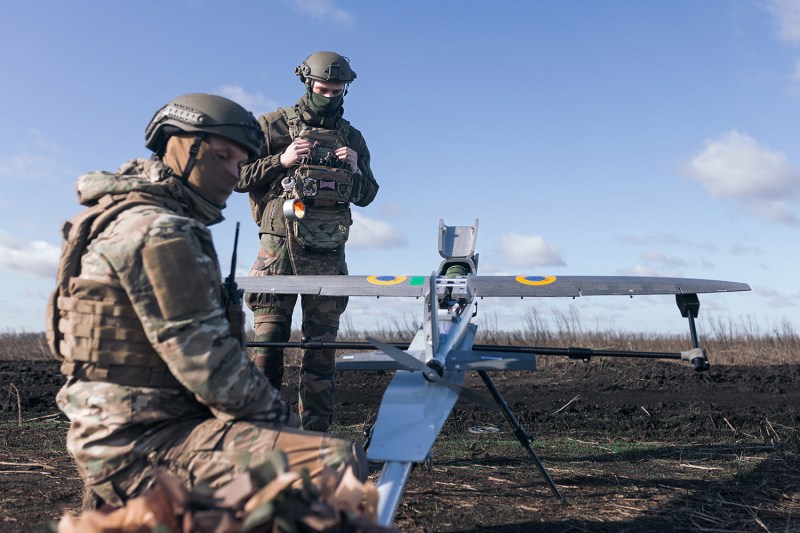
Two soldiers in uniform work with a drone, which is set up to be launched from the ground.
Ukrainian soldiers prepare a new strike drone for flight in the Kharkiv region on April 7. After years of developing systems to fend off Russian drone attacks, Ukraine is offering its expertise and technology to Gulf states. Nikoletta Stoyanova/Getty Images
Some of the added protection could come through hardening infrastructure, including selective undergrounding. Yet undergrounding is costly, and underground repairs generally take longer and come with direct costs that are higher than those for overhead systems. Transmission undergrounding can be roughly three to 10 times more expensive for new construction and one-and-a-half to five times more expensive for conversions, depending on the system. Fully hardened or partially subterranean designs would raise already large capital bills even before the cost of frontier chips is counted. Undergrounding makes most sense for selected components such as power links, control rooms, backup systems, and certain network nodes, not as a universal solution for every new AI camp.
A more realistic answer is a combined resilience and defense model that accepts replication as necessary but insufficient. Cloud firms already build around geographical distribution and support cross-data center replication. That can preserve workloads and shorten recovery time, but it does not replicate destroyed hardware. If a strike destroys or disables a GPU hall, the data may survive elsewhere, but the local compute capacity does not. That is why the most useful U.S. contribution is not only more redundancy, but a much stronger lower-tier air defense architecture around compute sites. That means counter-drone systems, jamming, machine guns, 30mm guns, Coyote interceptors and integrated command systems that connect air and ground defenses. Ukraine also offers practical lessons in building cheaper and more scalable defenses against mass drone attacks, including the use of interceptor drones and other lower-cost tools.
Future compute deals in the Gulf will need to come bundled with lower-cost layered air defense, selective hardening, resilient power and network design, and tighter security cooperation. Cheap drones have not killed Gulf AI ambitions. They have made them more dependent, more expensive, and more strategically governed than before.