
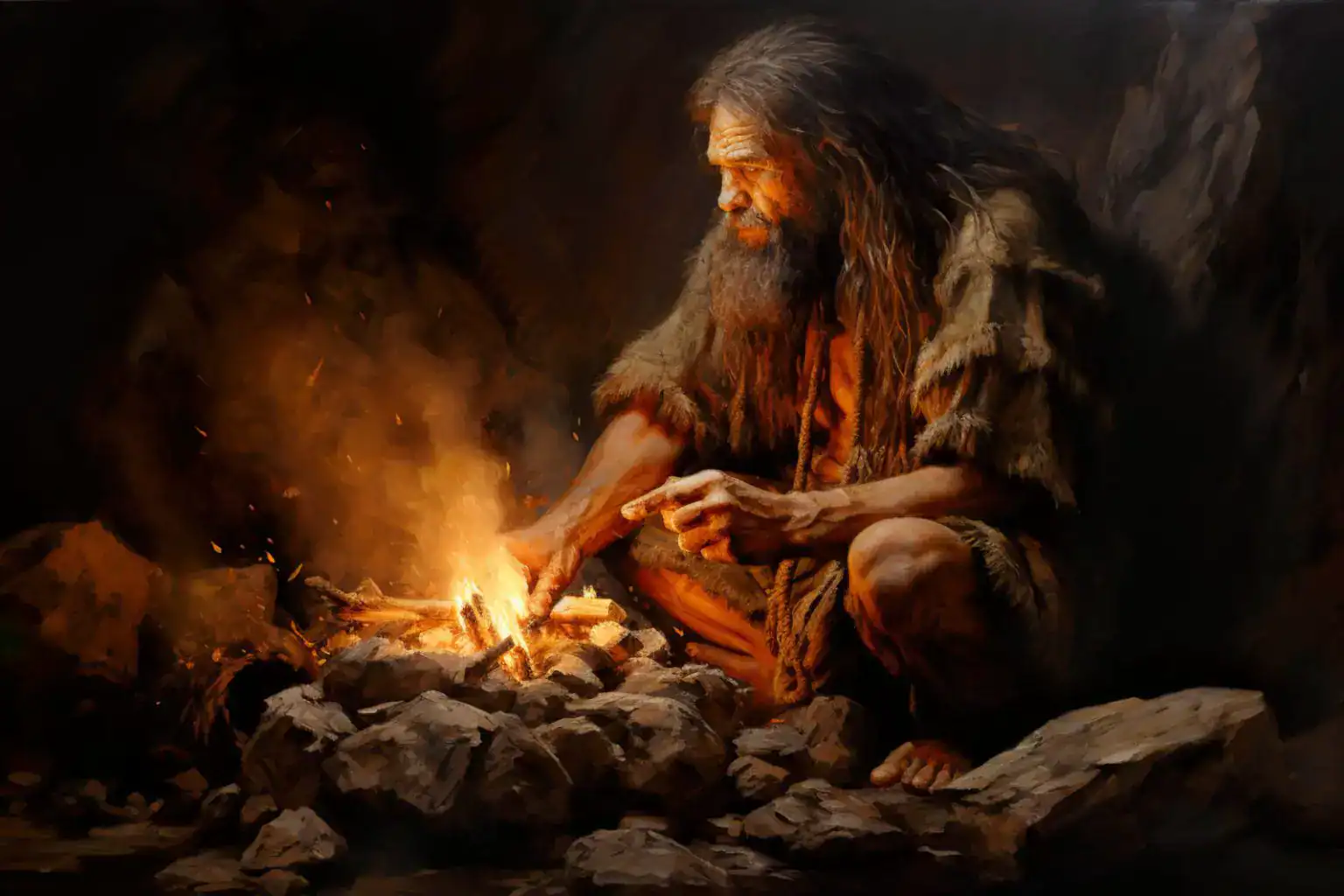
 Artistic depiction of an ancient Neanderthal around a campfire.
Humans and Neanderthals not only coexisted and interbred, but actively collaborated and shared their cultures. This stunning finding, based on excavations from Tinshemet Cave, suggests that they were sharing hunting strategies, tool-making tips, and mourning their dead in the exact same way.
In fact, the humans and Neanderthals of this cave lived as a single, unitary, cultural complex.
The Same Culture
Modern research has steadily dismantled the myth of the Neanderthal brute. They made sophisticated tools, adapted to harsh environments, and likely engaged in symbolic behavior. We also know Neanderthals and Homo sapiens interacted, including through interbreeding.
But Tinshemet Cave is a puzzling site.
We know that Homo sapiens and Neanderthal-like hominins were contemporaries in the area because their fossil remains chronologically overlap. Advanced dating techniques consistently place these diverse populations within the same window of approximately 130,000 to 80,000 years ago. This timeline is further reinforced by biochronology, specifically the shared presence of tropical rodent species like Mastomys and Arvicanthis. These act as biological “index fossils” that identify this specific environmental period across the region.
The puzzle comes from technology these populations used. Archaeologists look at stone tools like a cultural stamp. If you found a certain type of flint blade, you assumed a certain group of people made it. But at Tinshemet Cave, although both Homo sapiens and Neanderthal groups were there, the technology is the same.
 Pieces of carved stone tools. Image from the research.
Everyone seems to have been using something called the centripetal Levallois method, a complex, multi-step technique for shaping a flint core so it produces a planned flake. It takes foresight, manual skill, and probably teaching. This is not the kind of method people stumble into independently every other week, it’s the kind of technique one generation passes on to the next.
But this specific tool-making style has been found at at several other sites (like Qafzeh, Skhul, and Nesher Ramla), showing that the populations in these sites were highly interconnected, regardless of their species.
×
Thank you! One more thing…
Please check your inbox and confirm your subscription.
This method also tells us what they would have hunted for: big game. Specifically, aurochs (massive, extinct wild oxen) and equids (wild horses). While earlier humans in the region were more opportunistic, the Tinshemet crowd was focused. They were taking down the biggest, most dangerous animals in the landscape. This kind of hunting requires intense social cooperation and planning. You don’t bring down an aurochs alone. You do it with a team. Based on the fossil evidence, this team likely included both humans and Neanderthals.
Common Rituals
Culture also shows how linked these populations were. The cave yielded five individuals, including two fully articulated skeletons. One was an adult (Tinshemet 2) and another was a child (Tinshemet 1).
Both were placed in the same fetal position, lying on their right side, with their arms tucked toward their faces. This was clearly a ritual position.
The site also produced more than 7,500 ochre fragments. Ochre is a natural pigment made from clay, sand, and iron oxide, and it can range from yellow to deep red. Since the material appears to have come from roughly 100 kilometers away, it must have been brought to the cave intentionally. Some pieces were even heat-treated, probably to intensify their color. In one burial, a large red ochre lump was found between the legs of the deceased.
We see the exact same thing at Qafzeh and Skhul caves. The similarity of this ritual suggests a shared symbolic language, or maybe even the same religion. When you see two different biological groups burying their children with the same pigments and in the same poses, they probably belong to the same culture.
Our Family Tree is Actually a Web
The more we look at our evolutionary history, the more it’s starting to seem that Homo sapiens didn’t suddenly become smart and replace everyone else. Instead, it seems like other species like Neanderthals were doing just as well. If anything, Tinshemet suggests a melting pot for culture and technology.
If there is a spark that made us special, Tinshemet suggests that the spark was connectivity. Our ancestors’ ability to look past physical differences and adopt a common culture is what allowed them to thrive in a harsh, unpredictable world. We moved from being a lonely species on a solo mission to a diverse family that learned to speak the same language of survival and symbolism. We even have the Neanderthal DNA inside us to prove it.
So, what happened to this unified culture? The study doesn’t find a clear ending to this story. This technological and cultural package lasted for about 50,000 years. It was a stable, successful way of being human. Eventually, the climate changed, and new waves of migration altered the landscape, but the Tinshemet Cave may have even more discoveries to show us.
Excavations at Tinshemet Cave began in 2017 and are led by Prof. Yossi Zaidner of the Hebrew University of Jerusalem, Prof. Israel Hershkovitz of Tel Aviv University, and Dr. Marion Prévost of the Hebrew University of Jerusalem. One of the central questions guiding the research is how Neanderthals and Homo sapiens interacted during the mid-Middle Palaeolithic in this region. Researchers are exploring whether these groups competed, coexisted peacefully, or worked together in meaningful ways.
The study was published in Nature Human Behavior.