
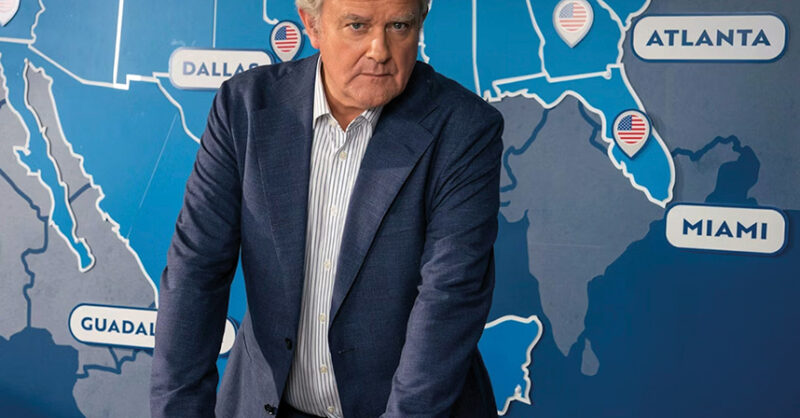

Photo by BBC
“Yes!”, “Yes?”, “Yes…” and, “Yes.” It is astonishing how much comedy in Twenty Twenty Six – as with its predecessors Twenty Twelve and W1A – can be juiced and pulped out of that affirmative. A fulsome yes, a baffled yes, an ignorant yes and a peremptory yes. Not since Molly Bloom’s final explosion of consciousness has the little word achieved such resonance. But while her “yes” was embracing, life-affirming, this is a “yes” which, for all its repetitions, confirms nothing but the infuriating nonsense of a working life.
These three series have just one consistent character, Hugh Bonneville’s Ian Fletcher. In Twenty Twelve he was the head of the Olympic Deliverance Commission, tasked with managing the 2012 Games. In W1A he was the BBC’s Head of Values (working alongside colleagues like the Head of Generic Comedy and Drama, and the Director of Better). Now, in Twenty Twenty Six, he has been seconded to Miami to serve as Director of Integrity for the 2026 Fifa World Cup, which will soon be hosted across Mexico, Canada and the US. But these three roles were really the same job: presiding over meetings, muddling compromises, making reassuring noises. In this context, Ian Fletcher simply becomes the office archetype of the harried and silvering administrator, orbited by an ensemble of drones and bloviators.
The first episode of Twenty Twenty Six sees Ian’s arrival at his new office in Miami. It’s much like his old offices in Canary Wharf and New Broadcasting House: it’s bright and open plan, the kind of place where people have bells on their desks to celebrate passing victories, and where there’s an inspirational graffito (“Do Good Things”) on the wall. The only difference is the Americans, who look authentically American (the mayor of Miami is perfectly portrayed, with his jutting jaw and blinding white teeth, like little sugar cubes). Ian’s first task is to ditch the desk he is given – central, and overlooked, a nightmare that any office worker will recognise – for the much more imperious desk in the corner. And the very fact that this is amusing is testament to Bonneville’s acting, a comic set-piece of awkward shuffling and furtive glancing.
This transitions to the meat and drink of Ian Fletcher’s life: a roundtable meeting. The style here is instantly recognisable from W1A. There’s an intractable and mildly political dilemma – which cities will host the semi-finals: Vancouver, Miami or Los Angeles? And this is then spun out into a flurry of point and counterpoint from Ian and his team, all empty suggestions and meaningless filler. The comedy here is as much a question of cinematography as writing – the camera darts from face to face, the inanity and confusion of the meeting spiralling out of sense until Ian delivers a rare full sentence of management wisdom: “Problems can be solutions waiting to happen.” By the second episode we’ve reset for a new unfathomable: is it safe to play football at temperatures beyond 85 Fahrenheit?

Subscribe to the New Statesman today and save 75%
Twenty Twelve was broadcast in 2011, in the possibly unpropitious BBC Four evening slot. The addition of Twenty Twenty Six forms part of a televisual universe that has lasted 15 years, and which has enjoyed rare popular breakthroughs, with “that’s so W1A” becoming an established linguistic shorthand for infuriating, politically correct bureaucracy. This success must have something to do with the series’ identification of a new, or at least transformed, management class. A “middle management”, and even a “metropolitan elite”, have been around for a very long time. But one in 60 of Britain’s workforce is now employed in HR. The phrase “lanyard class” wouldn’t have been coined if it didn’t refer to something, and the W1A universe is the greatest cultural response to their arrival.
The supporting cast around Bonneville is less impressive than in his previous outings, and the programme misses Jessica Hynes’s “brand consultant”, Siobhan Sharpe, who had all the best lines in W1A. Some of Twenty Twenty Six feels recycled from the earlier series: the head of sustainability first clashed with the foul-mouthed moneyman back in Twenty Twelve, and the joke isn’t quite as funny now. But it’s still some of the best comedy on TV. Or, as Ian Fletcher would put it, “Yes, well, yes.”
Twenty Twenty Six
BBC
[Further reading: Euphoria needs to grow up]
Content from our partners
This article appears in the 15 Apr 2026 issue of the New Statesman, Angry Young Women