
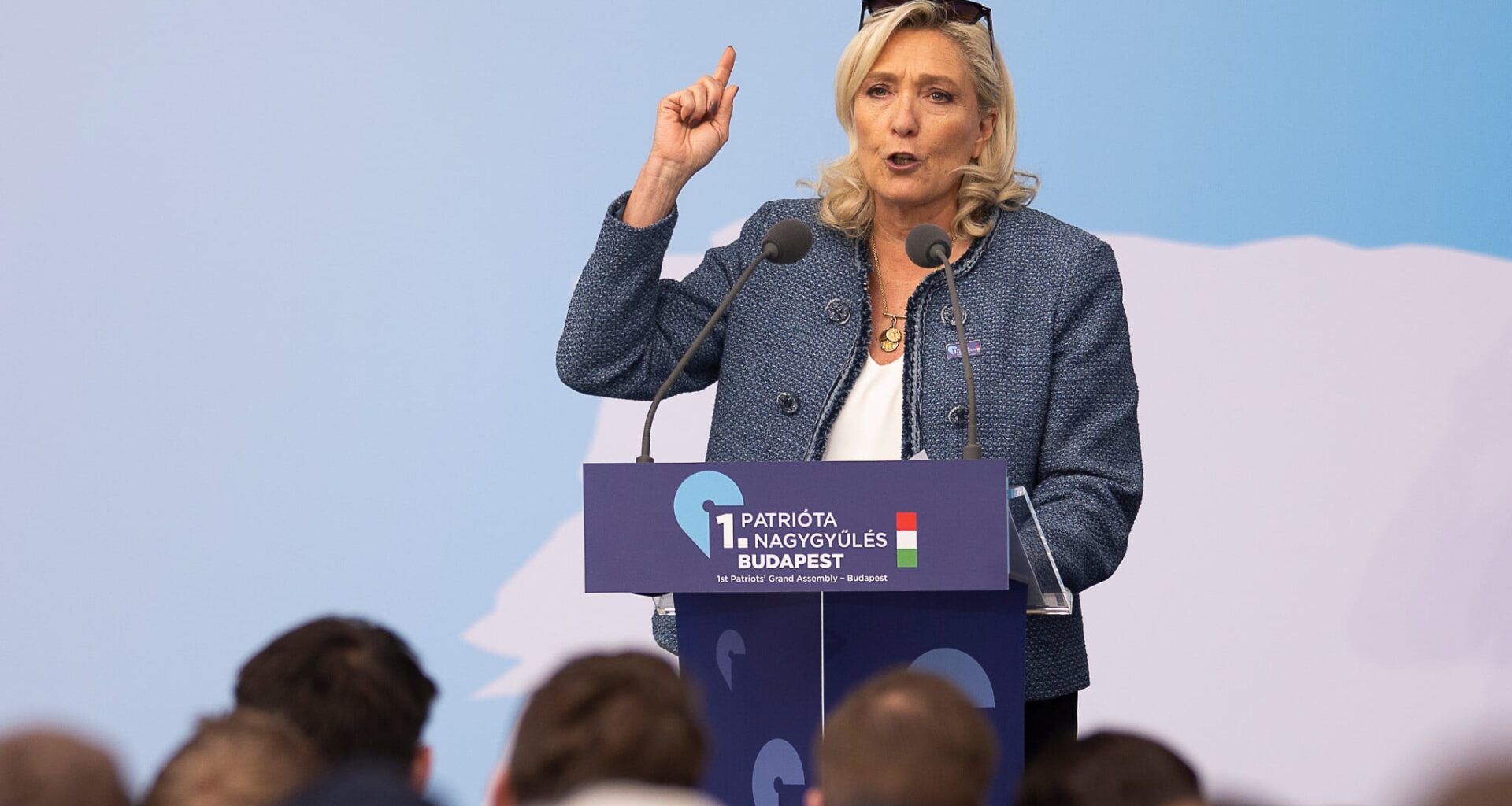
French far-right leader Marine Le Pen reportedly held a discreet meeting this week with Israel’s ambassador to the country, Joshua Zarka, continuing an ongoing shift in Israel’s approach to European far-right parties, as well as a rift between Jerusalem and French President Emmanuel Macron’s government.
The meeting — first reported by French Jewish radio station RCJ and subsequently confirmed by Le Parisien, citing the Israeli embassy — was not publicly announced through official diplomatic channels.
It came against the backdrop of Le Pen’s criticism of many Israel-related policies of Macron, who defeated her in the country’s last two presidential elections, and who has angered Israeli officials by criticizing Jerusalem’s conduct during the multifront war sparked by the Hamas onslaught of October 7, 2023.
Le Pen also reportedly met recently with Lebanon’s ambassador to France, Rabih Chaer.
Israel and Lebanon this week launched historic negotiations in the United States amid the conflict between Israel and the Lebanese terror group Hezbollah, with the Jewish state being vocal about sidelining Paris from the talks.
Get The Times of Israel’s Daily Edition
by email and never miss our top stories
By signing up, you agree to the terms
“We’d like to keep the French as far away as possible from pretty much everything, but particularly when it comes to peace negotiations,” said Israel’s US ambassador Yechiel Leiter, who represented Israel at the negotiations in Washington, on Tuesday. “They’re not needed. They’re not a positive influence, particularly not on Lebanon.”
While Le Pen is generally a staunch supporter of Israel and backed the Jewish state after the October 7 onslaught, she has recently criticized the war against Iran and distanced herself from Israel in the context of the current war with Hezbollah, calling this month for France to “protect Lebanon, its people and its sovereignty” and backing Macron’s proposal to include Lebanon in the regional ceasefire.
A few days earlier, she recognized the Jewish state’s “right, and even its duty, to defend itself and ensure the security of its territory and its inhabitants,” while simultaneously urging the “only democracy in the region” to “respect the rules of international law, particularly those relating to armed conflict.”
Israel has traditionally boycotted European far-right parties, including Le Pen’s National Rally and its predecessor, the National Front.
In recent years, however, Israeli officials have begun engaging more openly with such factions. Diaspora Affairs Minister Amichai Chikli has cultivated ties with European far-right politicians, and Jordan Bardella, another of National Rally’s leaders, spoke in Israel at a government conference on antisemitism last year.
Also, last year, Foreign Minister Gideon Sa’ar instructed diplomats to establish formal communication channels with Le Pen’s party, along with far-right political parties in Sweden and Spain.
These parties — including Sweden Democrats and Spain’s Vox — had previously been shunned by Israeli government institutions due to concerns over antisemitism, Holocaust denial, and their historical ties to fascist movements.

Israeli Ambassador to France Joshua Zarka. (Courtesy)
The Foreign Ministry, the President’s Residence and the Prime Minister’s Office had distanced themselves from these European factions due to their controversial histories and rhetoric.
Upon his appointment as foreign minister in November 2024, Sa’ar analyzed the parties based on four key factors: their stance on Israel, their attitudes toward local Jewish communities, how Jewish communities in their respective countries view them, and whether they have actively confronted their antisemitic legacies.
The foreign minister ultimately determined that dialogue was viable with these three parties but decided to maintain Israel’s policy of non-engagement with Austria’s Freedom Party and Germany’s Alternative for Germany (AfD), reports said at the time.
In February 2025, Sa’ar met with Jewish and pro-Israel leaders in Brussels, where he explained his rationale. He emphasized that while Israel does not endorse every aspect of these parties’ platforms, it is essential to recognize shifts in their policies and rhetoric. Sa’ar argued that these parties have undergone reform, pointing to their pro-Israel stance and efforts to combat antisemitism.
Zarka’s meeting with Le Pen came as the latter faces legal uncertainty ahead of France’s presidential race next year. A court decision expected in July could determine whether she remains eligible to run after she was found to be embezzling European Union funds.
You appreciate our wartime journalism

You clearly find our careful reporting of the Iran war valuable, at a time when facts are often distorted and news coverage often lacks context.
Your support is essential to continue our work. We want to continue delivering the professional journalism you value, even as the demands on our newsroom have grown dramatically during this ongoing conflict.
So today, please consider joining our reader support group, The Times of Israel Community. For as little as $6 a month you’ll become our partners while enjoying The Times of Israel AD-FREE, as well as accessing exclusive content available only to Times of Israel Community members.
Thank you,
David Horovitz, Founding Editor of The Times of Israel