

Sky This Week is brought to you in part by Celestron.
Friday, April 17
New Moon occurs at 7:52 A.M. EDT.
Spring is often called galaxy season and with no Moon in tonight’s sky, it’s a perfect time to view some distant neighbors. Tonight, we’re targeting M104, the famous Sombrero Galaxy, which lies near the border of Virgo and Corvus. It’s readily visible in any small scope.
Wait until a few hours after sunset, as the region rises higher in the east. Around 11 P.M. local daylight time, M104 is more than 10° high in the south. You can find it by sliding 11° due west (to the right, at this particular time of night) of Spica, Virgo’s 1st-magnitude alpha star.
Glowing at magnitude 8.0, the Sombrero is just a tad less than twice as long as it is thick, spanning roughly 7’ along its longer axis and just over 4’ along its shorter axis. Most noticeable is the dark dust lane that runs through the bright, nearly edge-on disk — this is what gives it the appearance of an old-fashioned sombrero and lends the galaxy its name. M104 isn’t quite edge-on from our point of view, however; it’s tilted at about 6°, so the northern half of the galaxy is noticeably brighter than the southern half, which is more hidden by dust.
Related: See spring’s best galaxies
Sunrise: 6:19 A.M.
Sunset: 7:41 P.M.
Moonrise: 6:04 A.M.
Moonset: 8:24 P.M.
Moon Phase: Waxing crescent (1%)
Times for sunrise, sunset, moonrise, and moonset are given in local time from 40° N 90° W. The Moon’s illumination is given at 10 P.M. local time from the same location.
Saturday, April 18
This evening offers a lovely view as bright Venus moves into Taurus and is joined in the western sky by a delicate crescent Moon. Both hang beneath the sparkling star cluster M45, better known as the Pleiades or Seven Sisters.
An hour after sunset, blazing Venus cannot be missed, still 11° above the western horizon. Just to its lower right, some 6° away, is the Moon. Our satellite is now roughly one-and-a-half days old, with just 4 percent of its eastern limb directly illuminated by the Sun. You may notice that the entire disk is visible, however, as earthshine — sunlight bouncing off Earth — lights up the regions still in darkness. You’ve got plenty of time to enjoy the view, until the Moon sets just before 10 P.M. local daylight time.
Some 7° above Venus, the Pleiades will pop into view as the sky darkens. Sometimes confused with the Little Dipper (a much larger asterism located due north), this gaggle of young stars does appear to some observers to outline the shape of a tiny dipper or spoon. Covering roughly 110’ on the sky, it’s a gorgeous sight to the naked eye, through binoculars, or in a low-powered scope. You might even try peering at these young suns through your finder scope for a widefield view.
Sunrise: 6:17 A.M.
Sunset: 7:42 P.M.
Moonrise: 6:36 A.M.
Moonset: 9:44 P.M.
Moon Phase: Waxing crescent (4%)
Sunday, April 19
The Moon reaches perigee, the closest point to Earth in its orbit, at 2:56 A.M. EDT. At that time, our satellite will be 224,707 miles (361,631 kilometers) from Earth.
The Moon passes 5° north of Venus at 5 A.M. EDT, then passes 5° north of Uranus at 2 P.M. EDT. By this evening, our satellite is more than 2.5 days old and some 10 percent lit, glowing in the western sky. It is located 5° east of the Pleiades star cluster in Taurus, now standing above it rather than to the cluster’s lower right, as yesterday. Venus still blazes below the cluster, outshining any star in the region by far.
Uranus is now located some 7.2° southwest of the Moon, to our satellite’s lower left. The ice giant is also roughly 4.5° due south of the Pleiades. To spot it, you’ll want to wait until the sky grows fully dark, then skim south of the Pleiades with binoculars or a telescope. Uranus’ tiny, 3”-wide disk glows at magnitude 5.8. Venus will close in on the faint outer solar system world later this week, providing a great guidepost to find it.
Mercury passes 1.8° south of Mars at 8 P.M. EDT; rising shortly before the Sun, these planets are located in the early-morning sky. We’ll check on them and their neighbors tomorrow.
Sunrise: 6:16 A.M.
Sunset: 7:43 P.M.
Moonrise: 7:16 A.M.
Moonset: 11:03 P.M.
Moon Phase: Waxing crescent (10%)
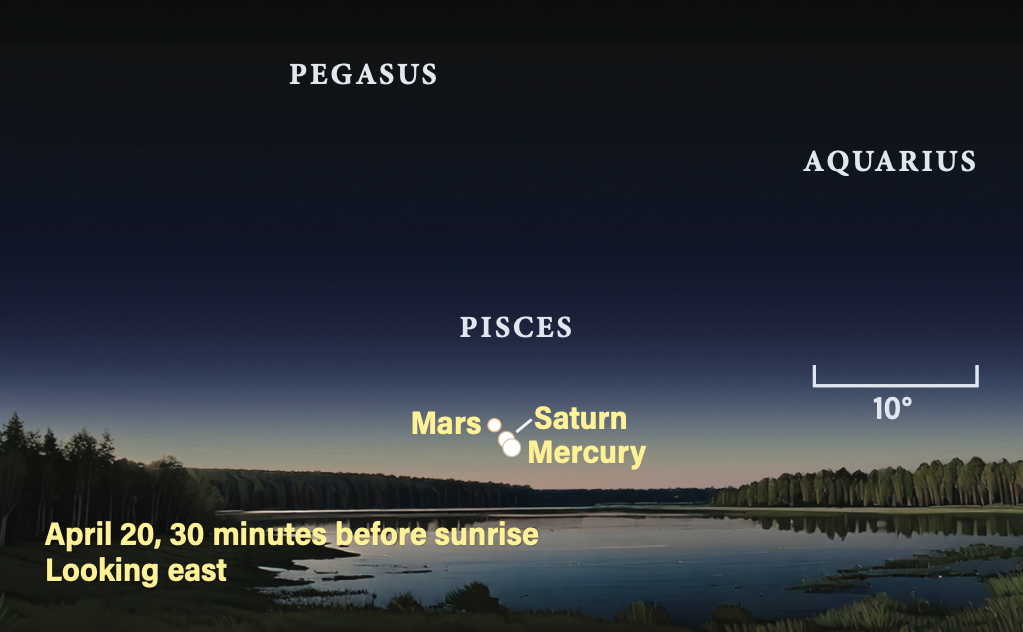
Shortly before sunrise on April 20 is a great opportunity to spot three planets together. You will need a clear eastern horizon and binoculars to catch them all. Credit: Astronomy: Roen Kelly
Monday, April 20
After passing south of Mars late on the 19th, Mercury passes 0.5° south of Saturn at 4 A.M. EDT this morning. Mars will later pass 1.3° north of Saturn at 2 P.M. EDT.
This trio of planets congregates in the early-morning sky today: Mercury, Mars, and Saturn all lie within a 2°-wide area before sunrise, not to be missed. However, observing them will be a bit challenging, as they currently rise only shortly before the Sun.
Some 30 minutes before sunrise, the trio is just 2° high in the east. The brightest of the three is Mercury at magnitude –0.2, so look for this world first. Saturn, which is next brightest at magnitude 0.9, is just 28’ north (to the upper left) of Mercury; both are visible in the same field of view with binoculars or a small scope, and you will likely need some form of optical aid to pick up the ringed planet. Mars, the faintest of the three at magnitude 1.2, is located just over a degree north (again, to the upper left) of the Saturn-Mercury pair. Most scopes should still be able to capture all three in the same field.
Remember, as always, to stop your search and put away any optics at least several minutes before sunrise from your location, which may differ from the time given below.
Sunrise: 6:14 A.M.
Sunset: 7:44 P.M.
Moonrise: 8:06 A.M.
Moonset: —
Moon Phase: Waxing crescent (18%)
Tuesday, April 21
Have you had a chance to spot Comet C/2025 R3 (PanSTARRS) yet? It’s sinking quickly toward the horizon in the Northern Hemisphere, so if you have clear skies this morning, give it a try. Its visibility will only diminish from here, and quickly.
Standing only 2° above the eastern horizon an hour before sunrise, PanSTARRS remains a stunning and popular target for astroimagers and is just brighter than 5th magnitude. Now a few days past perihelion, its tail spans several degrees and its nucleus glows that bright, familiar cometary green, generated by diatomic carbon (C2).
PanSTARRS is now located in Pisces, to the lower left of the Great Square of Pegasus. The nearest bright star is Algenib (Gamma [γ] Pegasi), which glows at magnitude 2.8. From this star, scan 9.4° due east (to the lower left) to land on the comet. Although it’s technically bright enough to see with the naked eye, binoculars may be your best bet. You can also try taking a several-second exposure of the eastern sky with your smartphone to see if that picks it up as well. Follow the comet as long as you can while the sky brightens, but put away any optics before sunrise.
Sunrise: 6:13 A.M.
Sunset: 7:45 P.M.
Moonrise: 9:07 A.M.
Moonset: 12:16 A.M.
Moon Phase: Waxing crescent (28%)
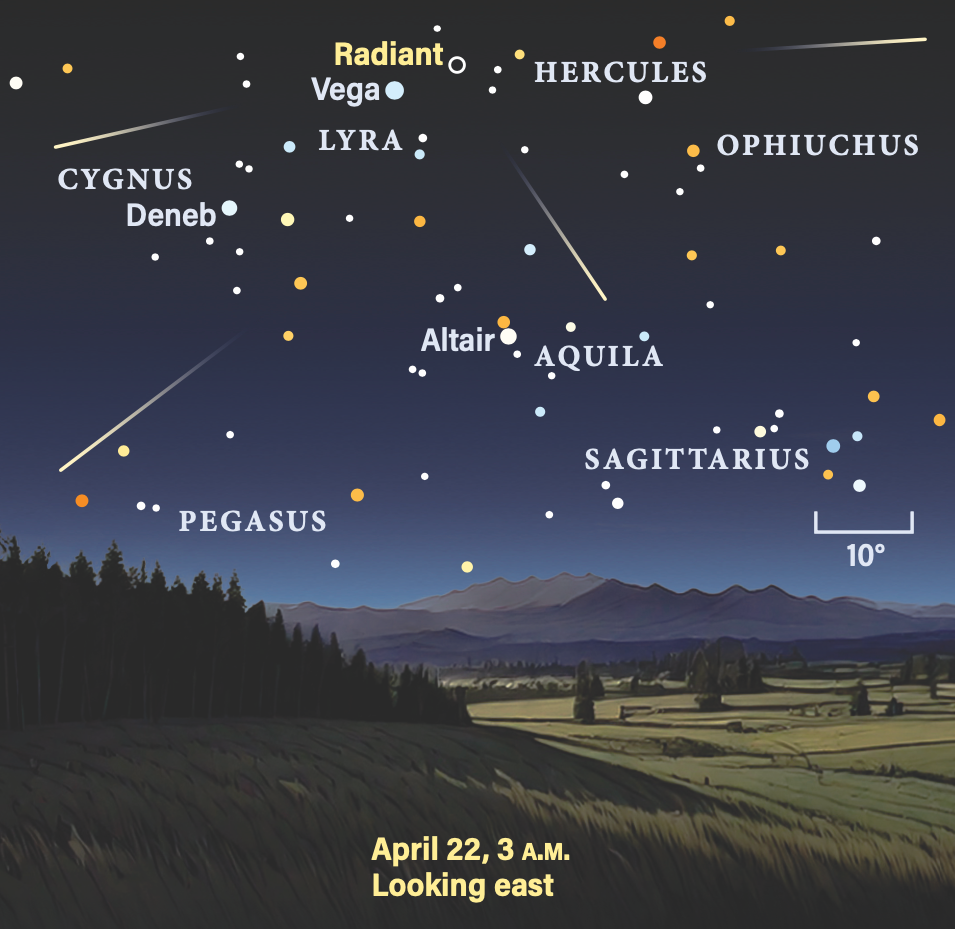
The Lyrids’ radiant is high in the east in the hours before dawn. Use this chart to locate it on the 22nd or 23rd, when meteor rates will be highest. Credit: Astronomy: Roen Kelly
Wednesday, April 22
The Lyrid meteor shower peaks this morning with minimal moonlight to interfere. The shower’s radiant — the point from which its meteors appear to originate — rises late in the evening and stands more than 60° high in the east by 3 A.M. local daylight time. This point is located just to the right of the blazingly bright star Vega, Lyra’s alpha star and one point in the famous Summer Triangle asterism, now visible in its entirety in the east.
The best time to view the shower is in the early-morning hours after the Moon sets (shortly before 1:30 A.M. local daylight time), when the sky is darkest and the radiant is high above the horizon. The maximum zenithal hourly rate of meteors expected — the very highest the rate can be — is about 20 meteors per hour, which means you should still see several meteors each hour you stargaze as sunrise draws closer. Most Lyrid meteors are considered medium-fast meteors, streaking through our atmosphere at some 30 miles per second (48 km/s). These streaks originated as dust shed by comet C/1861 G1 (Thatcher), whose orbit around the Sun takes more than 400 years to complete.
The Moon passes 4° north of Jupiter in Gemini at 6 P.M. EDT. If you prefer to observe in the evening, you can catch the pair high in the west after sunset, with our satellite standing just to the upper right of bright Jupiter, both below the two bright stars making the heads of the Twins, Castor and Pollux. They are visible until well after midnight.
Sunrise: 6:12 A.M.
Sunset: 7:46 P.M.
Moonrise: 10:17 A.M.
Moonset: 1:18 A.M.
Moon Phase: Waxing crescent (39%)
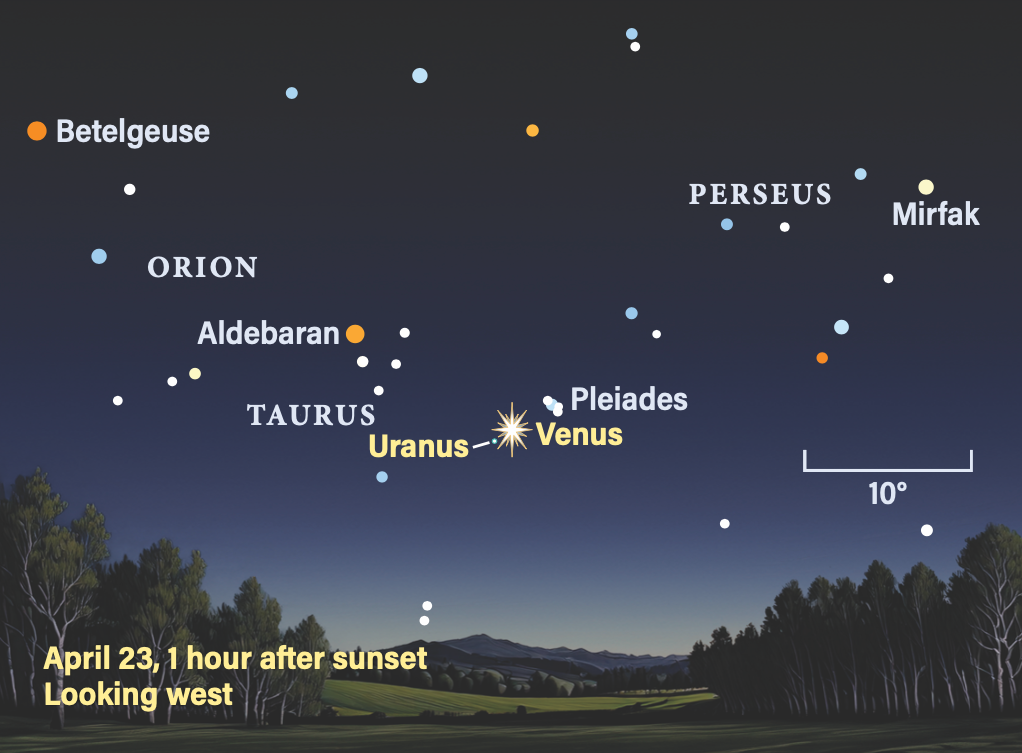
Uranus stands less than 1° south (to the lower left) of bright Venus April 23. You will need binoculars or a telescope to spot the distant ice giant. Higher in the west will be Jupiter and a waxing Moon. Credit: Astronomy: Roen Kelly
Thursday, April 23
Bright Venus acts as an easy stepping-stone to reach the much fainter and more distant ice giant Uranus this evening. If you haven’t seen the latter planet before, tonight is a great night to catch your first glimpse. Uranus is just 45’ due south of magnitude –3.9 Venus, meaning you can catch both together in binoculars or a telescope eyepiece.
Centering Venus should be a snap. Earth’s sister planet is the brightest point of light in the western sky after dark, located to the lower left of the Pleiades star cluster. Through a telescope, Venus’ bright disk appears 11” wide and 90 percent lit. Less than a degree to its south (lower left) is Uranus. Glowing a faint magnitude 5.8, this planet is so far from Earth that its disk spans only 3”, despite being physically much larger than Venus. The far-off world will look like a dim, “flat” star, but through your optics you may be able to identify that its disk is indeed circular, rather than a pinprick of light like a faint star.
If you aren’t able to observe the pair tonight, try again tomorrow: Venus will pass due north of Uranus early tomorrow morning and will still be less than 1.5° from Uranus after sunset. On the 24th, bright Venus will appear above (northeast of) Uranus in the evening sky.
First Quarter Moon occurs 10:32 P.M. EDT.
Sunrise: 6:10 A.M.
Sunset: 7:47 P.M.
Moonrise: 11:31 A.M.
Moonset: 2:07 A.M.
Moon Phase: First Quarter
Friday, April 24
Venus passes 0.8° due north of Uranus at 1 A.M. EDT.
By evening, the waxing Moon is now in eastern Cancer, not far from the Beehive open cluster (M44). This lovely grouping of stars shines at third magnitude and covers roughly a degree on the sky — it’s a great binocular target, even with the Moon nearby.
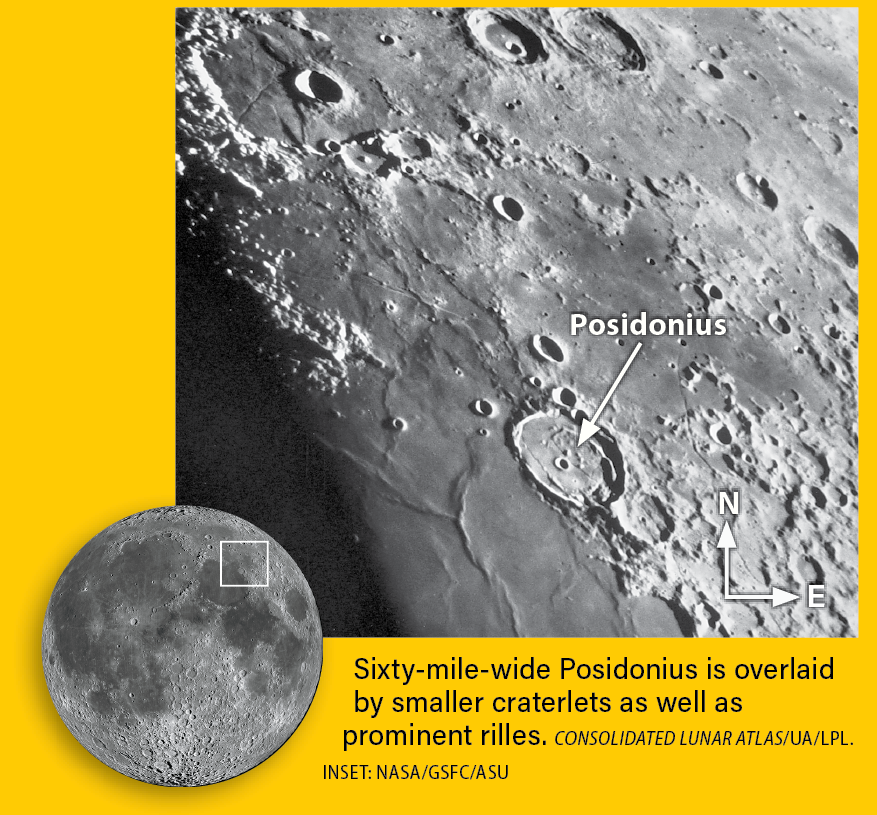
If you’ve got a telescope available this evening, turn it toward the Moon to scan around the sunlit portion of the disk as the terminator dividing night and day continues sweeping westward. The Sea of Serenity looms, dark and circular, just northeast of the terminator in the Moon’s northern hemisphere. Look along the northeastern rim of this mare to find the well-defined crater Posidonius. Use the map above to help you, though note the shadow in the lower lefthand corner of the larger image won’t be there, as the region is now in full daylight, unlike in the photo.
Nonetheless, Posidonius should appear similar to the photo. It’s a 60-mile-wide (97 km) circular crater with a distinctive central pockmark as well as a small curve of central peaks. Study its broad floor for differences in color — these arise from variances in reflectivity, or albedo, of the material covering it. Smoother, lava-covered regions appear darker, while lighter terrain is indicative of impacts and their debris. You may also notice Posidonius B, a 9-mile-wide (14.5 km) crater overlaying the larger Posidonius’ northeastern rim.
Sunrise: 6:09 A.M.
Sunset: 7:48 P.M.
Moonrise: 12:45 P.M.
Moonset: 2:45 A.M.
Moon Phase: Waxing gibbous (61%)