
Science often looks like white coats and high-tech, expensive labs, but sometimes, the future of energy starts with a mistake.
Researchers at Kyushu University in Japan were seeking complex, expensive methods to extract hydrogen from methanol.
In a surprising twist, the team stumbled upon a recipe so straightforward it could be replicated in a high school chemistry lab.
A massive release of hydrogen gas was achieved by mixing iron ions, sodium hydroxide, and methanol, then hitting the mixture with UV light.
“It was hard to believe at first,“ said Takahiro Matsumoto, lead author and Associate Professor at university’s Faculty of Engineering.
“In what can only be considered incredible serendipity, we found in one of our control experiments mixing methanol, iron ions, and sodium hydroxide, and then irradiating it with UV light, generated a considerable amount of hydrogen gas,” Matsumoto added.
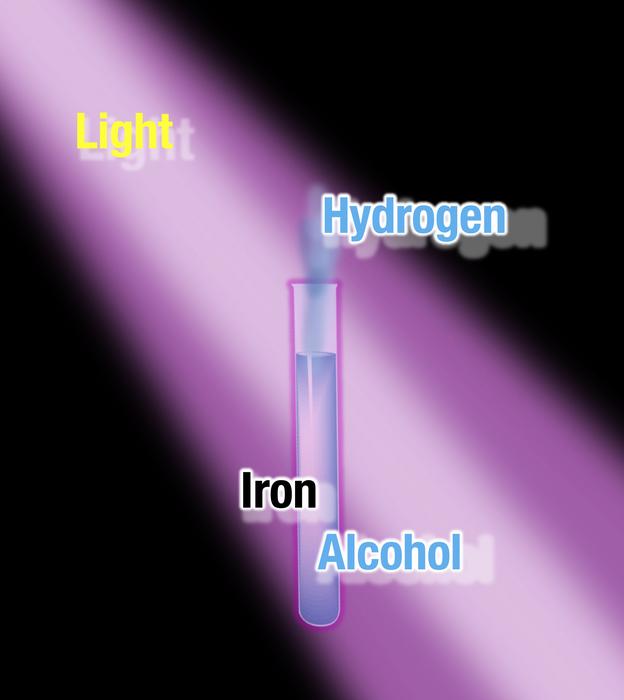 Conceptual illustration of light-driven hydrogen generation. Credit: Kyushu University/Matsumoto Lab
New recipe for sustainable hydrogen
While running a control experiment — a test meant to show what shouldn’t work — the team watched in disbelief as the basic mixture began bubbling with energy.
The reaction turned out to be a powerhouse. The simple iron mixture produced 921 mmol of hydrogen per hour per gram of catalyst. That is a technical way of saying it works just as well as the most expensive, high-tech catalysts.
The process, known as alcohol dehydrogenation, releases the hydrogen stored in compounds such as alcohols, such as methanol.
Beyond methanol, the researchers successfully extracted hydrogen from diverse sources, including other alcohols and raw biomass materials like glucose and cellulose.
The development also solves the problem of most modern catalysts, which are pricey.
Catalysts are the invisible backbone of modern life, essential for everything from electronics to pharmaceuticals. However, most high-performance catalyst structures are made of rare metals, making them both costly to produce and difficult to manufacture.
These methods often require precious metals like platinum or iridium. This new method uses iron, one of the most abundant and cheapest elements on Earth.
“Our research group has long been interested in developing catalysts from abundant and inexpensive elements. This time we turned our eyes toward sustainability and investigated the utility of common metals as catalysts for producing hydrogen gas,” explained Matsumoto.
Molecular-level understanding
There is still a catch. The researchers admit they don’t yet fully understand the magic happening at the molecular level.
“One limitation of this study is that we still do not know the reaction mechanism in detail. Additionally, although we observed hydrogen generation from other materials, the catalytic activity for these substrates is still low,” stated Matsumoto.
But the potential is undeniable. Hydrogen is a clean fuel that emits no carbon dioxide during use, but its current production remains ironically tied to fossil fuels.
To achieve a positive ecological impact, sustainable manufacturing methods are required that decouple hydrogen generation from carbon-intensive energy sources. This is precisely where the new iron-based method changes the game.
The researchers are now focused on optimizing the process to pave the way for more sustainable hydrogen technologies.
Apart from the industrial potential, Professor Matsumoto notes that the reaction’s extreme simplicity could allow anyone from students to hobbyists to recreate it — a feat he hopes will spark a widespread passion for scientific careers.