
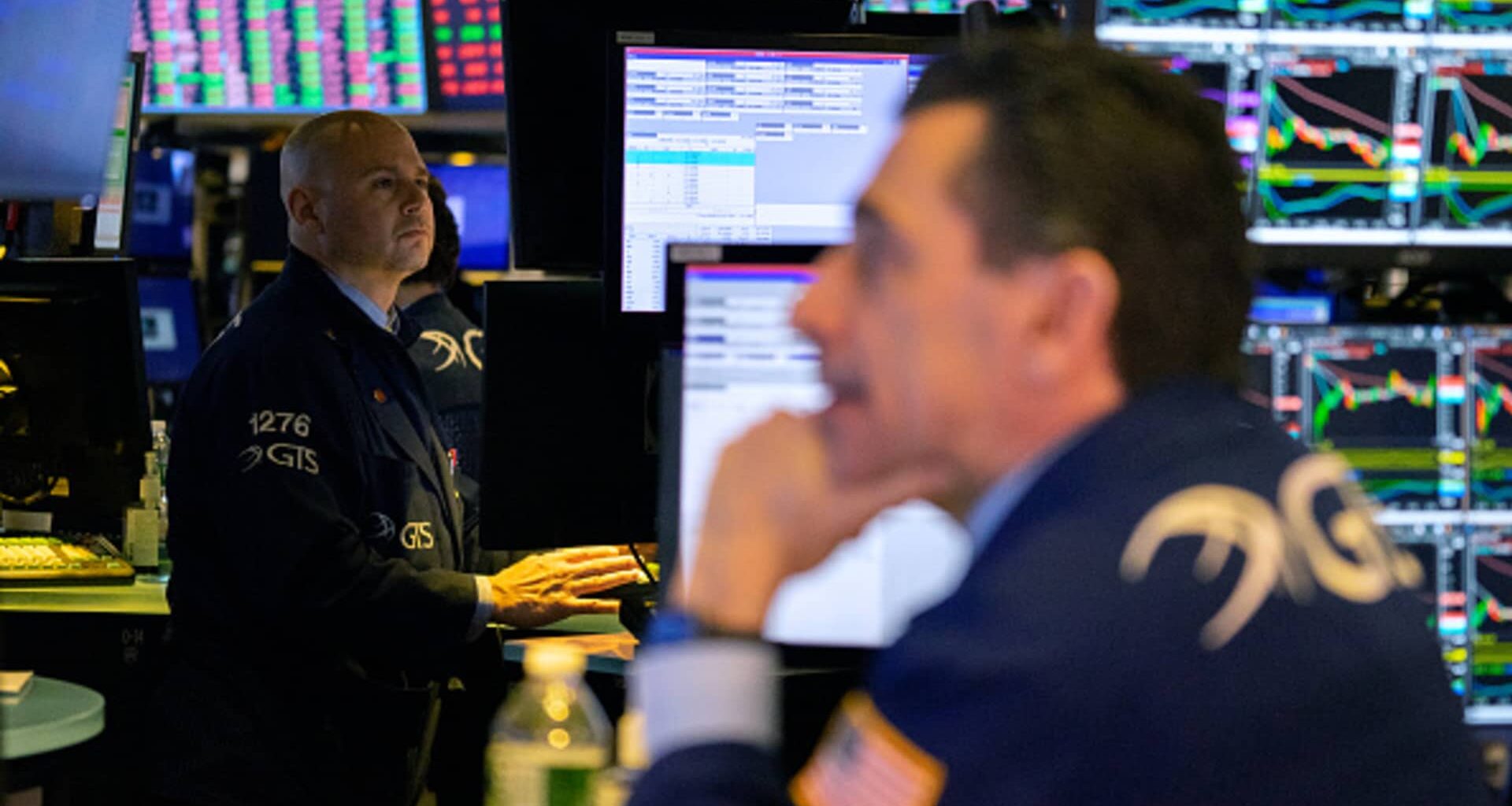
Traders work the floor of the New York Stock Exchange (NYSE) on March 6, 2020 in New York City. Stocks fell for a second day as investors seek refuge in government bonds as the worry Covid-19 spreads.
David Dee Delgado | Getty Images News | Getty Images
U.S. Treasury yields fell on Friday as Iran said maritime traffic could pass through the Strait of Hormuz after Israel and Lebanon agreed to a 10-day ceasefire, easing investor concerns that global inflation would push higher and economic activity weaken.
The 10-year U.S. Treasury note yield — the key benchmark for U.S. government borrowing — tumbled more than 6 basis points to 4.244%.
The 2-year Treasury note yield, which more closely tracks short-term Federal Reserve interest rate policy, was more than 7 basis points at 3.70%. The longer-dated 30-year Treasury bond yield dropped more than 4 basis points to 4.882%.
One basis point equals 0.01%, and yields and prices move in opposite directions.
Investors embraced the latest developments in the Middle East, where any de-escalation might act to help steady global economic activity and ease recent concern over a flare-up in inflationary price pressures.
Iran on Friday declared the Strait of Hormuz completely open to commercial traffic as long as the Israel-Lebanon ceasefire holds. The two nations agreed to a temporary pause in hostilities following talks in Washington on Thursday, and President Donald Trump repeated his assertion that an end to the war in Iran is in sight as the U.S. Navy continued to blockade Iranian ports around the Strait of Hormuz.
Oil prices tumbled Friday in reaction to Iran allowing shipping through the key passageway, boosting confidence in the inflation outlook. West Texas Intermediate futures, the benchmark for U.S. crude prices, closed down nearly 12% at $83.85 per barrel.
“From the beginning of the war, it was imperative to get the [strait] back open as its closure was a choke point on the global economy,” said Art Hogan, chief market strategist at B. Riley Wealth.
Forward-looking inflation expectations “should come down pretty rapidly,” Hogan said, noting that the increase in energy prices will “likely remain as an upward pressure in the [CPI] basket for the next month or two, but will start to exert downward pressure as we work our way into the back half of this year.”
More immediately, Federal Reserve Governor Christopher Waller on Friday said that current economic conditions, including the inflation risks posed by the Iran war, could lead the central bank to keep its key interest rate unchanged.
“High inflation and a weak labor market would be very complicated for a policymaker,” he said in a speech in Alabama. “If I face this situation, I’ll have to balance the risks to the two sides of the Fed’s dual mandate to determine the appropriate path of policy, and that may mean maintaining the policy rate at the current target range if the risks to inflation outweigh those to the labor market.”
Waller had been a supporter of cutting interest rates, but voted in March to hold the benchmark federal funds level in a range between 3.5%-3.75%.
— With additional reporting by CNBC’s Jeff Cox.