
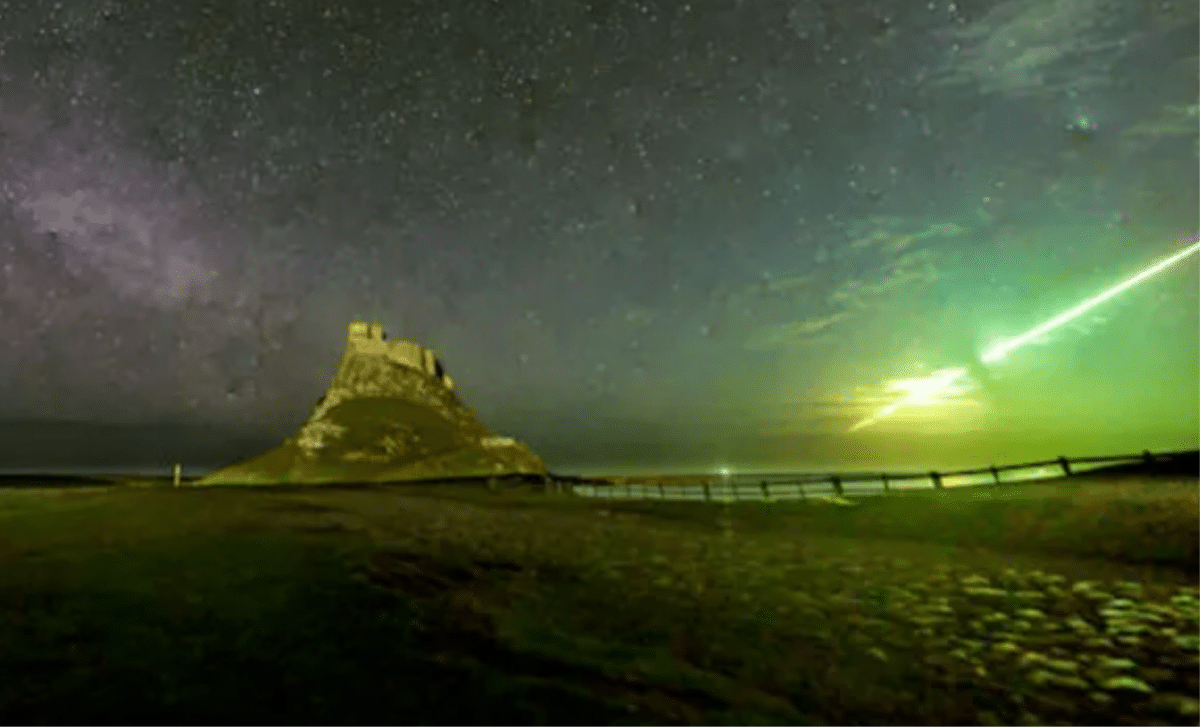
A bright green fireball meteor exploded over Lindisfarne Castle, located in northeast England. This stunning event, caught on camera by local photographers, marks a rare and thrilling moment in astronomy. The meteor, traveling at an astonishing speed of 20,000 mph, left an impression not only on witnesses but also on the scientific community.
The Meteor’s Spectacular Journey and Explosion
On the night of April 13, shortly after midnight local time, the meteor shot through the skies above Lindisfarne Island, a location steeped in history due to the infamous Viking raid of 793. The small space rock, about the size of a common object in everyday life, entered Earth’s atmosphere at an incredible speed of 20,000 mph. As it descended, it broke apart with an energy that produced a dazzling emerald-green glow, stunning onlookers from the UK, Belgium, the Netherlands, and even Germany.
Lindisfarne, also known as “Holy Island,” is a place that has long been tied to moments of historical significance. For centuries, the island has been a quiet backdrop to stories of invasions and cultural shifts, and now, it has played host to one of nature’s spectacular occurrences. The meteor’s brief but powerful presence in the sky lasted just seconds, but its impact was much longer-lasting, as it captured the attention of thousands, including photographers, amateur astronomers, and casual onlookers.
This meteor was not merely an ordinary streak in the sky. It was a fireball, an explosive type of meteor that disintegrates in the atmosphere, creating an intense burst of light. The bright green hue, as reported by Spaceweather.com, is often associated with high amounts of magnesium and nickel in the rock, substances that, when interacting with Earth’s atmosphere, release a brilliant light.
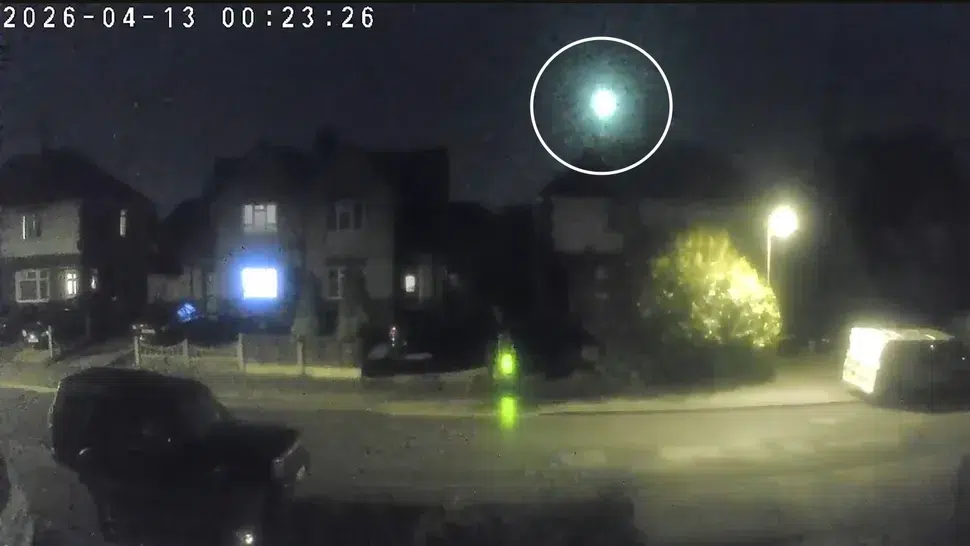 The fireball was captured on multiple doorbell and security cameras, including this one in Warsop, Nottinghamshire. (Image credit: Joanna Staniforth via AMS)
Witness Accounts and the Reaction of the Public
When the fireball exploded over Lindisfarne, it was not only photographers who were mesmerized by its brilliance. Local resident Ian Sproat, who was photographing the Milky Way above the ancient castle, recalled the thrill of the moment. “We all screamed when it happened,” Sproat told Spaceweather.com. “I was so excited!” His excitement was shared by many others, with over 230 people reporting the fireball to the American Meteor Society (AMS), an organization dedicated to tracking and documenting meteors globally.
The meteor’s visual impact was significant enough that it was captured by several doorbell cameras, some as far as Nottinghamshire. Witnesses were left in awe, and many took to social media to share their experiences, contributing to a flurry of interest across the UK and beyond. For some, this wasn’t just another sky event; it was a once-in-a-lifetime experience.
The widespread sightings highlight the increasing number of fireballs that are being observed worldwide, with this particular meteor contributing to the ongoing “fireball season” that stretches from February to April. During these months, Earth’s position relative to the sun and other factors seem to increase the frequency of these bright, explosive events.
What Makes Fireballs So Special?
Fireballs are not your average meteors. They are space rocks that experience intense friction as they enter the Earth’s atmosphere, causing them to break apart and release a significant amount of energy in the form of light. These explosions, while visually stunning, are often short-lived. This specific fireball’s green hue was the result of its chemical composition, mainly magnesium and nickel, interacting with the atmosphere’s gases.
According to NASA, fireballs during this time of year occur more frequently, with an increase of between 10% and 30% compared to the rest of the year. This phenomenon may seem mysterious, but researchers speculate that Earth’s orbit and our position relative to other celestial bodies could be a contributing factor. While the exact cause remains unclear, the fact remains that such events are not uncommon, especially during the early months of the year.
Though most fireballs dissipate high in the atmosphere and do not leave debris, some fragments manage to survive and fall to the ground, becoming meteorites. However, the likelihood of this particular fireball’s fragments reaching Earth is minimal, as it exploded over the ocean, a vast and empty area. For those hoping to find pieces of the meteor, it’s likely that the fragments have long since disintegrated or fallen into the sea.