

It’s been a sad week for Barry Callebaut AG (VTX:BARN), who’ve watched their investment drop 18% to CHF1,085 in the week since the company reported its interim result. It was a credible result overall, with revenues of CHF6.8b and statutory earnings per share of CHF33.83 both in line with analyst estimates, showing that Barry Callebaut is executing in line with expectations. Earnings are an important time for investors, as they can track a company’s performance, look at what the analysts are forecasting for next year, and see if there’s been a change in sentiment towards the company. So we collected the latest post-earnings statutory consensus estimates to see what could be in store for next year.
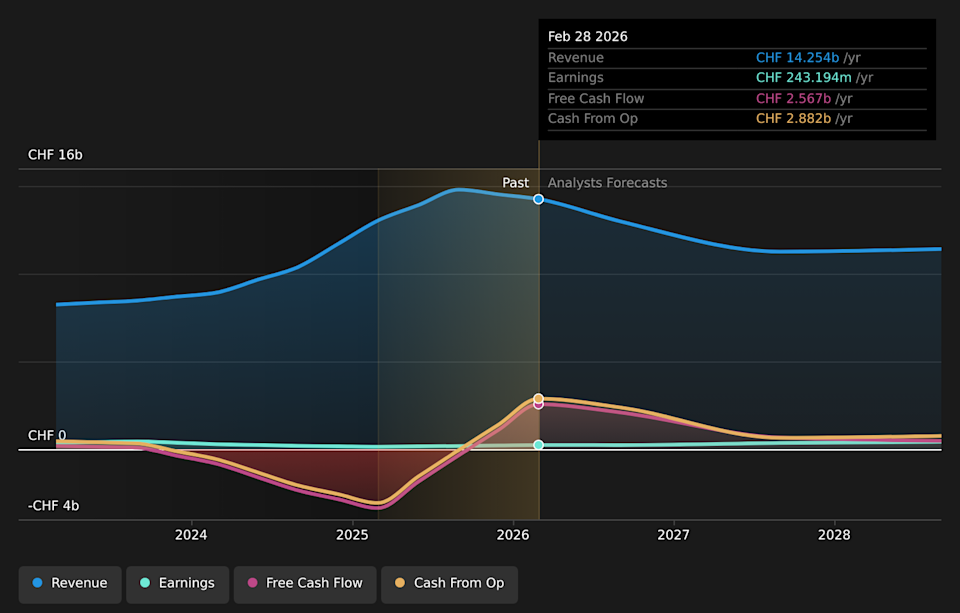 SWX:BARN Earnings and Revenue Growth April 19th 2026
Taking into account the latest results, the twelve analysts covering Barry Callebaut provided consensus estimates of CHF13.0b revenue in 2026, which would reflect a considerable 8.8% decline over the past 12 months. Statutory per share are forecast to be CHF43.71, approximately in line with the last 12 months. Yet prior to the latest earnings, the analysts had been anticipated revenues of CHF12.9b and earnings per share (EPS) of CHF51.05 in 2026. The analysts seem to have become more bearish following the latest results. While there were no changes to revenue forecasts, there was a substantial drop in EPS estimates.
Check out our latest analysis for Barry Callebaut
It might be a surprise to learn that the consensus price target fell 6.5% to CHF1,328, with the analysts clearly linking lower forecast earnings to the performance of the stock price. That’s not the only conclusion we can draw from this data however, as some investors also like to consider the spread in estimates when evaluating analyst price targets. The most optimistic Barry Callebaut analyst has a price target of CHF1,900 per share, while the most pessimistic values it at CHF1,000. This is a fairly broad spread of estimates, suggesting that analysts are forecasting a wide range of possible outcomes for the business.
Looking at the bigger picture now, one of the ways we can make sense of these forecasts is to see how they measure up against both past performance and industry growth estimates. These estimates imply that revenue is expected to slow, with a forecast annualised decline of 17% by the end of 2026. This indicates a significant reduction from annual growth of 17% over the last five years. Compare this with our data, which suggests that other companies in the same industry are, in aggregate, expected to see their revenue grow 2.3% per year. So although its revenues are forecast to shrink, this cloud does not come with a silver lining – Barry Callebaut is expected to lag the wider industry.
The most important thing to take away is that the analysts downgraded their earnings per share estimates, showing that there has been a clear decline in sentiment following these results. On the plus side, there were no major changes to revenue estimates; although forecasts imply they will perform worse than the wider industry. The consensus price target fell measurably, with the analysts seemingly not reassured by the latest results, leading to a lower estimate of Barry Callebaut’s future valuation.
Following on from that line of thought, we think that the long-term prospects of the business are much more relevant than next year’s earnings. At Simply Wall St, we have a full range of analyst estimates for Barry Callebaut going out to 2028, and you can see them free on our platform here..
Don’t forget that there may still be risks. For instance, we’ve identified 3 warning signs for Barry Callebaut (1 can’t be ignored) you should be aware of.
Have feedback on this article? Concerned about the content? Get in touch with us directly. Alternatively, email editorial-team (at) simplywallst.com.
This article by Simply Wall St is general in nature. We provide commentary based on historical data and analyst forecasts only using an unbiased methodology and our articles are not intended to be financial advice. It does not constitute a recommendation to buy or sell any stock, and does not take account of your objectives, or your financial situation. We aim to bring you long-term focused analysis driven by fundamental data. Note that our analysis may not factor in the latest price-sensitive company announcements or qualitative material. Simply Wall St has no position in any stocks mentioned.