
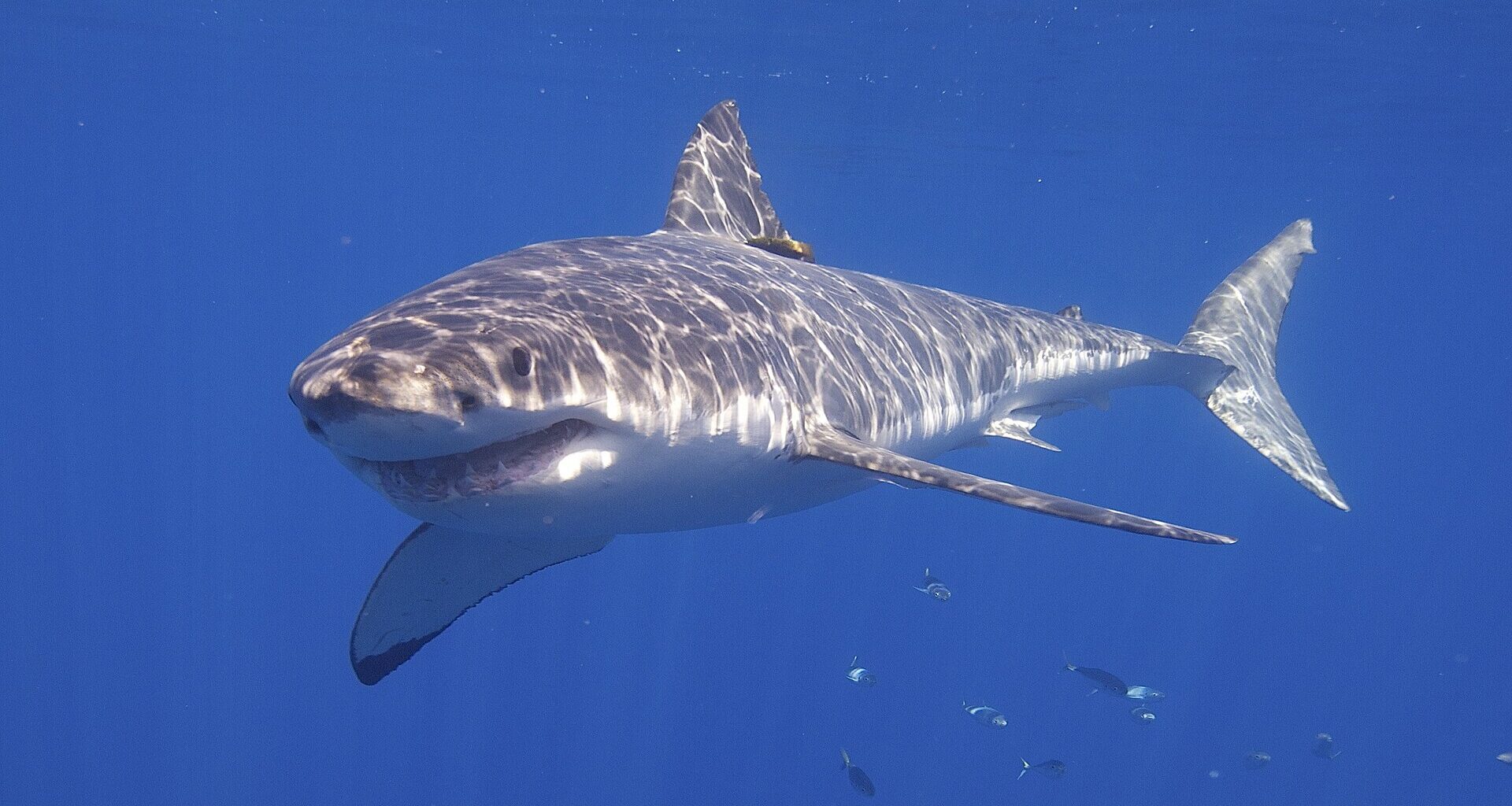
A new study reveals that rising ocean temperatures are threatening the legendary warm-bodied Great White shark, and they aren’t alone.
Some of the ocean’s most powerful predators are warm-blooded creatures that burn nearly four times more energy than their cold-blooded counterparts. The Great White shark is one of these, along with Ireland’s basking shark.
This rare group of mesothermic fishes, which comprises fewer than 0.1% of all species, retains metabolic heat. This ability allows them to keep parts of their bodies warmer than the surrounding seawater, enabling higher swimming speeds, long-distance migrations, and enhanced predatory performance, according to a press release.
However, they now face an uncertain future. A new study published in the journal Science suggests that climate change threatens the homeostasis of their environment. Record-high sea temperatures will push these species to their physiological limits, forcing them to dive to cooler depths.
Scientists from Trinity College Dublin and the University of Pretoria’s Faculty of Veterinary Science developed a novel technique to measure which aquatic species are most endangered by climate change.
“The results were really quite striking, and the implications are really sobering,” says Dr. Nicholas Payne from Trinity College. The fastest and most formidable predators of the seas may have just met their match.
Warm-bodied fish at risk
The scientists from Trinity and UP created a new framework to estimate the metabolic rate in free-swimming fish, according to the press release. They used tiny sensors to record body and water temperatures, allowing them to understand how much heat fish produce and lose in real-time.
After analyzing this biologging data, which included factors like body size and temperature, the study authors discovered that mesothermic fishes use about 3.8 times more energy than similarly sized ectothermic (cold-blooded) fishes.
“A 10°C (50°F) increase in body temperature more than doubles a fish’s routine metabolic rate,” explains Dr. Payne. “In practical terms, this means warm-bodied predators must consume significantly more food to fuel their lifestyle.”
“But that heightened energy demand is only part of the story. As fish grow larger, their bodies generate heat faster than they can lose it. This creates a mismatch driven by basic geometry and physics: larger bodies retain heat more effectively, and in mesotherms, high metabolic rates amplify this effect.”
Climate change: the new predator
If they exceed the theoretical “heat-balance threshold,” they might overheat, which would inhibit their ability to shed heat to maintain stability without changing their behavior or physiology. For example, a 1-tonne shark might start to struggle in waters above 17°C (62.6°F).
“Above such thresholds, fish must slow down, alter blood flow, or dive into cooler depths to avoid dangerous warming, but that comes at a cost. It might be harder to find food or catch it, especially if their main weapon is speed and power,” highlighted Professor Andrew Jackson from Trinity’s School of Natural Sciences
Long admired for their ferocity and speed, these high-performance predators may suffer a high cost, according to this research.
“What’s particularly concerning is that these animals are already operating on a tight energy budget, and climate change is narrowing their options even further. Understanding these constraints is essential if we want to predict how marine ecosystems will shift in the coming decades,” as concluded in a press release.
The full study has been published in Science.