
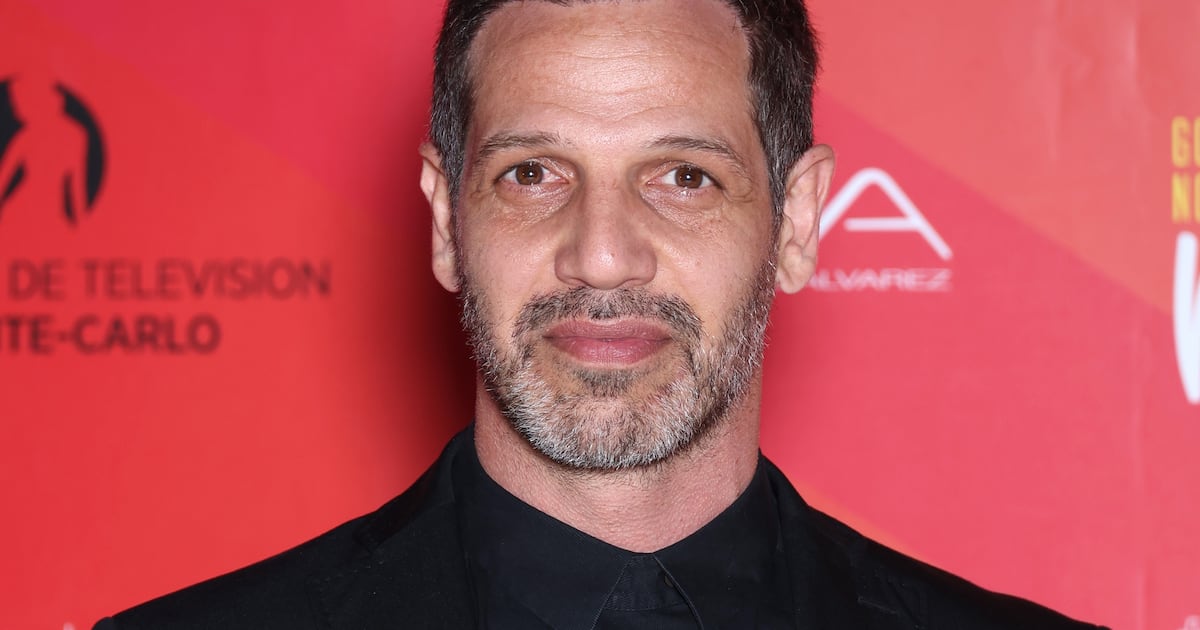
Yousef Sweid is no stranger to slurs. When a kindergarten playmate called him a “stinky Arab”, five-year-old Yousef was as surprised by the noun as the adjective.
Growing up in the northern Israeli city of Haifa, Sweid had yet to realise how, to others, he was a complex and often contradictory set of labels, identities and expectations as a Palestinian-Israeli citizen.
He has acquired new labels since: two Israeli-Jewish ex-wives and two heavily-hyphenated children who live with him in Berlin.
The 49-year-old is a well-known Israeli film, stage and television actor with roles in Game of Thrones, Unorthodox and the 2006 movie The Bubble.
But at Berlin’s Gorki Theatre, the audience is clearly appalled at how quickly the charismatic performer has them laughing at the heaviest of subjects – Israel, Zionism, even Hamas – with jokes that skewer the absurd tragedy of the Middle East conflict.
Even the title of his one-man show – Between the River and the Sea – is a risky, tongue-in-cheek swipe at his adopted home. After the October 7th, 2023, Hamas-led attacks on Israel, Germany proscribed a very similar river-to-the-sea phrase as a slogan of Hamas.
The edgy name has helped sell tickets to a show that is serious yet hilarious, heavy history with a light personal touch and, running through it all, a rich seam of extreme empathy.
“I was blessed – or cursed – with an Arab family in a Jewish community with Palestinian identity in the Israeli state,” says Sweid after the show.
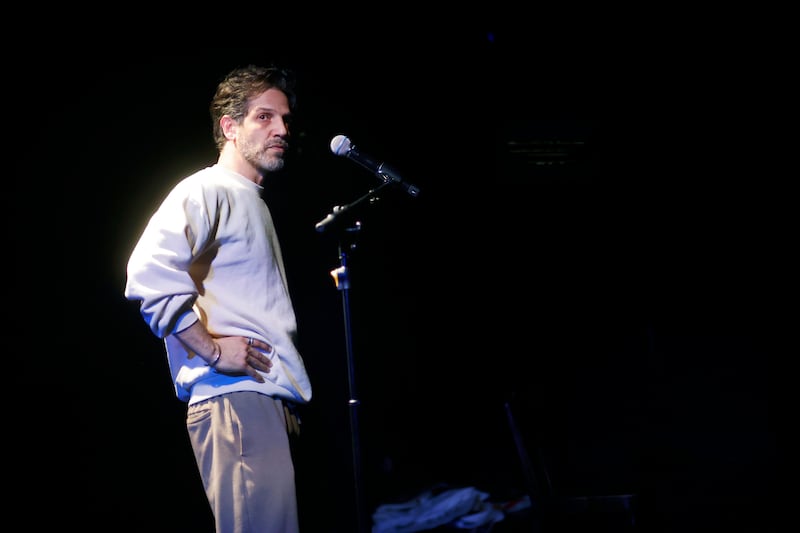 At Berlin’s Gorki Theatre, the audience is clearly appalled at how quickly the charismatic performer has them laughing at the heaviest of subjects. Photograph: Ute Langkafel, Galerie MAIFOTO
“My life led me to that I have to understand both sides.”
That lifelong habit exploded in his face after October 7th, as Sweid demonstrates in re-enacted phone conversations with old Israeli and Palestinian friends.
Take Daniel, his friend of more than 40 years, who grew up in a kibbutz. He lost friends on October 7th, others were taken hostage and his mother was almost burned alive.
“These are not humans, these are monsters,” says Sweid, as Daniel, of the attackers.
Sweid switches to Salma, a close Palestinian actor friend, whose neighbourhood was destroyed, her brothers abducted and two friends sexually abused by Israeli Defense Forces soldiers.
Playing his Palestinian friends, Sweid attacks their distant, silent friend: him. “You saw what those monsters did,” says one. Another: “Why don’t you take a stand, why don’t you just say what you think?”
Soon the accusations are raining down on the conflicted Sweid. Friendships shatter and the phone stays silent.
Even if you don’t agree, we can agree to at least sit together for an hour
— Yousef Sweid
After the show, Sweid describes the work – co-developed and written by his Austrian director and author Isabella Sedlak – as a form of therapy at a time of personal and professional crisis.
Sweid says long conversations with Sedlaks, a close friend, liberated him from a feeling that – as a member of the diaspora – he had no right to speak out about the tragedy unfolding in his homeland.
“Usually I am the one listening. I don’t live there any more, I am not suffering like everyone there,” he says.
“But when you have your own show, people have to listen and I see audiences from all sides – as well as Syrians, Iranians, Russians and Ukrainians – laughing and crying with me. Even if you don’t agree, we can agree to at least sit together for an hour.”
For Sweid, the hopelessness he saw in his homeland’s situation was a major motivation for leaving. And while horrified by the events of the last years, Sweid is not surprised.
“It was obvious that something was going to happen, something bad,” says Sweid, blaming political extremists for driving people apart with violent rhetoric and, then, physical barriers.
“When everyone sees the other side as monsters,” he says , “then the job is done to allow the horrific stuff to happen.”
Sweid asks challenging questions of all sides in the Middle East conflict- but also of his new homeland, Germany, as a staunch arms supplier to Israel.
In one scene, when Sweid’s lawyer is outraged at “babies being killed” in Gaza, the actor asks her: “If you don’t want babies to be killed, then why are you still selling them weapons?”
Ask him offstage about Germany’s policy choices in the last years, Sweid says he is wary of making political pronouncements in interviews.
“Everybody knows Germany is in a sensitive place, I don’t know what I think about it,” he says. “I do think criticism is important everywhere.”
And how does he view Ireland’s staunch support of the Palestinian people? Again, he is careful of veering into politics but says he is wary of the popular colonisation narrative, saying “it is a complicated conversation I don’t want to have with you now”.
He then pivots, jokingly, into how the Irish and Palestinian people have a common enemy. “In the end you have to believe,” he said, “that the English people are to blame for everything.”
The play has since moved to London, after which Sweid says he hopes to perform his piece in Ireland and is open for production offers. For anyone who grew up with the Northern Ireland conflict and its long, post-conflict tale, Sweid’s compelling performance makes old truths new again – and more necessary than ever.
“Artists have an obligation, in the end, not to solve the problem but, in the end, to offer a dream,” he says. “You are a bit f**ked if you are just one-sided in dealing with humans. You have to understand why they hate, why they have their pain.”
Between the River and the Sea is running at London’s Royal Court Theatre until May 9th.