
Planets orbiting two stars were expected to be everywhere. Instead, astronomers have found only a few, and new research suggests Einstein’s general relativity may be quietly wiping many of them out.
For years, this gap has puzzled scientists. Binary stars are common in the galaxy, and planet formation is thought to happen frequently, so the numbers simply did not add up.
Observations from major missions like Kepler and TESS confirmed the mismatch. What looked like a promising setup for finding exotic worlds has turned into a deeper question about how gravity behaves over time.
A Missing Population Around Binary Stars
Out of more than 6,000 confirmed exoplanets, only 14 orbit two stars. According to research published in The Astrophysical Journal Letters, astronomers expected hundreds based on how common both planets and binary stars are. The data makes the gap even clearer. Kepler alone identified about 3,000 eclipsing binary systems, yet only 47 planet candidates have been spotted in those environments. Just a handful have been confirmed.
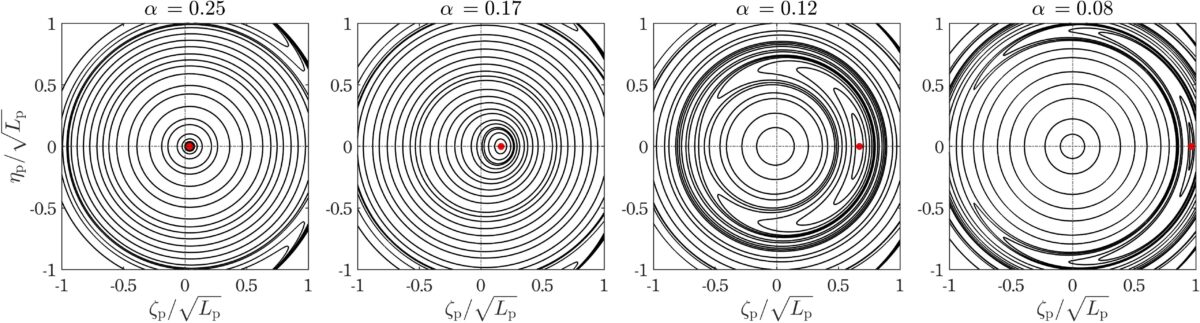 Schema showing how a planet’s orbit changes under Einstein’s gravity in a two-star system. Credit: The Astrophysical Journal Letters
There is also a very specific blind spot. Binaries that orbit each other in less than seven days have no detected planets at all. According to UC Berkeley researcher Mohammad Farhat, this creates a real “desert” where planets seem to be missing entirely.
“You have a scarcity of circumbinary planets in general and you have an absolute desert around binaries with orbital periods of seven days or less,” he said. “The overwhelming majority of eclipsing binaries are tight binaries and are precisely the systems around which we most expect to find transiting circumbinary planets.”
When Einstein Enters the Picture
The explanation seems to come from a subtle effect. In these systems, both the stars and the planet experience orbital shifts known as precession, but not for the same reasons. As a team from UC Berkeley and the American University of Beirut explained, the stars’ motion is affected by general relativity, especially as tidal forces slowly pull them closer together. That speeds up their motion, while the planet slows down.
At some point, the two motions sync up in what scientists call a resonance. That is where things go wrong. The planet’s orbit stretches more and more until it becomes unstable. As Farhat explained, the planet is either pushed out of the system or pulled inward and lost. Simulations suggest nearly 80% of planets in these tight systems do not survive.
A Zone That Clears Everything Out
There is another key piece, the instability zone. This is a region around binary stars where stable orbits do not last. Jihad Touma explainted that once a planet’s orbit becomes too stretched, it drifts into this zone.
“A planet caught in resonance finds its orbit deformed to higher and higher eccentricities, precessing faster and faster while staying in tune with the orbit of the binary, which is shrinking.” Touma added, “And on the route, it encounters that instability zone around binaries, where three-body effects kick into place and gravitationally clear out the zone.”
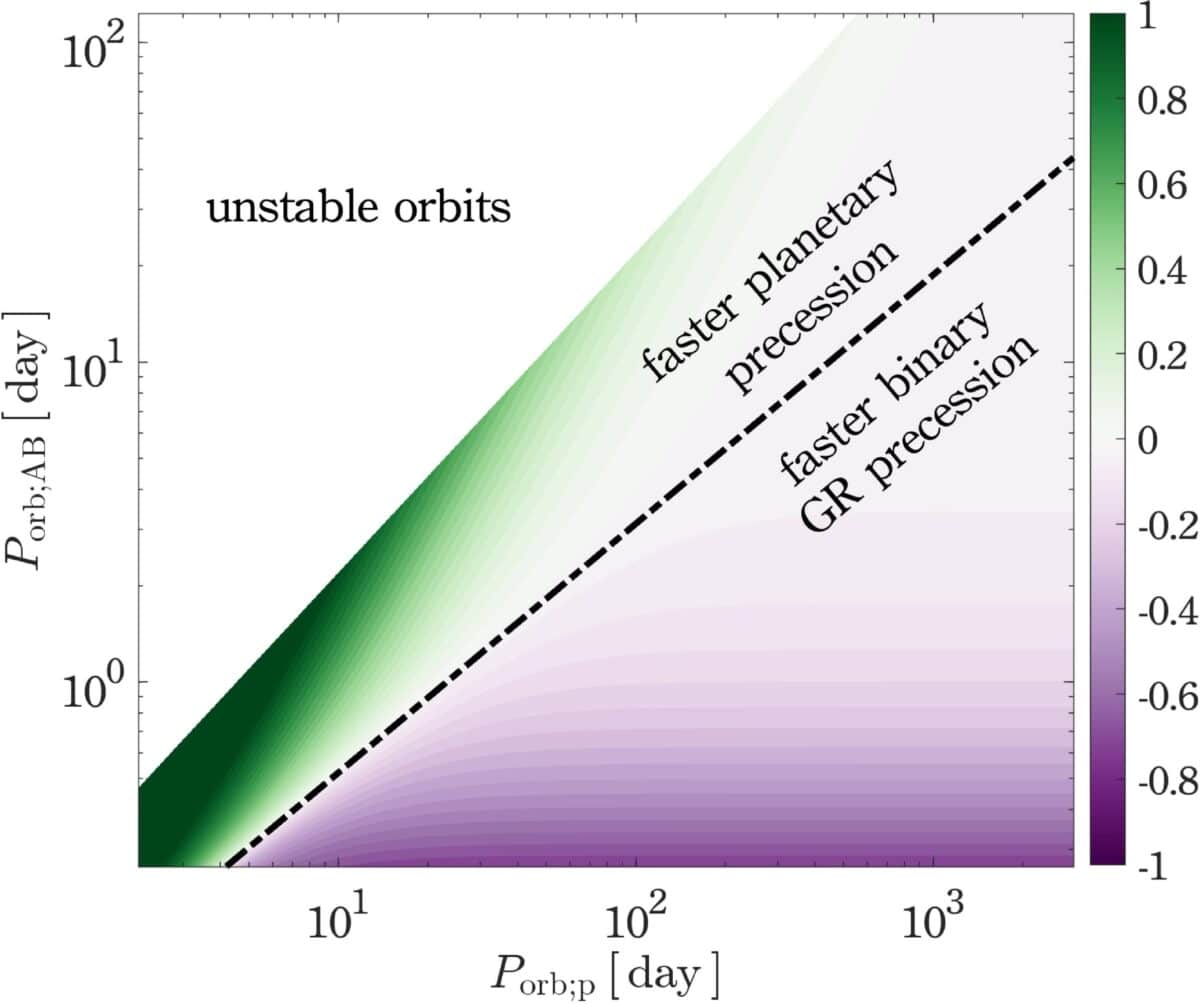 Diagram showing where planetary orbits become unstable in two-star systems. Credit: The Astrophysical Journal Letters
Most of the circumbinary planets we do see sit just outside this boundary. That likely means they formed farther away and moved inward over time, stopping just before things became unstable. Touma describes forming planets near this region as “trying to stick snowflakes together in a hurricane,” which reflects how chaotic it is.
What this shows is that Einstein’s theory, first introduced in 1915, is still shaping what we see in space today, sometimes by removing entire planets before they can be detected.