
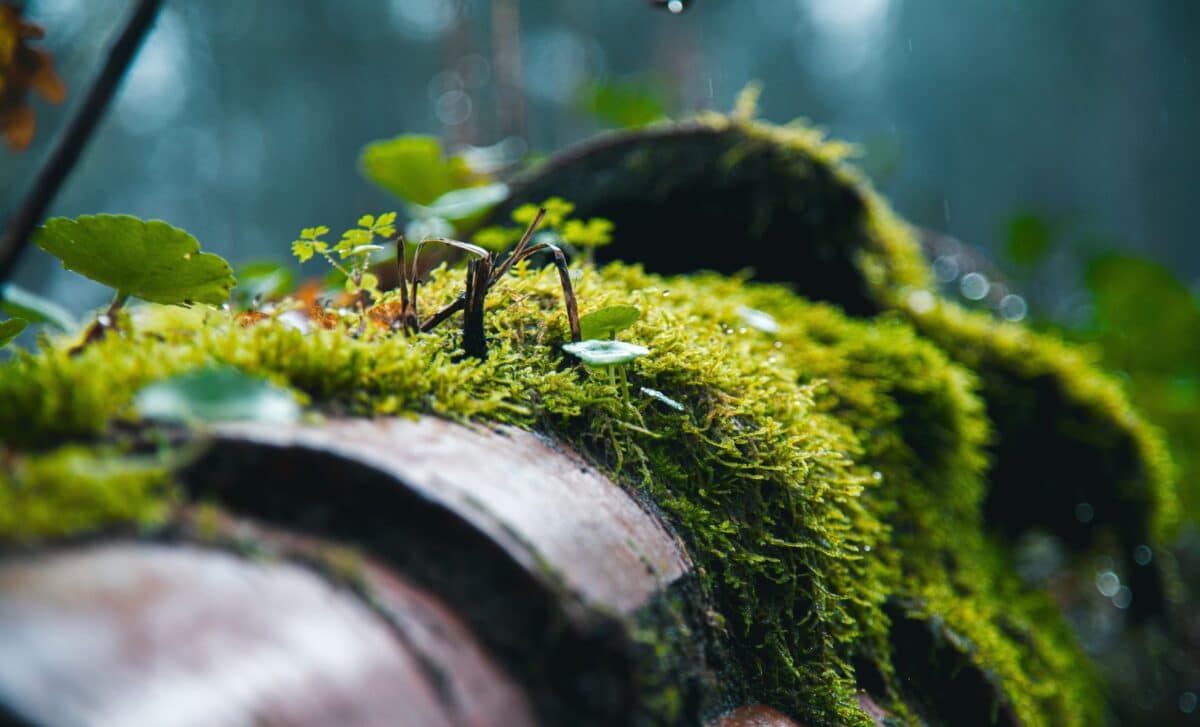
A small, unassuming moss has survived nearly nine months in the vacuum of space and still managed to grow once back on Earth. The result, observed after exposure outside the International Space Station, is giving scientists new ideas about how life might take hold beyond our planet.
The experiment, carried out by a team at Hokkaido University, sent spores of Physcomitrium patens into one of the harshest environments possible. Radiation, extreme temperature swings, and total vacuum were all part of the test, conditions that usually destroy living material pretty quickly.
Growing plants in space is still a major challenge for long missions. Oxygen, water recycling, and food production all depend on it. This study shifts the focus a bit, looking not at crops but at simple, tough organisms that might survive where others cannot.
A Natural Shield Against The Extremes Of Space
The researchers chose the sporophyte of Physcomitrium patens, a capsule that protects spores and helps them survive stress. According to results published in iScience, these structures spent 283 days outside the ISS after being launched aboard Cygnus NG-17 in March 2022.
“Most living organisms, including humans, cannot survive even briefly in the vacuum of space,” noted Tomomichi Fujita from Hokkaido University, the study’s lead author. “However, the moss spores retained their vitality after nine months of direct exposure.”
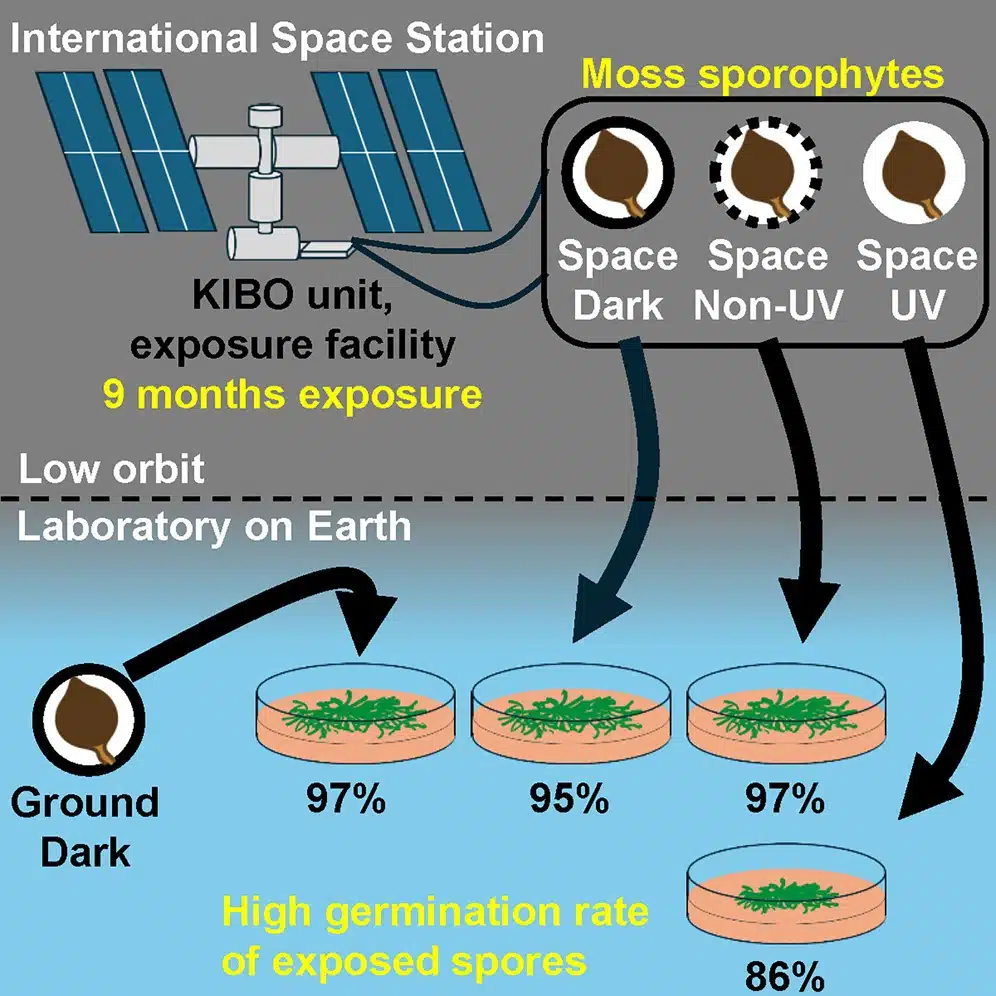 This image is a schematic illustration of an experiment conducted on moss spores in space. Credit: iScience
Astronauts placed the samples on an external platform, where they were directly exposed to cosmic radiation, micrometeorites, and temperatures ranging from -120°C to +100°C. They came back to Earth in January 2023 aboard a SpaceX Dragon capsule.
This protective capsule turned out to be key. It kept the spores intact throughout the mission, showing that some plant structures can handle space conditions without any extra shielding.
Radiation’s Not Winning This One
Back on Earth, the spores were grown in lab conditions. The outcome surprised even the researchers. About 86% of the exposed spores germinated, compared to 97% for those that never left Earth. As the study explained, that gap is smaller than expected given the level of radiation involved. Fujita admitted the team did not expect such an outcome.
“We expected almost zero survival, but the result was the opposite: most of the spores survived,” he said, adding that they were “genuinely astonished by the extraordinary durability of these tiny plant cells.”
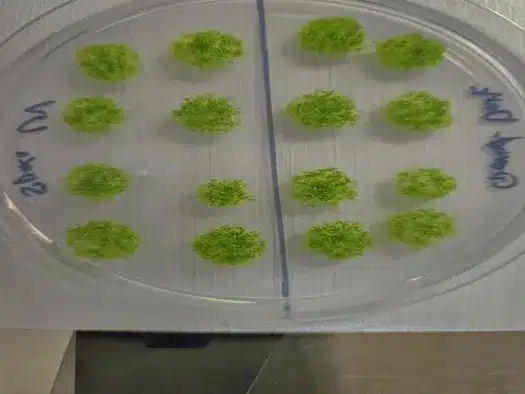 Germinated moss spores after exposure to space. Credit: Dr Chang-hyun Maeng & Maika Kobayashi
There was some impact. Scientists measured a 20% drop in chlorophyll a, which plays a central role in photosynthesis. Still, the spores grew. Their low water content and dormant state likely helped limit the damage.
The team also built a model suggesting these spores could survive up to 5,600 days in similar conditions. That is more than 15 years, a figure that pushes current assumptions about how long plant life can last in space.
Ecosystems on Mars? The Idea Just Got Real
These results are already feeding into discussions about building ecosystems beyond Earth. Instead of starting with food crops, scientists are considering hardy pioneer species that can kickstart basic biological processes. As mentioned in a press release, researchers stress that survival is only part of the story, what really matters is whether these organisms can grow and function elsewhere.
Moss like Physcomitrium patens could help produce oxygen, manage humidity, and even begin forming soil-like layers. They would be useful within closed-loop systems supporting lunar outposts or Mars missions.
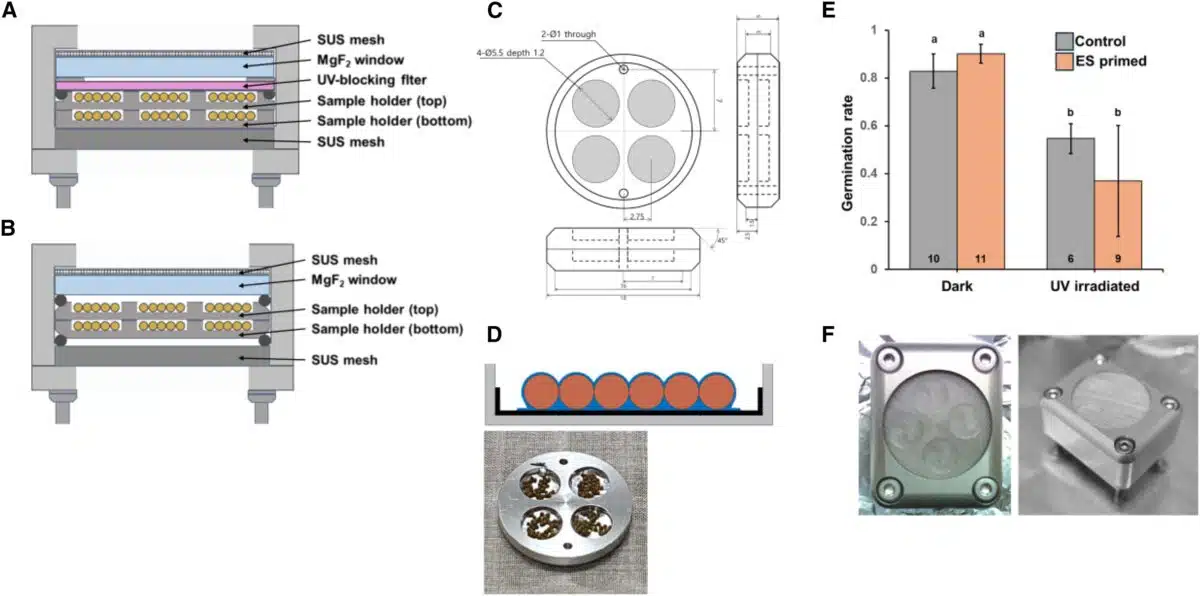 Layout of the space exposure unit and arrangement of samples for the experiment. Credit: iScience
Fujita said the experiment clearly shows how tough simple plant life can be. There are still plenty of unknowns, especially how these organisms would react to different gravity or Martian soil, but the study is a real step toward using living systems in space exploration.
“Ultimately, we hope this work opens a new frontier toward constructing ecosystems in extraterrestrial environments such as the Moon and Mars,” stated Fujita. “I hope that our moss research will serve as a starting point.”