
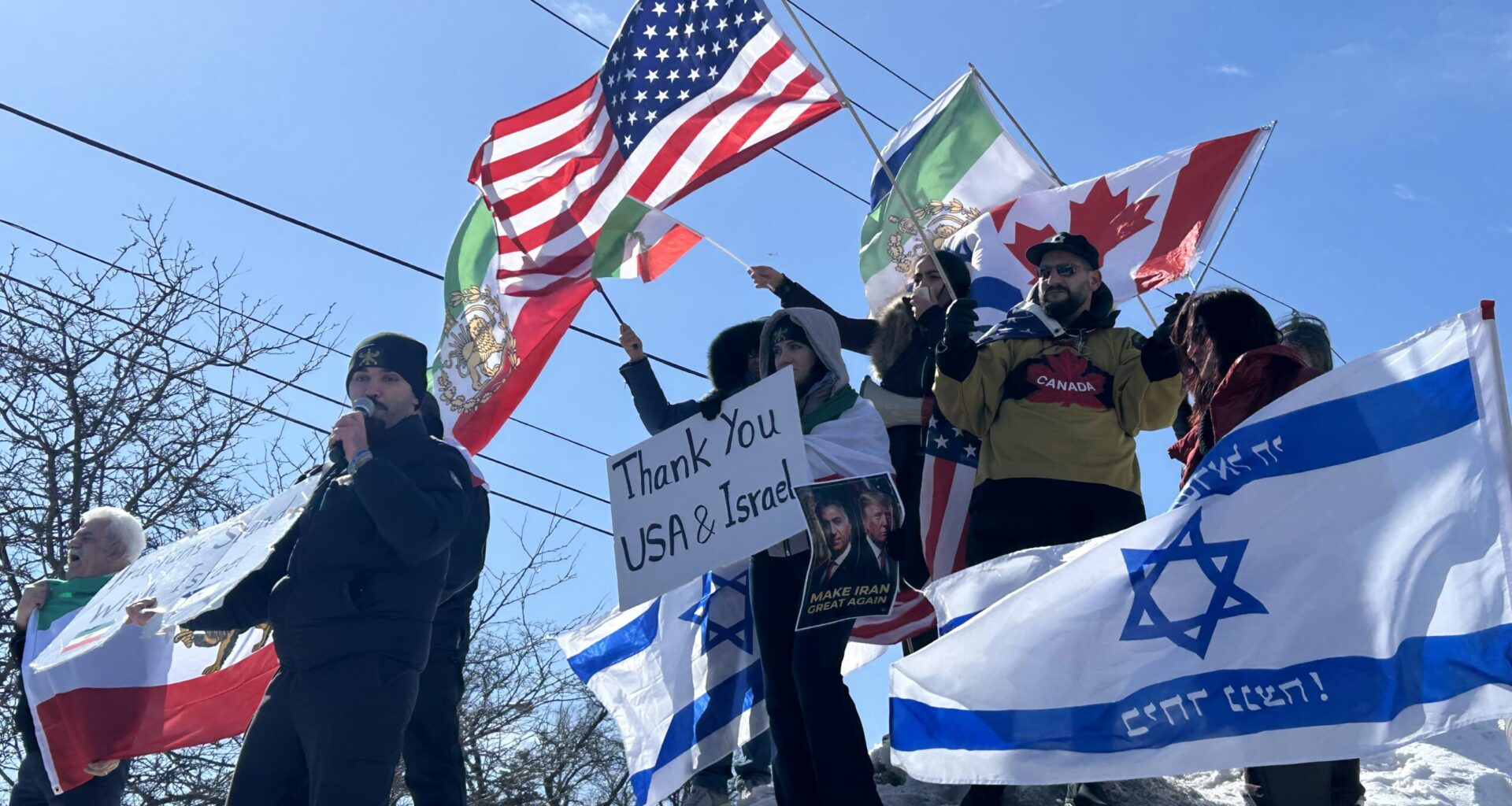
The buzzword of the moment is decentre. Everyone’s decentring everything all the time these days. Or maybe there are just two main contexts in which this comes up, at least on the beats I cover. Some women are decentring men, or trying. And Jews? We are, or are not, decentring Israel. Whatever that means. (I am getting to what it means.)
Exactly how central Israel ought to be to Jewish life elsewhere is a completely new topic I’m sure you’ve never come across before. Kidding! It’s everywhere, and it’s not new. It is, however, much in the news these days, with various diaspora Jews announcing that they’ve had it with being associated with Israel, whether by non-Jews or Jewish institutions, and requesting that they be excluded, as it were, from the narrative.
The question of how much to centre Israel is not quite the same as whether to be a full-throated supporter. There are Jewish anti-Zionists who give other countries little thought, as well as Jewish nominal Zionists who are aware there’s a Jewish state and aren’t seeking to destroy or redefine it but wouldn’t be able to distinguish Hebrew script from kanji.
Some of the decenter-Israel moment? movement? is not so much advocacy for a change to occur, but an acknowledgment of a longstanding reality: there are diaspora Jews, particularly ones in the United States whose families arrived in the early 20th century or earlier, who simply feel no connection to Israel, and experience Israeli flags at Jewish community centres or whatever as confusing. They don’t have Israeli family and friends, and their Jewish culture is multigenerationally local. Theirs is a Jewishness of Woody Allen and delis, maybe of synagogues or temples, maybe not. What’s the modern-day nation-state of Israel to them?
This sort of decentring isn’t strictly speaking decentring, though, because these are Jews who had never centred Israel to begin with. It’s like when someone describes a Jew whose first solid food was pureed ham as being an assimilated Jew, as if there were some primal distinctly-Jewish state from which they assimilated, some self they’re being disloyal to, simply in being exactly who they are.
On the whole, decentring Israel goes together with criticizing its behaviour or existence. It lines up with a sense that it is a liability to be associated with the Jewish state, and with a hope (naïve, as I see it) that if one could simply unlink anti-Zionism and antisemitism, once and for all, the latter would vanish.
A recent open letter from some Jewish writers to the Jewish Book Council “apparent bias toward centering Israeli and Zionist voices.” (Yes, we are a people of open letters and literary manifestos.) The New York Times ran a massively positive review of Molly Crabapple’s hew history of the Bund, Here Where We Live Is Our Country, with the provocative if anachronistic title, “What Does Judaism Look Like Without Zionism?” Meanwhile, “younger” Jews in Philadelphia are embracing Yiddish and playing klezmer, and studying their European roots as a way of decentring Israel. One is quoted by radio station WHYY as saying, “‘I grew up thinking that Israel was my culture and my lineage. That’s how American Jewish institutions teach it, and it’s just not true… My family is not from Israel-Palestine. My culture is Eastern European Yiddish.’”
I read this passage several times and found the whole thing frustrating. Frustrating, that is, not because, how dare this lady study her ancestry, ancestry that is, incidentally, my own as well. But rather because of a missing piece to this equation.
***
Shortly after Oct. 7, I had an unsettling conversation with a well-meaning non-Jewish friend. They were asking me about the attacks in a way that suggested they believed me to be from Israel. Something about whether I still had family back in Israel, possibly. It’s a blur, for so many reasons. And I had to try to convey that no, while I found world events upsetting, I’m not of Israeli heritage, and apart from a few distant relations, I don’t have family in Israel. I’m one of the Eastern Europe to North American Ashkenazi Jews. Ashkenazim, if you will, if that’s not too Israel-centric a plural.
But the more I think of it, the more I think my friend was onto something.
There is a sense in which I am, simply by virtue of being Jewish, a little bit from Israel. And it’s not what you think.
Because it’s not about a belief, religious or anthropological, about where my own family history begins. I have ample reason to believe I’m 300% Ashkenazi but have not 23-and-me’d. Nor, for me, a secular Jew, is it about a spiritual connection to the Holy Land.
What I do know is that my more recent ancestors were Jews in 19th and early 20th century Europe, minding their business, when slowly then all at once, European Jewish civilization got wiped out. There were pogroms, then Nazism, then nothing. Not literally zero Jews—there were some Holocaust survivors, and there’s been some postwar Jewish immigration to Europe (notably, North African Jews to France, former-Soviet Jews to Germany)—but nevertheless. Unlike most other white-looking North Americans, Jews cannot return to continental Europe to see the family who stayed in the old country. The places remain but the people do not.
I am aware, of course, that Israel is the Jewish state. But it was only after being there as an adult that I realized how Jewish it is in the sense that my late Montreal-born grandmother would have referred to as Jewish. By this I mean how prevalent Ashkenazi culture is, no not to the exclusion of Mizrahi or Sephardic culture, yes I’m aware that there have been internal power struggles and biases of various kinds, no this is not the place to unpack those. I simply mean that the food and culture that to me says ‘diaspora’ is alive and well in Israel, far from its climates and terrains of origin,and do you know why that is? It could very possibly have something to do with where Holocaust survivors wound up. Pogrom survivors as well; I am aware that modern Zionism predated the Second World War.
The Jewish civilization under increasing attack in the late 19th century and decimated by the Nazis and their many accomplices is gone. But its closest approximation, the closest there is to a continuation, is Israel. This is not me advocating for the creation of a Jewish state in Palestine. This is me describing where there are, at this moment, Jews living. Living Jews.
And it’s in that spirit that I locate my own… what to even call it? Zionism? Not really, because Israel is already there, I’m not urging it to be founded. Israelophilia? Possibly, but this suggests I’m drawn to it more as an outsider than a coulda-been-me-er. This is how it came to pass that I took a year of intro to Hebrew in my fourth year of undergrad, and informal Hebrew conversation classes at the start of grad school. This is why I’ve travelled to Israel as an adult, and why, despite finding its leadership approximately as sensible as that of my actual home country of the United States, despite this and other cultural passions of mine having somewhat waned with little kids and middle age, I still experience a bit of that thing so unchic for a Jew to feel these days: a connection to Israel.
Here Where We Live Is Our Country. Hereness. For me, that’s North America. But by the standards of hereness, I’m drawn more to living Jews than to the ones who in a just world would have been permitted to be born in Poland or wherever but that’s not how it played out. And as intriguing as it always is to learn about the last Jew in whichever remote corner once filled with Jews, I’m always more interested in learning about where Jewish life is thriving. And Israel has this over Poland.
If you, reading this, are an Israel-decentrer, by all means, you do you. I’m not mad at this, don’t put it in the newspaper that I am, it’s just not for me. It’s not that I think about Israel constantly or, on a day to day basis, much at all. But if I’m not drawn, as so many with my demographics are, to cosplaying Fiddler and romanticizing garment-district ancestors, it’s not because I’m delusional and imagine that my own recent ancestors spoke Hebrew and ate falafel. It’s that I know my European Jewish history too well to imagine the modern state of Israel emerged from European Jews’ out-of-the-blue desire to culturally appropriate Arabness. I know enough about the relevant population trajectories, that is, of the fraction of a population that remained, to realize that if I’m to have any affinity for the civilization my family came from, I have to recognize where it is that the civilization in question largely ended up.
I’m too aware of what an aberration the Israel-aloof American and sometimes Canadian Jews are, in the grand scheme of things, given how entangled Jewish families are, consisting of wide-ranging views about Israel and Israelis and non-Israelis and and and, but not quite so many ands, what with the less upbeat parts of our history. But not none.
Phoebe Maltz Bovy is The CJN’s Opinion Editor, and author most recently of The Last Straight Woman, out May 19. She can be reached at [email protected], @phoebebovy on Bluesky, and @bovymaltz on X. Subscribe to her podcast, The Jewish Angle wherever you get your podcasts.
***
What do you think? The CJN welcomes your feedback with a letter to the editor. If you wish to have your letter considered for publication, please submit using this form.

Phoebe is the opinion editor for The Canadian Jewish News and a contributor editor of The CJN’s Scribe Quarterly print magazine. She is also a contributor columnist for the Globe and Mail, co-host of the podcast Feminine Chaos with Kat Rosenfield, and the author of the book The Perils of “Privilege”. Her second book, The Last Straight Woman, will be published by the Signal imprint of Penguin Random House Canada in May 2026. Follow her on Bluesky @phoebebovy.bsky.social and X @bovymaltz.