
The new UT Dell Medical Center at the UT Dell Campus for Advanced Research will be on 27 acres in North Austin with room to grow. The University of Texas is reimagining what a hospital can be with artificial intelligence worked into the plans from the beginning.
Provided by Dell Medical School
The Michael and Susan Dell Foundation is giving the University of Texas more than $750 million to build the UT Dell Campus for Advanced Research and the UT Dell Medical Center on the university’s former West Pickle Research Campus in North Austin.

The campus at Braker Lane, west of MoPac Boulevard, will deliver complex care that Austin currently does not have with the goal of making the city a national leader in health care.
Article continues below this ad
This marks more than $1 billion given by the Dells to the university, making the couple UT’s first-ever billion-dollar donors. This is thought to be one of the largest philanthropic investments in a university, UT officials said. It also brings the Dells’ total philanthropic gift to world to $10 billion.
Susan Dell said the couple “feels beyond joyful, beyond proud. We feel very, very blessed.”
Philanthropy “is the most important thing we will do in our lifetimes,” she said.
“This gift by the Dells really allows us to accelerate something at a scale that is generational,” said Dell Medical School Dean Dr. Claudia Lucchinetti, in an exclusive interview with the American-Statesman. “This is about more than Austin. It’s about being a model for health and health care redesign for Austin, Texas and the country.”
Article continues below this ad
The foundation’s investment also includes funding more Dell Scholars scholarships and student housing, as well as investments in computer science, which the Dells have helped build at UT. The Dells already have supported 25,000 students at UT. Some of the Dells’ newest gift will go to building medical research capacity and to the Texas Advanced Computing Center, which will have a major presence in the new medical center.
“This is about launching the next generation of medical and research capabilities,” said Michael Dell, the founder and CEO of Dell Technologies, in an exclusive interview with the Statesman. “It’s really the ability to, from the ground up, design a new health care system with data and AI and computing built in that should lead to earlier diagnosis, more personalized care and better outcomes.”
The UT Dell Campus for Advanced Research will include both this West Pickle Research Center site and the J.J. Pickle Research Center to the east of MoPac Boulevard, said Jim Davis, president of the University of Texas.
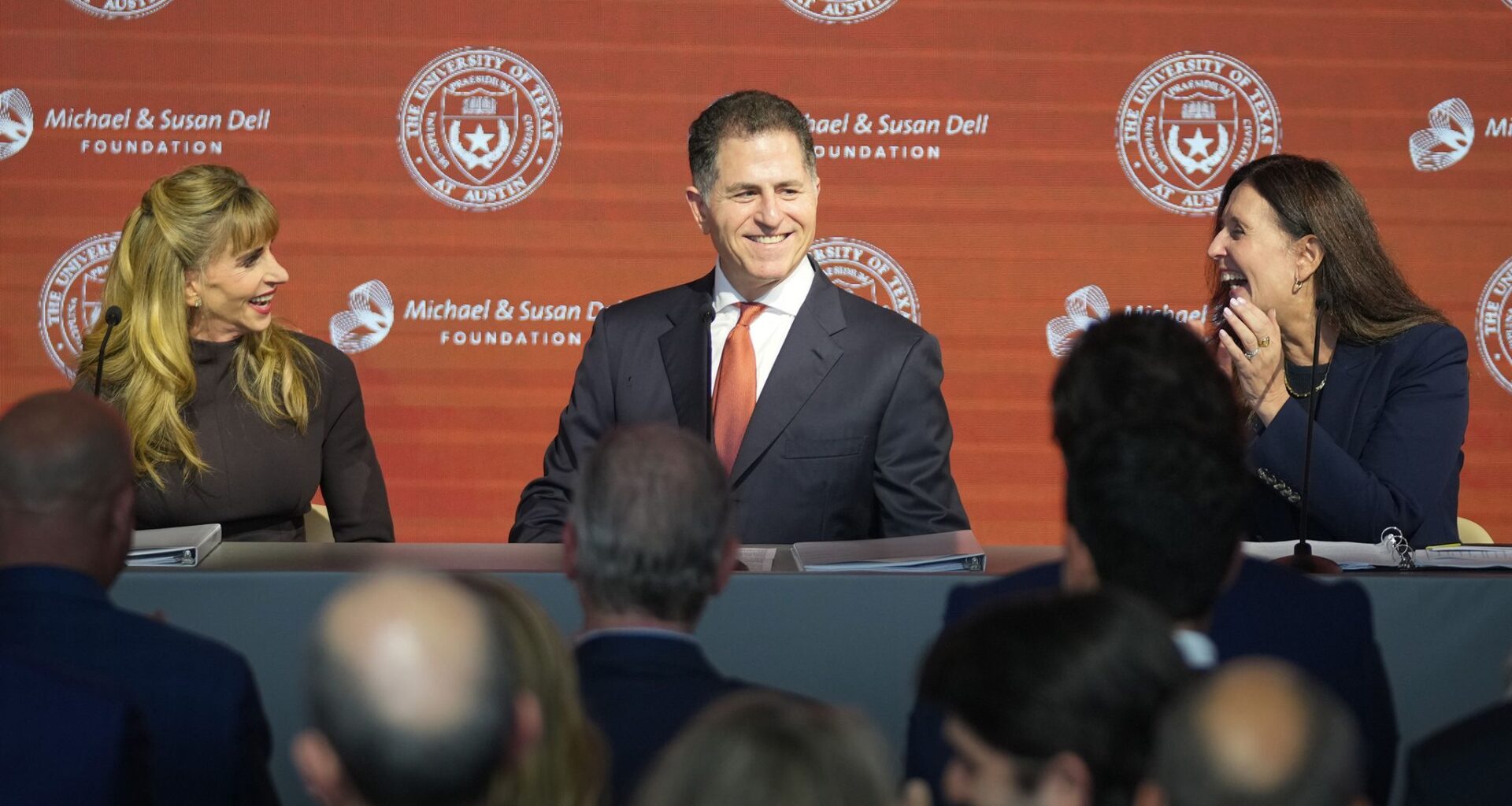
Michael and Susan Dell, left, announce a gift at an event at the West Pickle Research Campus in Austin on Tuesday, April 21, 2026. The Michael and Susan Dell Foundation is giving the University of Texas more than $750 million to build the UT Dell Campus for Advanced Research and the UT Dell Medical Center on the university’s West Pickle Research Campus in North Austin. Dr. Claudia Lucchinetti, right, Senior VP for Medical Affairs and Dean, Dell Medical School, applauds.
Jay Janner/Austin American-Statesman
The Dell Foundation’s funding joins a $100 million earlier gift to the hospital project by Tench and Simone Coxe, the owners of Austin FC.
Article continues below this ad
The total cost of the new hospital complex was originally estimated to be $2.5 billion, but that is expected to change as plans for the campus continue to evolve, Lucchinetti said. More fundraising is planned, and Dell expects other major philanthropists to join his foundation.
Tuesday marked the start of the university’s 10-10-10 plan: $10 billion in philanthropy in 10 years to make UT Dell Medical Center a top 10 hospital in the country.
“There are moments in our history where Longhorns have changed the course of our future,” Davis said. “Today is one of those moments.”
The UT Dell Medical Center will become a health care destination, Lucchinetti said, “that will be measured by the impact it makes, the lives it changes and the health discoveries made.”
Article continues below this ad
Building on a legacy of improving health care
The Dells have put their stamp on medical care in Austin in the past 25 years, as early philanthropists behind some major projects that now bear their name:
In 2007, Dell Children’s Medical Center opened to replace the Austin Children’s Hospital.
In 2016, Dell Medical School welcomed its first class.
In 2017, Dell Seton Medical Center at the University of Texas opened as a replacement for Brackenridge Hospital. It is Austin’s only Level 1 trauma center and Dell Medical School’s teaching hospital. That partnership will continue even when this UT Dell Medical Center opens.
In 2023, Dell Children’s North Austin Medical Center opened.
“You can put it on a timeline that goes back to my dorm room 2713, where my parents sent me away to be a doctor,” Michael Dell said. “I never forgot about the assignment.”
Article continues below this ad
“This is really the next step in the whole timeline,” he said of this investment.
His dorm, Dobie Hall, will now be renamed the Dell House by the university, Kevin Eltife, chairman of the UT System, also announced Tuesday.
“Michael Dell and Susan together have educated more doctors and treated more patients than Michael ever could wearing a white coat,” said Texas Gov. Greg Abbott. “Michael didn’t just build a computer, he changed the way people buy computers. Dell Medical is doing the same thing with regard to health care.”
Michael and Susan Dell announce a gift at an event at the West Pickle Research Campus in Austin on Tuesday, April 21, 2026. The Michael and Susan Dell Foundation is giving the University of Texas more than $750 million to build the UT Dell Campus for Advanced Research and the UT Dell Medical Center on the university’s West Pickle Research Campus in North Austin.
Jay Janner/Austin American-Statesman
Building a new medical center
The new UT Dell Medical Center has been reimagined since it was originally announced in 2023 as two hospitals on the former site of the Erwin Center arena.
Article continues below this ad
Instead of two hospitals, one for specialty care and one for the UT MD Anderson Cancer Center, the University of Texas is now building one UT Dell Medical Center with UT MD Anderson integrated into the specialty care hospital.
Thousands of people now travel from Austin to Houston to seek care at MD Anderson, said Dr. Peter Pisters, president of UT MD Anderson. “The need is clear.”
Pisters said the care will be “to the greatest extent possible identical” to the main MD Anderson campus in Houston, “because we are bringing our faculty here.”
In addition to cancer care, UT Dell Medical Center will have complex care unlike what Austin currently has, including multi-organ specialties, advanced cardiology and neurosciences, Lucchinetti said.
Article continues below this ad
Pisters also emphasized the integrated care by multidisciplinary teams that the new hospital will deliver. “This model is not about replicating the past. It’s about reimagining the future,” he said.
The teams have already been collaborating together, Pisters said, especially UT MD Anderson and the Texas Advanced Computing Center, which has been able to advance cancer research.
“Our collective teams have dramatically accelerated cancer research by working together,” Pisters said.
The care will be for everyone in the community, Lucchinetti said, including the safety-net population served by Medicaid or the Medical Assistance Program through Travis County’s hospital district, Central Health.
Article continues below this ad
“You don’t create advanced health care for some,” she said. The project will expand capacity for all to lessen the number of people who are traveling outside of Austin to get specialized care. “It’s important that we don’t create a two-tiered health system.”
More: The highest-paid UT Austin employees of 2025: Search salary data
When the 14-acre Erwin Center site proved to be too small to contain the vision for the new hospital, UT moved the site to the more than 300-acre West Pickle Research Center site. The new medical complex will take up 27 acres of that site to start.
The project’s $2.5 billion cost is still in flux as the plans for the hospital evolve. Some cost savings will be achieved by not having to build down and up on a small footprint site, and by not having to build two of everything for two different hospitals.
Article continues below this ad
UT has not announced what will be built on the Erwin Center site, yet.
At the Braker Lane campus, UT already has started moving dirt for the center’s power plant. Phase one of the hospital is expected to break ground this fall, with the first patients expected to receive care in late 2030. More of the hospital will open in 2031 and 2032. Additional phases can be added as Austin grows.
The initial hospital is expected to open with 300 to 500 beds, which is similar in size to Ascension Seton Medical Center, St. David’s Medical Center and St. David’s North Austin and South Austin campuses. The campus also will have outpatient clinics and research areas.
The medical center is expected to add 200 physicians not currently working in Austin. Dell Medical School already has brought 450 doctors to Austin and trained more than 650 doctors in residencies and fellowships. Each year, another 50 students enter the medical school.
Article continues below this ad
Michael and Susan Dell, second and third from right, announce a gift at an event at the West Pickle Research Campus in Austin on Tuesday, April 21, 2026. The Michael and Susan Dell Foundation is giving the University of Texas more than $750 million to build the UT Dell Campus for Advanced Research and the UT Dell Medical Center on the university’s West Pickle Research Campus in North Austin. Applauding are, left to right, Dr. Peter Pisters, President of UT MD Anderson, UT President Jim Davis, Gov. Greg Abbott, Kevin Eltife, Chairman of the UT System, and Dr. Claudia Lucchinetti, Senior VP for Medical Affairs and Dean of the Dell Medical School.
Jay Janner/Austin American-Statesman
A completely different hospital
The hospital will be different than any other university medical center, Lucchinetti said. “When you do not have legacy constraints, you have an opportunity for leapfrog advancements.”
“You get to build a health system around the patient,” she said.
Article continues below this ad
This medical center will be designed with technology and artificial intelligence embedded thoughtfully into the design, she said. The artificial intelligence will not be obvious to the patient. “It is behind the scenes, helping us anticipate disease sooner, identify a problem sooner,” Lucchinetti said.
On both the clinical side and the research side, Austin is poised to be a leader in innovation, Michael Dell said. “We have an opportunity in Austin to take all the best of the learnings and link them to computer science and the Texas Advanced Computing Center, to really drive the next innovations and inventions, to make Central Texas one of the places where that’s happening,” he said.
The artificial intelligence is not replacing doctors or nurses, but it will allow them to use tools to focus more on preventive medicine, such as predicting a patient’s fall before it happens or anticipating which patients are vulnerable to sepsis. AI will help doctors intervene in heart disease as it starts before it leads to a hospitalization.
Article continues below this ad
The technology will free doctors and nurses to be more present with their patients, building a connection, instead of spending hours charting patient procedures. That will help lessen doctor and nurse burnout, Lucchinetti said.
For families, the integration of multiple specialties in one place should make the experience easier and less fragmented as it is now. “Families can stop being the project manager,” Lucchinetti said. “They can focus on the person they love.”