
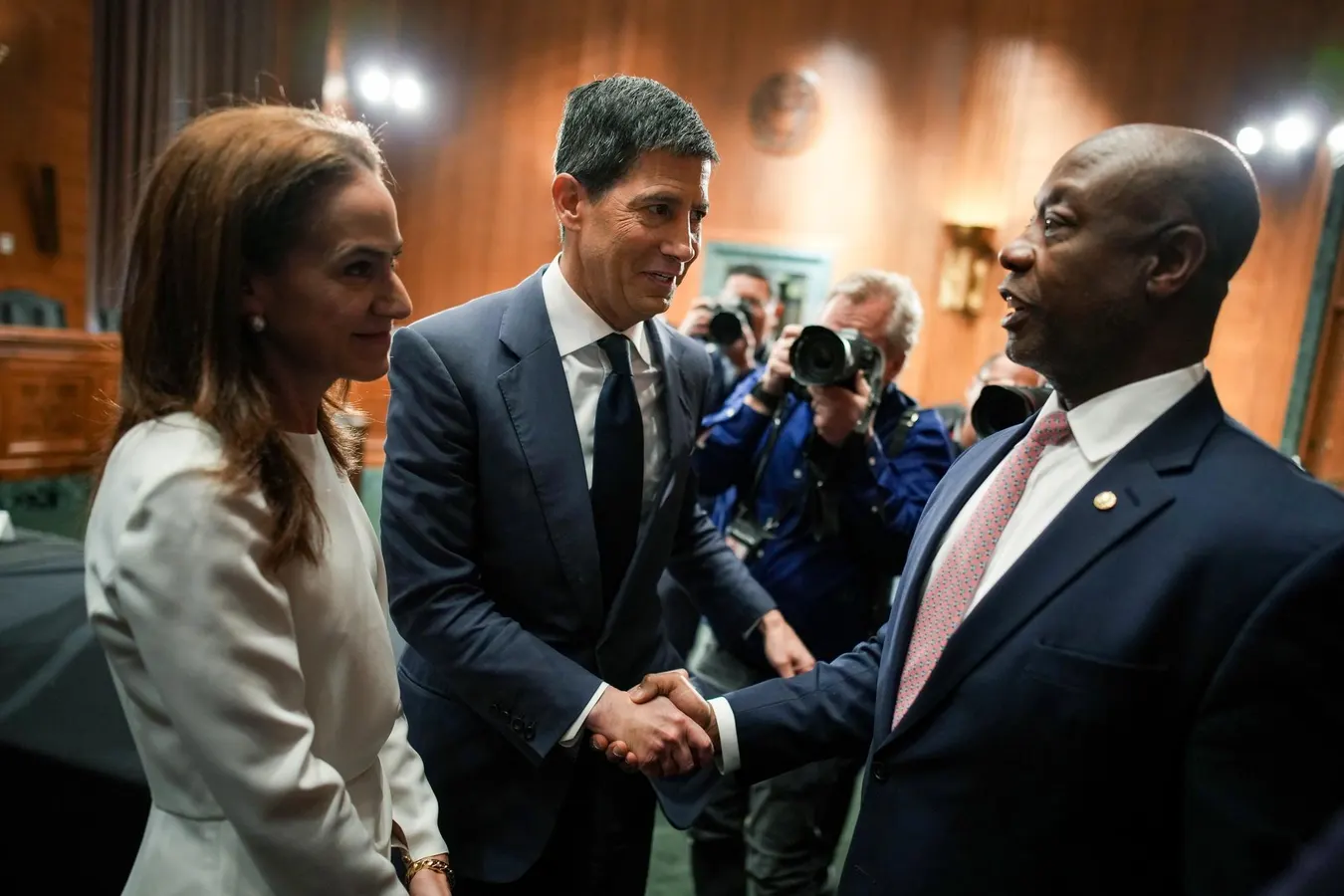
Kevin Warsh (center), President Donald Trump’s nominee for Chair of the Federal Reserve, and his wife Jane Lauder (left) greeting Senate Committee on Banking, Housing, and Urban Affairs Chairman Senator Tim Scott at Warsh’s confirmation hearing on April 21, 2026 in Washington, DC.
Getty Images
Kevin Warsh, President Donald Trump’s pick for Federal Reserve chair, faced the Senate Banking Committee at a confirmation hearing Tuesday morning. While he addressed Senate Democrats’ concerns over Fed independence and pressure from the president, Warsh largely avoided discussing details about his fortune.
Senator Elizabeth Warren had already taken particular issue with Warsh’s vague financial disclosure. In addition to accusing Warsh of mishandling the 2008 financial crisis while he was a Fed governor from 2006 to 2011 and calling him “[President Trump’s] chosen sock puppet,” Warren criticized Warsh’s disclosure for its “failure to disclose the full extent of his assets,” which in turn poses immediate issues. “One or more of his dozens of funds and entities could hold stock in a prohibited financial institution, and the public would never know,” stated an April 15 report by Warren’s Senate Committee on Banking, Housing and Urban Affairs.
At yesterday’s hearing, Warren continued to press Warsh—whose father-in-law is Trump’s billionaire pal Ronald Lauder—asking whether his Juggernaut Fund L.P. invested in Chinese-controlled firms or any companies affiliated with President Trump and his family or with Jeffrey Epstein. Warsh simply responded that “those assets will be sold” if he’s confirmed. In his financial disclosure filed on April 10, he had written that the assets weren’t disclosed “due to pre-existing confidentiality agreements.”
He certainly hasn’t been forthcoming when it comes to his personal finances. In his disclosure, Warsh revealed assets for himself ranging from $135 million to more than $226 million and another $56 million to more than $95 million for his wife, Estee Lauder heir Jane Lauder, who worked at the cosmetics giant for nearly three decades and still sits on the board. Forbes estimates her net worth at $2 billion, three-fourths of which comes from her stake in Estee Lauder, which her grandmother founded in 1946. Even without her fortune, Warsh’s holdings dwarf those of the current Fed chair Jerome Powell, who disclosed assets between $19 million and $75 million last year.
Most Federal Reserve chairs have been economists or bankers, with some notable exceptions including industrial conglomerate heir Marriner Eccles (chair from 1934-48), paper company executive Thomas McCabe (1948-51), former New York Stock Exchange president William McChesney Martin (1951-70), former Textron CEO William Miller (1978-79) and Powell himself, who was a partner at private equity titan Carlyle Group from 1997 to 2005.
Much of Warsh’s fortune seems wrapped up in his work as a partner in the family office of billionaire hedge funder Stanley Druckenmiller, who Warsh mentioned in his opening statement yesterday, calling him “one of the most successful investors of our time” and “a patriot.” (Druckenmiller is also a former boss of Treasury Secretary Scott Bessent.)
Warsh’s two largest assets —both named Juggernaut Fund, LP and each valued at more than $50 million apiece—are part of Duquesne Family Office, Druckenmiller’s firm where Warsh has worked since 2011; it’s not clear though what the funds hold. He also lists a total of $250,001 to $500,000 in dozens of startups and private companies, from software giant Databricks and AI data center developer Crusoe to prediction market platform Polymarket (on whose advisory board Don Jr. sits) and Elon Musk’s SpaceX (expected to go public in the biggest IPO ever in June). It’s not stated anywhere whether the disclosed range represents the value of these stakes at the time of investment or their current value.
Many of these investments—including all of the above, plus stakes in several crypto firms—are held through DCM Investments 10, per the disclosure. That too is associated with Druckenmiller’s office, and invested in funds that appear to be managed by Abstract Ventures, a San Francisco-based venture capital firm with $1.8 billion in assets under management.
Warsh lists 72 entities called THSDFS LLC—again, all associated with Druckenmiller—but only mentions one investment, in blockchain travel platform TravelXChange. A search of Securities and Exchange Commission filings uncovered additional holdings by those LLCs in fintech firms Affirm and Chime, diagnostics outfit Veracyte and ticket marketplace StubHub, among others. Warsh also listed liabilities ranging from $3 million to $12 million including capital commitments to eight of those THSDFS firms.
Some of the more interesting details of the disclosure are the clues to Warsh and his wife’s properties: a $12 million, 4-bedroom home in Palm Beach (held in his name), an $8 million penthouse in Manhattan’s NoLiTa neighborhood (held in hers), four adjacent properties in East Hampton worth a combined $18 million (hers) and a stake in two thoroughbred horse racing operations—Vicarage Stable and Jump Sucker Stable (his). Lauder’s assets in the disclosure also include an entity holding artwork, valued at more than $1 million, plus undeveloped land in New York’s Suffolk County valued between $5 million and $25 million.
Unlike Lauder, Warsh doesn’t come from a billionaire family. Born in Albany, New York to a father who made school uniforms and a journalist mother, Warsh graduated with a bachelor’s in public policy from Stanford in 1992 and went to law school at Harvard. He joined Morgan Stanley’s mergers and acquisitions department in 1995 and left the firm to join the George W. Bush administration in 2002 as a special assistant to the president for economic policy—the same year he and Jane Lauder, who also went to Stanford, married. A few years after that, he was nominated to the Federal Reserve Board of Governors in 2006.
In the two decades since, Warsh joined the boards of logistics giant UPS and South Korean online retailer Coupang. He also worked as a consultant for Deputy Defense Secretary Stephen Feinberg’s private equity firm Cerberus Capital Management.
Those consulting gigs and board memberships have been lucrative. Besides his assets, his disclosure also listed income ranging from $6.3 million to $11.4 million in 2025 through the date of his disclosure in April. That included $10.2 million in consulting fees from Druckenmiller’s Duquesne and $750,000 from Feinberg’s Cerberus, as well as speaking fees from companies including Brazilian bank BTG Pactual, pharma giant Eli Lilly and private equity firms TPG and Warburg Pincus. According to SEC filings, his shares in UPS and Coupang are worth $3 million and $9 million, respectively.
This isn’t the first time Warsh has been close to becoming Fed chair. Trump briefly considered Warsh for the position in 2017 before ultimately picking Powell—a decision the president has said he regrets. If Warsh is confirmed, all of those moneymaking opportunities and investments will come to a crashing halt: He committed in his ethics agreement to resigning from his board and consulting positions and divesting from most of his investments, including those with Druckenmiller and the Abstract funds, within 90 days of his confirmation.
That could prove to be a bad bet if one of those investments—SpaceX—goes public at a stratospheric $2 trillion valuation after those 90 days are up. Either way, Jane and the Lauders ought to be able to bail Warsh out.