
Researchers have found that a swirling water vortex can force opposing waves to form rotating lines of stillness across an entire tank.
That result turns a famously hard-to-see quantum effect into something scientists can watch directly and test in plain sight.
Waves made visible

Inside a custom water tank, ripples arriving from opposite sides met a central whirlpool and carved flat tracks across the surface.
At Okinawa Institute of Science and Technology Graduate University (OIST), doctoral student Aditya Singh linked those tracks to the broader wave behavior the team set out to understand.
Instead of collapsing into an ordinary standing pattern, the surface locked into rotating bands that stretched far beyond the vortex itself.
That wider reach made the finding more than a visual curiosity and set up the deeper question of how water could expose a hidden quantum rule.
The quantum effect
The pattern echoed the Aharonov-Bohm effect, a quantum effect where electrons react to hidden magnetism without direct contact.
In 1959, Yakir Aharonov and David Bohm argued that particles could change their wave timing without entering a magnetic field.
More than 20 years later, electron experiments confirmed the effect, but scientists still inferred altered waves indirectly.
Water cannot act like electrons in every way, but it can display hidden wave changes openly in a room.
Copying quantum behavior
Michael Berry proposed the water-wave analog in 1980, replacing the hidden magnet with a draining vortex – a rotating whirlpool.
As ripples passed around that swirl, moving water near the drain slightly changed their timing and bent their crests.
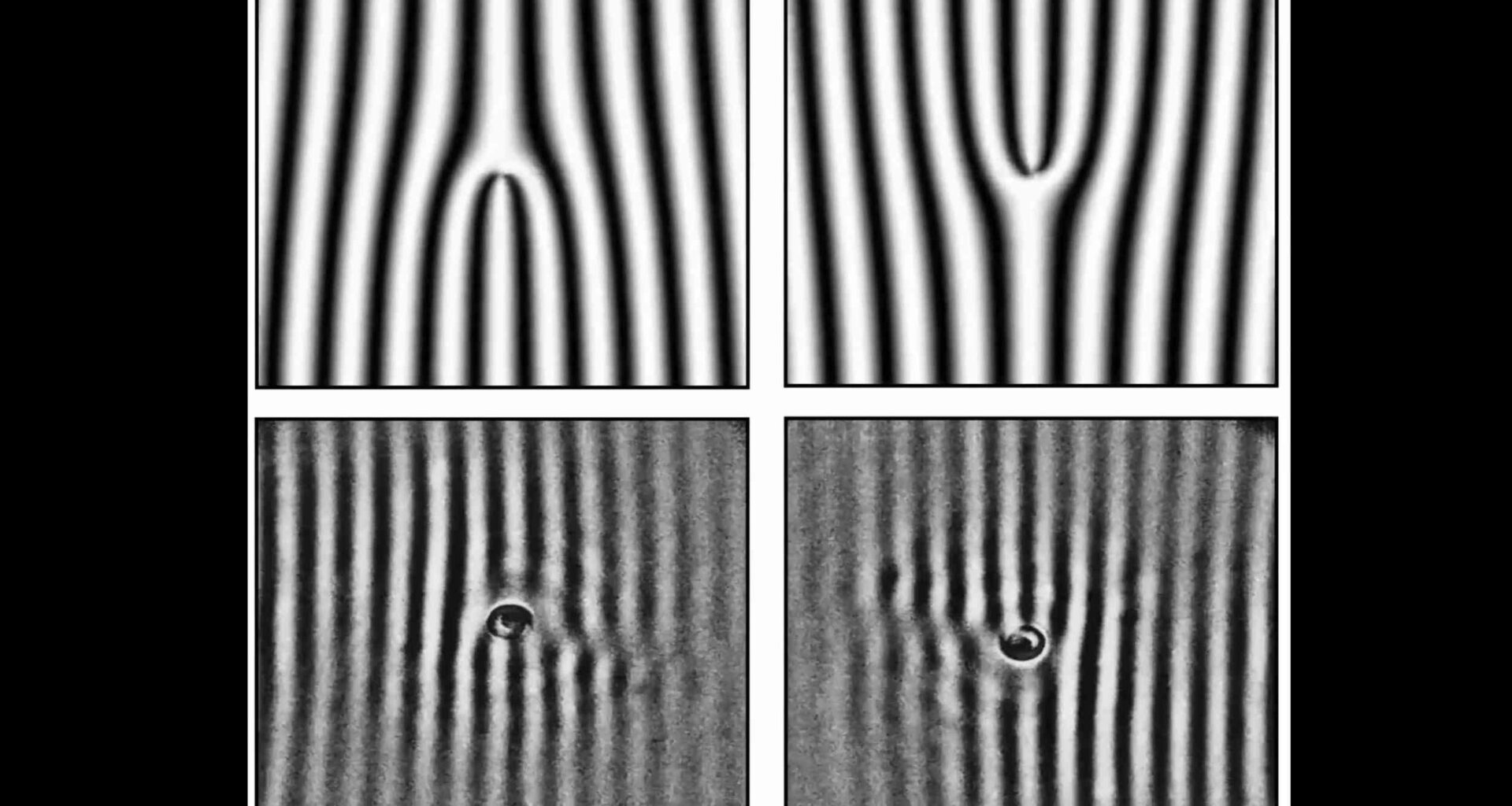
Single-direction waves made a pitchfork-shaped distortion, which flipped when the waves crossed from the opposite side in the tank.
Singh’s team tested the harder case, sending matched waves from both sides to meet at once inside OIST’s apparatus.
Wave interaction effects
Against expectation, the two wave trains did not erase the old distortion or show two simple copies near the center.
Their crests and troughs interfered, so some paths canceled perfectly and formed nodal lines, bands where wave height stayed zero.
Those lines reached away from the vortex instead of staying near its center, making the response system-wide and easier to see.
This result stood out because earlier water versions mostly exposed wave changes close to the swirling core, not across the tank.
Counting wave lines
As OIST researchers increased the vortex flow, the tank produced one line, then two, in repeatable and measurable steps.
That count was quantized, forced into whole-number steps, even though the water flow itself changed smoothly during the experiment.
When flow did not match a whole-number setting, line counts alternated as the pattern turned over time.
Such behavior gives the tank a simple dial for probing features that quantum experiments struggle to isolate cleanly.
Rotating wave behavior
Rotation added another surprise: the still lines always turned opposite the swirl that created them in the water.
In the equations, each passing wave carried a winding mark from the vortex, and opposing waves combined those marks.
Physicists call that topology, pattern behavior that survives local disturbance, because the whole surface must stay consistent.
Once one crest appeared or vanished at the core, nearby crests bent to keep the pattern joined.
Limits of the model
OIST’s tank showed the effect clearly, but it did not become a miniature quantum machine or perfect copy.
Water has viscosity, meaning internal friction, so distant nodal lines fade as the surface loses energy to motion.
Electrons also differ because quantum phases repeat in fixed flux units, while vortex strength can vary continuously in water.
That mismatch limits the comparison, yet it also lets researchers sweep through many wave settings.
What analogs reveal
Simple analogs earn their keep when they make hidden structures visible without pretending to replace the original system.
Here, cameras showed the full surface at once, while simulations checked the lines electron experiments would hide.
“But when we also saw them in our simulations, we dropped everything and quickly worked out the mathematics underlying how they arise,” Singh said.
Seeing and calculating the same pattern made the water result harder to dismiss as a lab accident.
Next experiments beckon
More complex tanks could place several vortices in a grid, forcing waves to choose many looping paths.
Such a setup could mimic superconductors, materials that carry current without resistance, where many vortices shape collective flow.
Researchers also see possible lessons for engineered light, sound, and quantum materials that depend on wave control.
Any useful technology remains distant, but the tank now offers a low-cost way to find surprises first.
Why it matters
A famous quantum puzzle, a water vortex, and a set of rotating quiet lines now point to the same lesson.
When scientists make hidden wave rules visible, they gain a safer way to test ideas before harder experiments.
The study is published in Communications Physics.
—–
Like what you read? Subscribe to our newsletter for engaging articles, exclusive content, and the latest updates.
Check us out on EarthSnap, a free app brought to you by Eric Ralls and Earth.com.
—–