
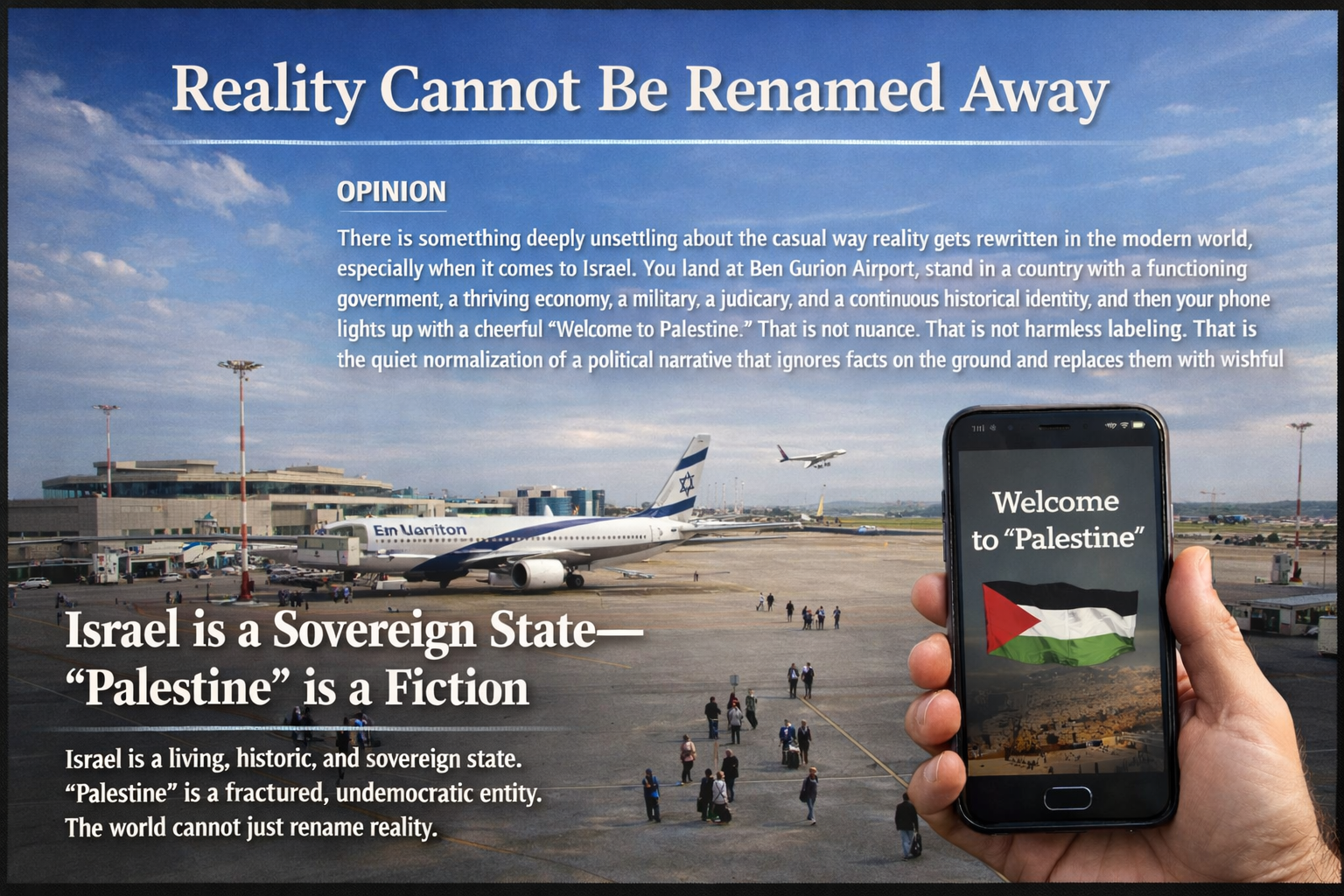
There is something deeply unsettling about the casual way reality gets rewritten in the modern world, especially when it comes to Israel. You land at Ben Gurion Airport, stand in a country with a functioning government, a thriving economy, a military, a judiciary, and a continuous historical identity, and then your phone lights up with a cheerful “Welcome to Palestine.” That is not nuance. That is not harmless labeling. That is the quiet normalization of a political narrative that ignores facts on the ground and replaces them with wishful thinking.
Let’s be blunt. Israel is not a theoretical construct. It is not a debated concept. It is a sovereign state with defined institutions, recognized borders, and a capital in Jerusalem that it governs in practice. It has existed as a modern state since 1948, and its historical roots go back thousands of years. The language spoken there is Hebrew, revived and sustained as a living language. The culture is unmistakably Israeli, shaped by Jewish history, tradition, and continuity. These are not abstract claims. They are observable realities.
Now contrast that with what is being labeled “Palestine” in these automated systems. What exists is not a unified, sovereign state with full control over its territory. It is a fragmented political entity with competing leadership, divided governance, and borders that are claimed but not fully controlled. Judea&Samaria operates under a patchwork of jurisdictions. Gaza is governed separately under entirely different leadership. There have been no national elections in nearly two decades. This is not what a functioning, sovereign state looks like in practice.
And yet, despite this, global systems increasingly present “Palestine” as if it were equivalent to Israel. That is where the frustration comes from. Not from denying complexity, but from watching complexity get flattened into a one sided narrative. Recognition by some countries or observer status at international institutions does not magically create any level of sovereignty, stability, or legitimacy that Israel demonstrably possesses on the ground.
There is also a deeper issue here about historical continuity. The land of Israel has had a continuous Jewish presence for millennia. Jerusalem has been central to Jewish identity, religion, and history long before modern political movements existed. To suggest that this identity can simply be overwritten or reframed because of contemporary political pressures is not just inaccurate, it is intellectually dishonest.
At the same time, acknowledging Israel’s legitimacy does not require denying that there are some disputes over land, governance, and rights. But there is a difference between engaging with a complex conflict and pretending that reality is something it is not. Declaring something into existence through terminology does not make it functionally real.
The “chicken versus horse” analogy, while blunt, captures a frustration many people feel. If something operates as a sovereign state, looks like one, and is recognized and functioning as one, then calling it something else does not change that reality. Conversely, if something does not meet those criteria in practice, labeling it as equivalent does not elevate it to that status.
What is particularly troubling is how this narrative seeps into everyday technology. Phones, apps, and automated systems are not neutral when they embed geopolitical assumptions into their outputs. These systems rely on databases built by organizations that make editorial choices, and those choices reflect prevailing political trends rather than strictly observable facts. When millions of people see the same labels repeated, it subtly shapes perception, often without them even realizing it.
This is not about denying anyone’s aspirations. It is about insisting that language reflects reality rather than distorting it. Israel is a sovereign state with a clear national identity, functioning institutions, and historical continuity. That is not up for debate simply because it is politically inconvenient to some.
The world does not get to redefine a country out of existence by relabeling it in software or diplomatic language. Reality on the ground matters. Governance matters. History matters. And if we lose sight of that, then we are no longer dealing with facts. We are dealing with narratives imposed on top of facts, hoping that repetition will eventually make them stick.
It will not. Reality has a way of asserting itself, no matter how many times it is rebranded.
CEO of Time to Stand Up for Israel, a nonprofit organization with a powerful mission: to support Israel and amplify its voice around the world. With over 200,000 followers across various social media platforms, our community is united by a shared love for Israel and a deep commitment to her future.
My journey as an advocate for Israel began early. When I was 11 years old, my father was deployed to the Middle East through his work with UNTSO. I had the unique experience of living in both Syria and Israel, and from a young age, I witnessed firsthand the contrast in cultures and realities. That experience shaped me profoundly.
Returning to the Netherlands, I quickly became aware of the growing wave of anti-Israel sentiment — and I knew I had to speak out. Ever since, I’ve been a fierce and unapologetic supporter of Israel. I’m not religious, but my belief is clear and unwavering: Israel has the right to exist, and Israel has the duty to defend herself.
My passion is rooted in truth, love, and justice. I’m a true Zionist at heart.
From my first breath to my last, I will stand up for Israel.