

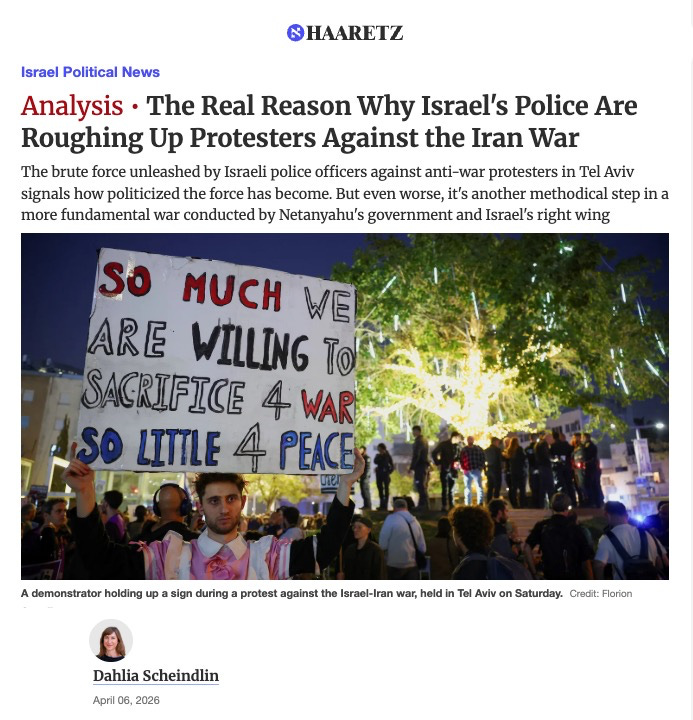
 Haaretz.com screenshot (edited)
The protests against Israel’s present war have not been nearly as enormous as the protests against Judicial Reform, because — among other reasons — the war is still widely supported. But there are, of course, people opposed to the war, as they have every right to be, and some of them are protesting against the war, which is also their right.
But if you follow the daily press here closely, you can’t help but notice the reports of police force being used against protesters, often when it’s not entirely clear why. Is this a command from Itamar Ben-Gvir at the top, because he doesn’t like protesters, or is there something more insidious at play?
That depends on who one asks. But as we hear in today’s conversation, some longtime observers of Israeli society believe that the problem is deeper — and more troubling — than “merely” Ben Gvir. Dahlia Scheindlin is among those people, and today, in light of the piece above that she wrote for Ha-Aretz, we hear her explain her thesis in greater detail.

A few weeks ago, we posted a conversation with Yonatan Green, the author of Rogue Justice: The Rise of Judicial Supremacy in Israel, in which he shared his rather strong views of Israel’s “Basic Laws,” how they are created and the role that they play. If you listened to Green, think about how different is Dahlia Scheindlin’s view of those Basic Laws. Israel’s unresolved constitutional issues, as we can tease out from the two speakers, color much more about Israeli society and its divisions than we might think.

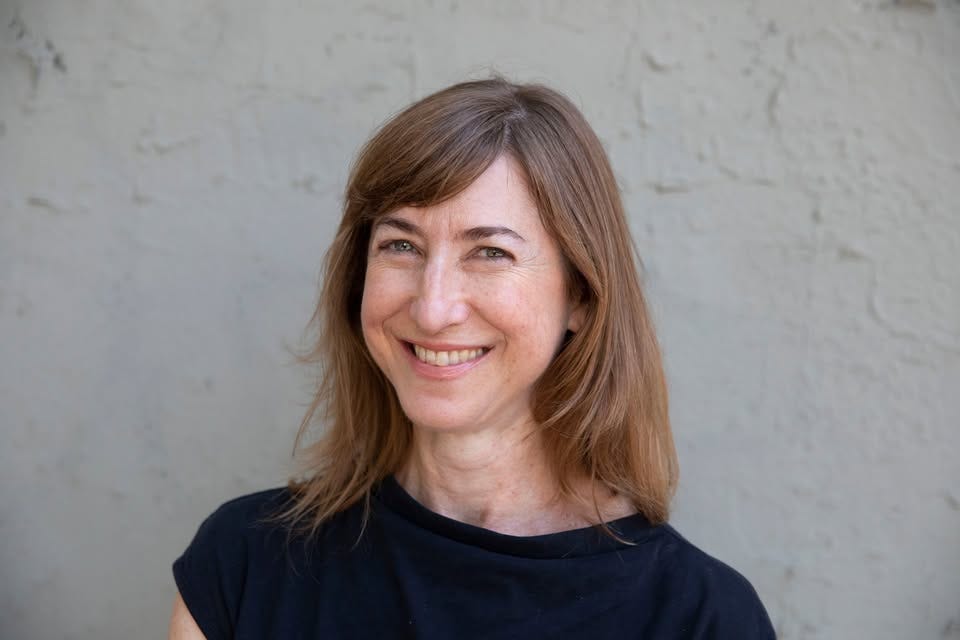
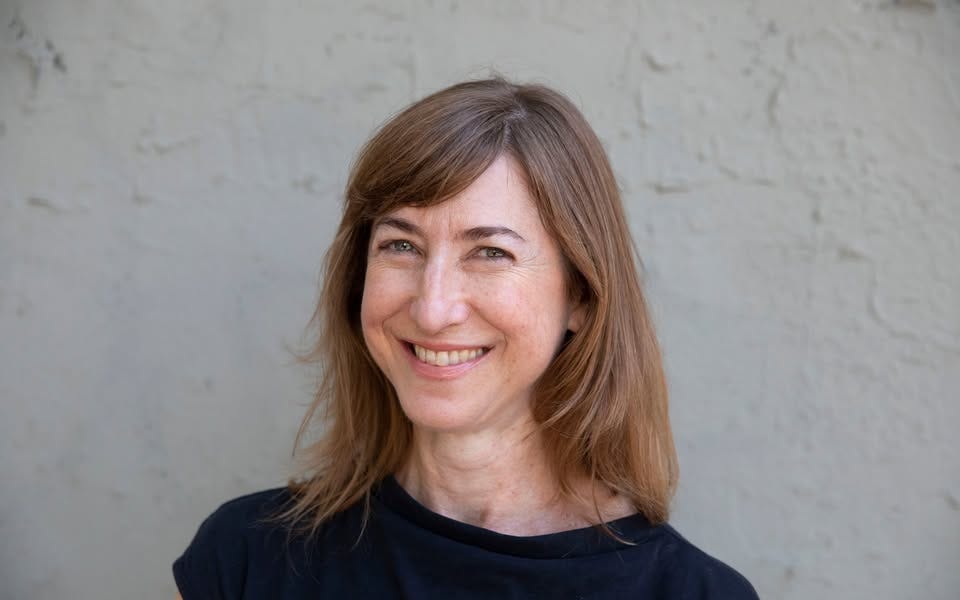
Dr. Dahlia Scheindlin is a political strategist and a public opinion researcher who has advised on nine national campaigns in Israel and worked on elections, referendums, and public affairs campaigns in 15 other countries for over 25 years. In addition to Israel, she has regional expertise in the Balkans and Eastern Europe, the South Caucasus and Cyprus.
Dahlia conducts extensive public opinion research for civil society organizations, including joint Israeli-Palestinian surveys. She holds a PhD in political science from Tel Aviv University and a master’s degree from Harvard Divinity School. Dahlia is a regular columnist for Haaretz (English) and a policy fellow at Century International. Her writing has appeared in the New York Times, The Guardian and The Observer, Foreign Affairs, Foreign Policy, Financial Times, The New York Review of Books, The New Statesman, The New York Post, among other publications.
Her book, The Crooked Timber of Democracy in Israel: Promise Unfulfilled was listed on Foreign Affairs’ Best Books of 2024.
Dahlia is a board member of A Land for All, and has been an academic fellow in programs at Columbia University, Brandeis University, UCLA, and in the fall of 2025 was the Distinguished Middle East Fellow at University of Pennsylvania. Dahlia provides regular commentary for international and Israeli media, appearing regularly on CNN, BBC, NPR, CBC, and is quoted widely in leading print media.

The link at the top of this posting will take free subscribers to an excerpted portion of today’s conversation.
For paid subscribers, the link at the top will take you to the full conversation; below, paid subscribers will also find a transcript for those who prefer to read, as always.