
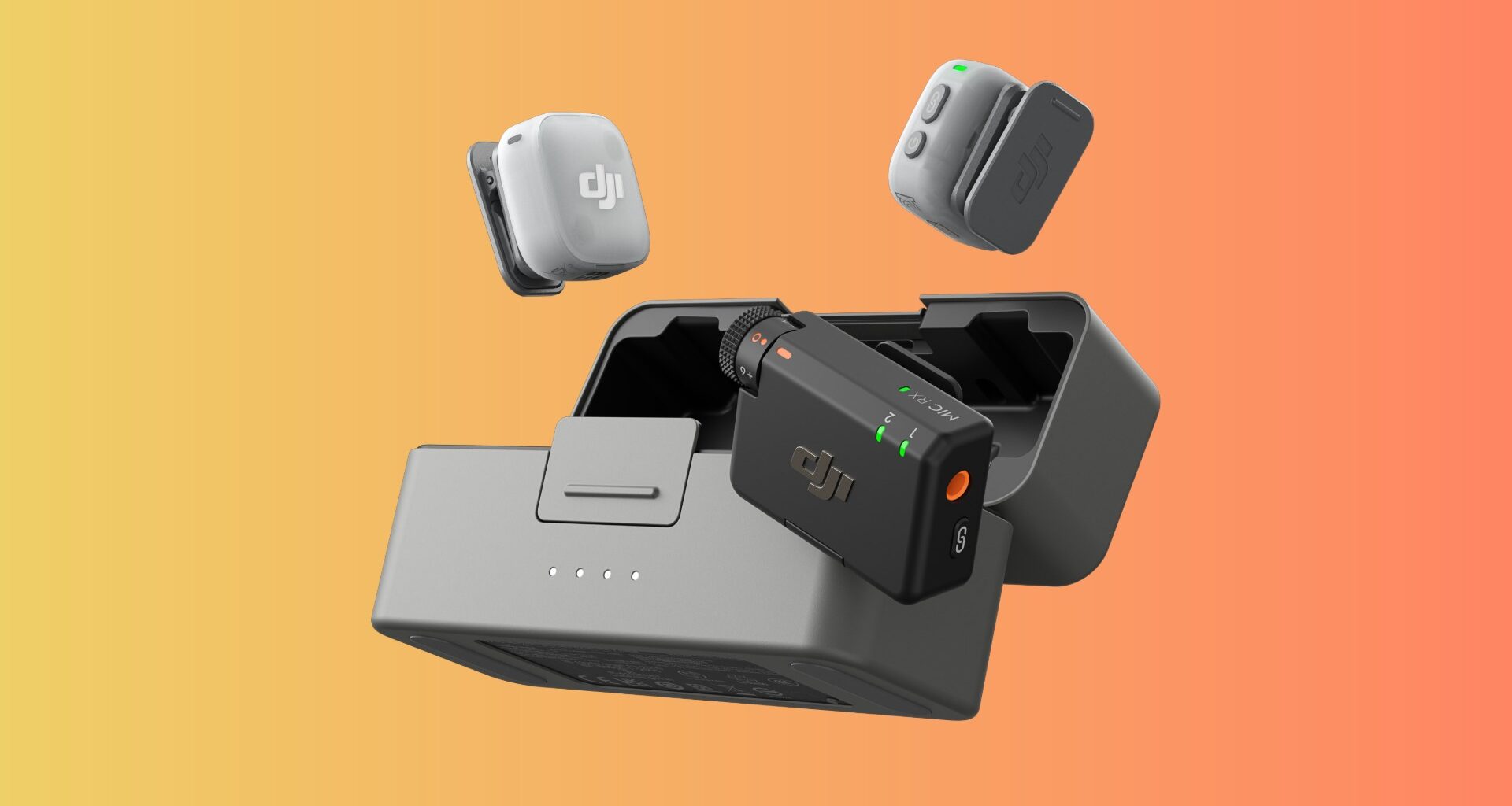

DJI has launched the Mic Mini 2, a second-generation ultra-compact 2.4GHz wireless microphone aimed at vloggers and run-and-gun shooters. The 11-gram transmitter brings three voice tone presets, two-level active noise cancellation, automatic limiting, and 48kHz 24-bit audio, alongside cross-generation compatibility that lets the new transmitters and the existing Mic Series Mobile Receiver mix with DJI Mic 2, Mic 3, and the original Mic Mini in a single setup. The new system starts at 89 GBP / 89 EUR in Europe and the UK, but it will not be available in the United States at launch.
Just over a year after the original DJI Mic Mini arrived as DJI’s lightweight answer to creators who found the Mic 2 overkill, the company is back with a refresh. The Mic Mini 2 keeps the format intact (tiny clip-on transmitter, tiny receiver, charging case) but layers on the audio-processing tricks that arrived with the DJI Mic 3 earlier in the cycle, plus a cross-product compatibility story that finally makes DJI’s growing microphone portfolio behave like a proper ecosystem.
 Charging Cae-topview-opening with Camera RX. Credit: DJIA familiar form factor with a few grams added
The Mic Mini 2 transmitter weighs approximately 11 grams (excluding the magnetic clip and magnet) and measures 28.58 x 28.04 x 13.52mm / 1.13 x 1.10 x 0.53in. That is one gram more than the original Mic Mini, but the trade-off is the new magnetic front cover system. The transmitter ships with two interchangeable covers in Obsidian Black and Glaze White, with eight additional multi-color covers sold separately. DJI has also commissioned illustrator Victo Ngai to design a four-piece “Time Series” set (Dawn, Surge, Blaze, and Glimmer), which will be available as a separate accessory.
 Victo Ngai’s four-piece “Time Series”. Credit: DJI
The detachable magnetic clip can be rotated, allowing you to keep the capsule pointed at the source whether the transmitter is clipped to a lapel, an inverted collar, or a strap. The magnet attachment, carried over from the Mic 3 ecosystem, lets you fix the unit through fabric without leaving a clip visible. A windscreen ships in the box.
Inside, the omnidirectional capsule covers a frequency range of 20Hz to 20kHz (with a low-cut filter that shifts the response to 100Hz when activated), handles up to 120dB SPL, and has an equivalent self-noise of 24dBA. Audio is captured at 48kHz, 24-bit, with five-level gain adjustment and dual-track recording (a -6dB safety track) available through the DJI Mimo app. There is no 32-bit float recording on board, and there is no internal recording on the transmitter itself, both of which remain reserved for the larger Mic 2 and Mic 3 systems.
 DJI Mic Mini 2 additional multi-color covers sold separately. Credit: DJIThree voice tone presets and two-stage noise cancellation
This is where the Mic Mini 2 inherits the DSP playbook of its bigger siblings. Three voice tone presets are now available: Regular (the default, intended for neutral capture), Bright (which lifts the high frequencies), and Rich (which adds low-end weight). The presets are selected through the Mimo app and are essentially a shortcut for users who would otherwise reach for an EQ in post.
Two-level active noise cancellation is also new for the Mini line. Basic mode is intended for indoor reverb, fan hum, and air-conditioning rumble, while Strong mode targets noisier outdoor environments. Noise cancellation is off by default and can be toggled in the Mimo app, on the Mic Series Mobile Receiver via a dedicated switch, or directly on the host device when paired through OsmoAudio (more on that below). When the transmitter is connected to a phone over Bluetooth, however, the noise reduction defaults to Strong and cannot be adjusted.
Automatic limiting is enabled by default and aims to prevent clipping when sound levels spike unexpectedly, which is the kind of feature that earns its keep on a creator-tier microphone where there is rarely a chance to re-record. The limiter can be turned off in the Mimo app when the transmitter is paired with one of the DJI receivers, but it cannot be disabled when the TX is connected to a phone via Bluetooth.
A receiver lineup that finally talks to itself
The most interesting part of the announcement is not the new transmitter; it is what it can connect to. DJI is pushing two receiver options for the Mic Mini 2.
The DJI Mic Mini Receiver (the camera-bound unit that ships with the 2 TX + 1 RX kit) accepts up to two transmitters at once and supports mixed pairing between original Mic Mini and Mic Mini 2 transmitters, with a stated transmission range of up to 400 meters / 1,312 feet in open conditions. It weighs around 17.8 grams and measures 46.50 x 29.61 x 19.32mm / 1.83 x 1.17 x 0.76in.
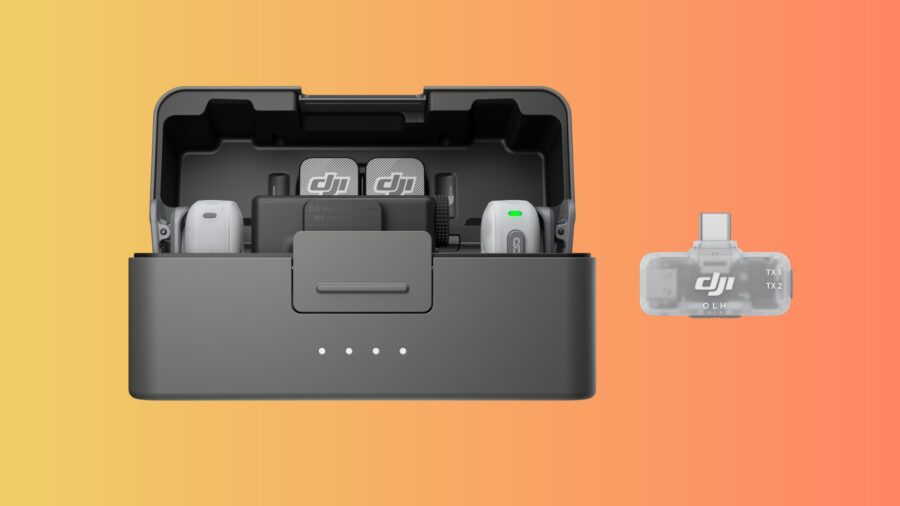
The DJI Mic Series Mobile Receiver (a 6.5-gram USB-C dongle for smartphones) is the more interesting piece. Operating in what DJI calls “green light mode,” it supports two Mic Mini or Mic Mini 2 transmitters at up to 300 meters / 984 feet. Switched into “blue light mode,” it accepts any two transmitters from the Mic Mini, Mic Mini 2, Mic 2, or Mic 3 line, with the trade-off being a reduced 200-meter / 656-foot range. For owners who have accumulated a mixed bag of DJI mics, that is a meaningful workflow improvement, particularly for two-person shoots where one might already be wearing a Mic 2 or Mic 3 transmitter.
In all cases, the audio is delivered to the phone at 48kHz 24-bit through USB-C, which is significantly cleaner than the 16kHz Bluetooth pipeline that creators have historically relied on when shooting straight to a phone.
OsmoAudio Direct Connection now spans the full Osmo lineup
DJI’s OsmoAudio Direct Connection feature lets the Mic Mini 2 transmitter pair directly with select DJI cameras over Bluetooth at 48kHz 24-bit, without using a receiver. Compatible devices include the Osmo Pocket 3, Osmo Action 6, Osmo Action 5 Pro, Osmo Nano, and Osmo 360, with up to two transmitters supported simultaneously on the Pocket 3, Osmo 360, Nano, and Action 6.
The benefit here is twofold: there is one less device to carry (no receiver, no cable, no adapter), and the audio is sampled at 48kHz instead of the 16kHz that standard Bluetooth peripherals are limited to on most action cameras. Worth noting: when paired through OsmoAudio, transmitter operating time is around seven to eight hours, which is shorter than the receiver-paired figure quoted below.
Battery life and charging cases
DJI quotes approximately 11.5 hours of operating time for the Mic Mini 2 transmitter when paired with the Mic Mini Receiver in a 2 TX + 1 RX configuration with noise cancellation off. The receiver itself runs for around 10.5 hours under the same conditions. The TX charges in roughly 70 minutes, the RX in around 100 minutes, and a 5-minute top-up provides about an hour of operation.

There are now two charging cases. The full-size DJI Mic Mini 2 Charging Case (159.3 grams, 106.30 x 42.50 x 59.20mm / 4.19 x 1.67 x 2.33in, 1,950mAh) holds two transmitters, one receiver, windscreens, magnets, magnetic clips, and the 3.5mm locking audio adapter cable. It can fully recharge a 2 TX + 1 RX kit roughly 3.6 times, which is what DJI translates into the marketing claim of about 48 hours of total runtime.

The smaller DJI Mic Mini 2 Charging Case (1 TX + 1 Mobile RX) is new and aimed squarely at mobile creators. It weighs 71 grams, measures 78.8 x 33.07 x 44.70mm / 3.10 x 1.30 x 1.76in, holds a single transmitter and the Mobile Receiver, and provides about 1.3 charge cycles. Charging time is approximately one hour. Both cases use Bluetooth 5.3 and the GFSK 2Mbps wireless mode for synchronization, and both transmitters automatically enter sleep mode when they lose contact with the receiver, in order to conserve battery.
A Mic Mini 2S is already on the way
Buried in the press materials is a teaser that may matter more than the launch itself for working professionals: DJI confirms that a Mic Mini 2S is coming this summer, aimed at creators who need internal recording and a 4 TX + 1 RX configuration. That is a pointed nod to the Mic 3’s ecosystem (which supports up to four transmitters and eight receivers), and it suggests the “S” variant will fold the on-board recording capability of the larger Mic systems into the Mini form factor. If you are debating whether to jump on the Mini 2 today or wait, that detail is worth filing away.
Pricing, availability, and the US question
The DJI Mic Mini 2 is available now from store.dji.com and authorized retail partners in the following configurations:
DJI Mic Mini 2 (2 TX + 1 RX + Charging Case): 89 EUR DJI Mic Mini 2 (1 TX + 1 Mobile RX + Charging Case): 54 EURDJI Mic Mini 2 Multi-Color Windscreens: 18 EURDJI Mic Mini 2 Multi-Color Magnetic Front Cover: 118 EURDJI Mic Mini 2 Time Series Magnetic Front Cover (Dawn, Surge, Blaze, Glimmer): 36 EUR
DJI has confirmed that the Mic Mini 2 will not be available in the US market at launch, citing pending authorization. This puts the product into the same regulatory limbo as the Osmo Pocket 4 and a growing list of other DJI releases, and it remains an open question when (or whether) US creators will get an official channel to buy. The full feature breakdown and spec sheet are available on the DJI Mic Mini 2 product page.
Is mixed-device compatibility enough reason to upgrade, or are you waiting for the Mic Mini 2S with internal recording? Don’t hesitate to let us know in the comments below!