

JTA — Counterterrorism officials in Buenos Aires are investigating after a Jewish library and a Chabad center in a suburb of the Argentine capital were attacked last week.
On Thursday night, Molotov cocktails thrown at the Israeli Literary Center and Max Nordau Library in La Plata, according to a statement published Friday by the center’s board of directors.
Multiple individuals “threw a blunt object filled with fuel at the front of the library, breaking windows and causing material damage,” the board said, noting that the device did not ignite and no one was injured.
The library, a secular educational center founded in 1912 that promotes Argentine Jewish culture, said it is reinforcing security measures in light of the attack.
On Sunday, the Chabad of La Plata was also attacked, according to DAIA, the Argentine Jewish community group, which condemned both attacks. DAIA, which first reported the Chabad attack, did not describe the nature of the attack beyond reporting no injuries.
Get The Times of Israel’s Daily Edition
by email and never miss our top stories
By signing up, you agree to the terms
“We are deeply concerned about the recurrence and the short timeframe of these incidents,” DAIA said in a statement.
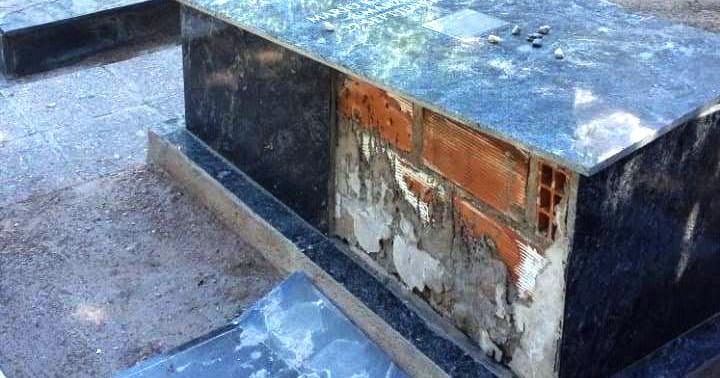
A grave that was vandalized in a Jewish cemetery in San Luis city, in northwest Argentina in February, 2019 (Courtesy/DAIA )
The Ministry of Security of the Province of Buenos Aires and the Complex Crimes and Counterterrorism Unit of the Buenos Aires Provincial Police are investigating both attacks.
La Plata’s Jewish population numbers about 2,000, and its Chabad center has existed for more than 25 years. Argentina as a whole is home to the sixth-largest Jewish community in the world and the largest in Latin America, mostly centered in Buenos Aires.
“These acts of violence threaten democratic coexistence and the values of respect and pluralism that we defend our neighbors,” La Plata Mayor Julio Alak said. “We will not allow hatred and intolerance to have a place in our city.”
Argentina is the site of some of the deadliest attacks on Jewish institutions in modern history. A 1992 bombing of the Israeli Embassy in Buenos Aires killed 29 people, while a 1994 attack on the AMIA Jewish community center left more than 80 people dead.
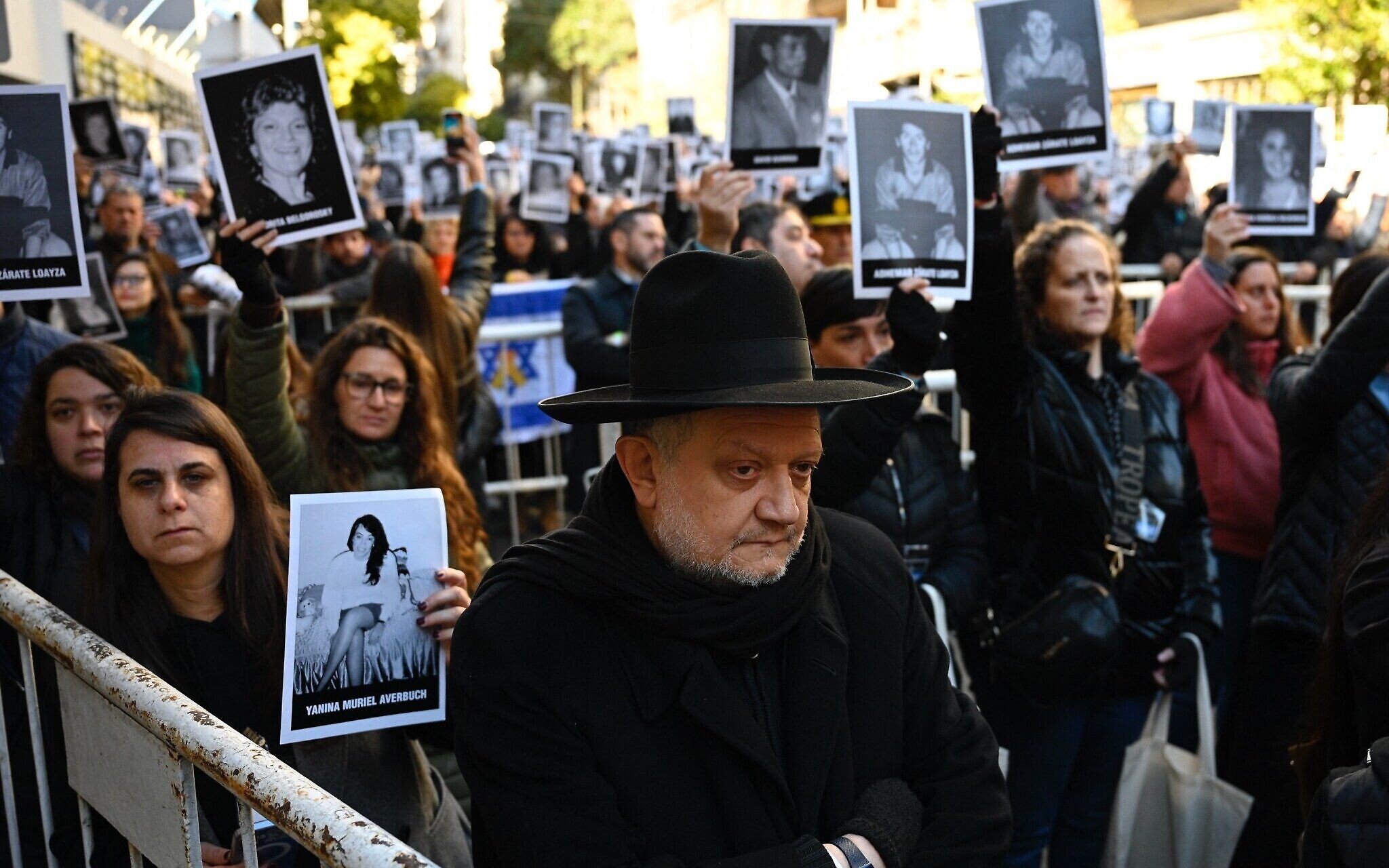
People hold pictures of victims during a ceremony to commemorate the 31st anniversary the AMIA bombing attack which left 85 dead and more than 300 wounded, in Buenos Aires, Argentina, on July 18, 2025. (Luis ROBAYO / AFP)
Argentina’s president, Javier Milei, a pro-Israel economist, has advanced efforts to hold Hezbollah and Iran responsible for their alleged role in the attacks after years of foot-dragging by prior leaders.
The incidents in La Plata come as Jewish institutions around the world are on high alert amid a string of attacks since the start of the US-Israel war on Iran in February. Several synagogues and Israeli outposts in Europe have faced arson attacks that a group seen as tied to Iran have claimed responsibility for staging.
No one has been injured in those attacks.
Argentina has also faced homegrown antisemitism scandals. In September, a video of a group of Buenos Aires high school students on a graduation trip chanting “Today we burn Jews” went viral, earning condemnation from Jewish community advocates and even Milei himself.

Argentine President Javier Milei lights a torch at the 78th Independence Day ceremony, held at Mount Herzl in Jerusalem, on April 21, 2026. (Chaim Goldberg/Flash90)
The group, from the private school Escuela Humanos, was traveling with Escuela ORT, a Jewish school.
Following the attacks in La Plata, comments on a local news outlet’s Instagram post about the attack on the local Chabad on Sunday were filled with antisemitic tropes, including blood libels and false flag theories.
Antisemitism watchdogs say false flag allegations, which claim that attacks against Jews or Israeli targets are actually staged operations meant to garner sympathy for the targets or to cast blame on another party, have flourished in recent years.
Times of Israel staff contributed to this report.
Which gorgeous bird do you prefer?

THIS MONTH ONLY: Join our reader support group for as little as $6/month and receive an exclusive tote bag featuring one of Israel’s native birds.
Choose between the Duchifat (orange), Israel’s national bird, or the Shaldag (blue), a beloved symbol of the Israeli landscape.
As a member of the Times of Israel Community, you’ll also enjoy:
An ad-free experience of our site and podcasts.
Exclusive access to award-winning films via DocuNation.
Weekly letters from founding editor David Horovitz.
Join ToI Community & claim my bag
Already a member? Sign in to stop seeing this
You appreciate our wartime journalism

You clearly find our careful reporting of the Iran war valuable, at a time when facts are often distorted and news coverage often lacks context.
Your support is essential to continue our work. We want to continue delivering the professional journalism you value, even as the demands on our newsroom have grown dramatically during this ongoing conflict.
So today, please consider joining our reader support group, The Times of Israel Community. For as little as $6 a month you’ll become our partners while enjoying The Times of Israel AD-FREE, as well as accessing exclusive content available only to Times of Israel Community members.
Thank you,
David Horovitz, Founding Editor of The Times of Israel