
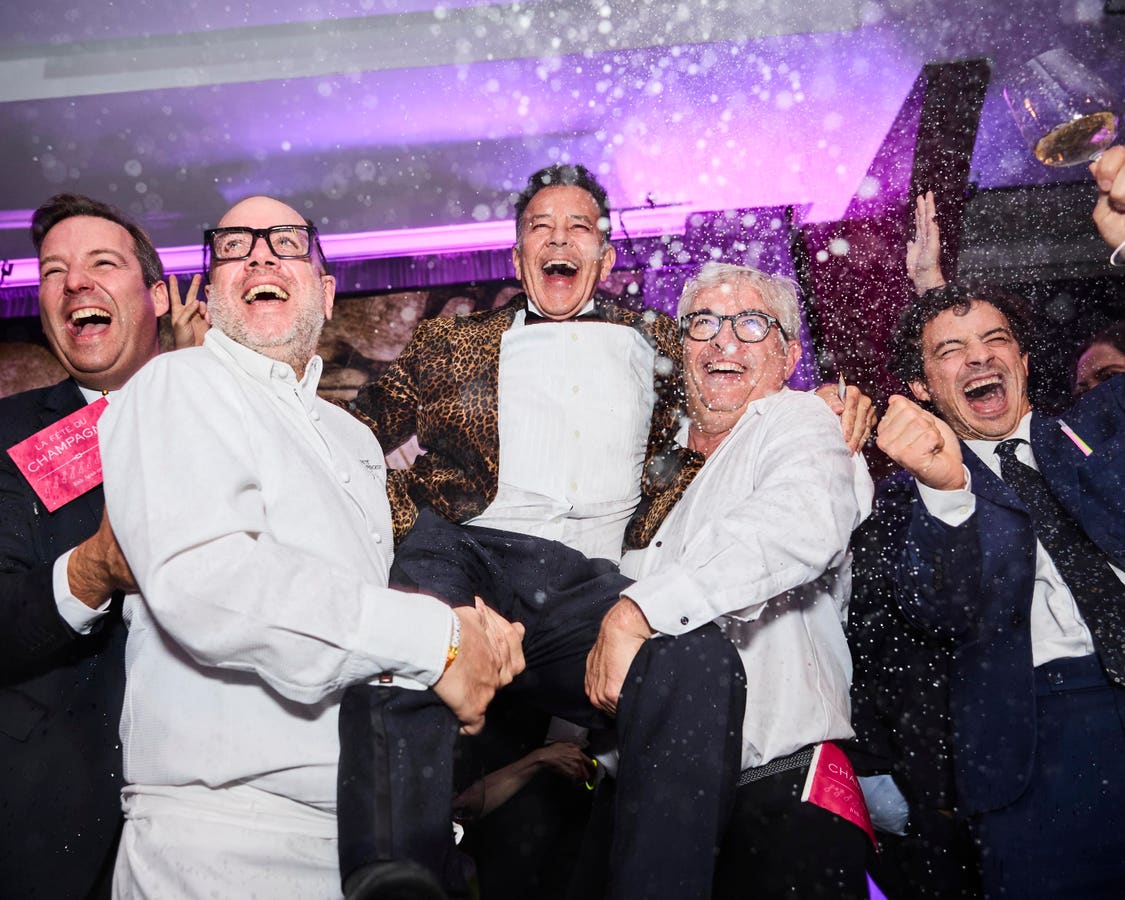
Daniel Johnnes, founder of La Paulée, La Fête du Champagne, La Tablée and Pressoir, is transforming fine wine through immersive events, storytelling and hospitality.
Pressoir Wines
Daniel Johnnes is one of America’s most influential sommeliers and wine-event entrepreneurs, best known as the founder of La Paulée, La Fête du Champagne, La Tablée and Pressoir. Through immersive events built around Burgundy, Champagne, Rhône wines, chefs, sommeliers and producers, Johnnes has helped redefine fine wine as something more joyful, social and accessible.
That matters now more than ever. The wine industry is competing for younger consumers, attention, loyalty and emotional relevance. Johnnes’s answer is not louder marketing or more jargon. It is hospitality. It is storytelling. It is food, music, generosity, education and a room full of people willing to share. At a Daniel Johnnes event, fine wine does not feel like a museum object. It feels alive.
Who Is Daniel Johnnes?
Daniel Johnnes’s love affair with French culture began in 1974, after an 18-hour journey from New York to a small village in the Vaucluse. He woke up in a 14th-century building, surrounded by the light of Provence, the smell of garrigue, dried herbs, smoke from burning vine cuttings and the sounds of a local market. He remembers the “sing song cadence” of people speaking Provençal. That first encounter with France shaped everything that followed.
Johnnes went on to work in French kitchens, including with Guy Savoy in Paris and in the Landes region of southwestern France. Those years taught him precision, patience, care for ingredients and the discipline required to “climb the ladder.” But his career-defining turn came in New York, when he interviewed at Le Régence at the Plaza Athénée, where Daniel Boulud had been named chef de cuisine. Asked whether he wanted to work in the kitchen or the dining room, Johnnes chose the front of house and that decision helped shape his approach to wine and hospitality for years to come.
Johnnes later joined Montrachet in Tribeca, a restaurant he describes as part of a New York culinary revolution where casual fine dining was born. Montrachet combined high-quality ingredients, serious wine and genuine hospitality without the stiffness or snobbery of older haute cuisine rooms. For Johnnes, it proved that wine could be world-class and still feel relaxed. This philosophy became the foundation of his career.
How La Paulée Became Burgundy’s Most Celebrated Wine Event In America
Daniel Johnnes with the Pressoir team: Edouard Bourgeois, Justine Puaud, Daniel Johnnes, Jaime Dutton, Astrid Breggia, Max Goldberg Liu, and Nikita Malhotra. Johnnes says he hires people not just for what they know, but for who they are: “You can’t learn to be a nice person.”
Pressoir Wines
La Paulée is inspired by the Burgundian harvest celebration La Paulée de Meursault, but Daniel Johnnes turned the American version into something bigger than a dinner. It is part wine festival, part cultural summit, part family reunion and part rock concert.
Johnnes has said La Paulée “distills wine appreciation into the simplest, purest form” and creates “a community of people who truly enjoy sharing with others.” He describes the atmosphere as “a rock concert that builds to a crescendo of joy.”
That may be the most important thing to understand about Daniel Johnnes. He respects wine deeply, but he refuses to let reverence become intimidation.
La Paulée brings together elite winemakers, sommeliers, chefs and collectors, but its emotional power comes from connection. Producers are not distant names on a label. They are in the room. Chefs are not hidden in the kitchen. They become part of the celebration. Sommeliers are not gatekeepers. They are translators.
One of Johnnes’s favorite event traditions captures the spirit perfectly. Toward the end of the evening, the brigade of chefs marches out of the kitchen banging pots with whisks or spoons to the rhythm of the Rolling Stones’ “Sympathy for the Devil.” The entire room stands to applaud them. Johnnes calls it a deeply emotional moment.
It is theatrical, but it is not gimmicky. It reminds guests that great wine only becomes memorable when it is shared with great food, service, people and feeling.
The Burgundy focus is also commercially significant. The United States remains Bourgogne’s leading export market by both volume and value. In 2024, Bourgogne exports to the U.S. reached 20.9 million bottles, up 15.9% from 2023, generating €369.6 million in revenue, up 26.2%. Bourgogne wines also represented 12% of French AOC wine export volume to the U.S. and 17.2% of revenue.
Why Daniel Johnnes Wants To Take The Pretension Out Of Wine
Daniel Johnnes takes the stage with Peter Liem, co-founder of La Fête du Champagne, celebrating the producers, stories, and shared joy that have made the event one of Champagne’s most dynamic gatherings.
Pressoir Wines
For decades, wine has had a communication problem. It promises pleasure but often delivers anxiety. Consumers are told to enjoy themselves, then confronted with dense technical language, unfamiliar regions, vintage hierarchies and the fear of ordering the “wrong” bottle.
Daniel Johnnes has built his career by moving in the opposite direction. Asked how to get younger generations excited about wine, his answer is simple: “Take the pretension out of wine enjoyment. Teach people to trust their own palate.” For young sommeliers, his advice is just as direct: “Taste, taste, taste and develop your own vocabulary.”
The wine industry is facing real pressure. Silicon Valley Bank’s 2025 State of the U.S. Wine Industry Report warned that the wine category continues to face weak demand, negative volume trends and growing competition from substitutes including spirits, beer, cocktails, ready-to-drink beverages and low- or no-alcohol options.
At the same time, younger consumers are not unreachable. They simply need a different kind of invitation. Wine Market Council’s 2025 U.S. Wine Consumer Benchmark Segmentation Survey found that Millennials are now the largest U.S. wine-drinking cohort at 31%, surpassing Baby Boomers at 26%. Gen Z’s share rose from 9% to 14%, even though only part of that generation is currently of legal drinking age.
This is exactly where Johnnes’s philosophy becomes powerful. He is not asking younger drinkers to memorize wine. He is inviting them to experience it.
Storytelling Is The Real Luxury
Johnnes believes storytelling is central to making wine accessible. Technical information has its place, but most people do not fall in love with a wine because they hear the percentage of new oak or the age of the vines. They fall in love because someone brings the place, history and family behind the bottle to life.
Johnnes describes storytelling as “putting color on a white canvas.”
That is the secret behind his events. A great bottle may impress someone for a night. A great story can shape how they think about wine for years.
Johnnes insists that the principals of each Domaine or house be present at his events because authenticity matters. He does not want importer-driven sales conventions. He wants guests to meet the people who make the wines. That direct contact gives the experience emotional weight and gives the wine an extra dimension.
In a world where luxury can feel overly produced, this kind of direct human connection feels increasingly rare.
La Fête Du Champagne And The Rise Of Champagne As A Food Wine
If La Paulée is Daniel Johnnes’s love letter to Burgundy, La Fête du Champagne is his argument that Champagne deserves to be understood as wine, not just as a celebration cue.
Johnnes says he saw similarities between Champagne today and Burgundy 15 to 20 years ago—greater attention to terroir, more interest in organic and biodynamic farming, and a stronger focus on site expression. He also wanted to emphasize that Champagne belongs with food and can be enjoyed on all occasions, not only at weddings, parties or New Year’s Eve countdowns.
That message arrives at an important time for the category. Comité Champagne reported that total Champagne shipments reached 271.4 million bottles in 2024, down 9.2% from 2023. Exports were down 10.8% to 153.2 million bottles, although exports still represented 56.4% of total Champagne sales.
The takeaway is evident, Champagne needs more than occasion-based consumption to grow. It needs consumers to understand why it belongs at the table.
La Fête du Champagne answers that challenge by reframing Champagne as serious, versatile and deeply connected to food. An important update because when Champagne is only positioned as a symbol of celebration, demand depends heavily on special moments. When Champagne is positioned as a wine of terroir, texture, farming and pairing, it becomes part of a broader lifestyle.
Why Younger Wine Consumers Want Experiences, Not Just Bottles
One of Daniel Johnnes’s sharpest observations is that young people want to be part of an experience. He says he loves watching the evolution from “wine collector” to “wine and experiential lover.”
The old fine-wine model was built heavily around collecting, cellaring, scoring and scarcity. Those things still matter, especially at the high end. But younger consumers often want more than ownership. They want participation. They want a story they can tell, a dinner they can remember, a producer they can meet, a photo worth sharing and an experience that feels personal.
Social media has accelerated that movement. Johnnes sees social platforms as useful because they give people access to many different points of view and allow them to find sources that align with their taste. The opportunity for wine is enormous, but only if the industry speaks in a way that feels inviting. Wine Market Council’s findings suggest that younger generations are becoming central to the U.S. wine market, while SVB’s analysis underscores the need for better marketing and stronger consumer engagement.
Johnnes has been doing that work long before it became a trend. He understood that the future of fine wine would not be won only in cellars or auction rooms. It would be won around tables.
The Team Behind The Warmth
Ask Daniel Johnnes about his team and he does not start with their credentials. He starts with the character of his team. He praises their individuality, tastes, passions and expertise, but says the most important common denominator is that they are “truly warm, friendly people who love hospitality.” He hires people based on who they are, not simply what they know. “One can always learn about wine from books,” he says. “But, you can’t learn to be a nice person.”
That line could serve as a mission statement for the modern luxury hospitality industry. Knowledge is important. Access is important. Taste is important. But warmth is the multiplier. In wine, the guest’s emotional state shapes everything. A person who feels intimidated will drink defensively. A person who feels welcome will explore.
Daniel Johnnes’s Legacy: Hospitality, Education And Access
Daniel Johnnes’s influence is not limited to events. His work with the Sommelier Scholarship Fund reflects a deeper commitment to education and access. The fund was created to help young sommeliers experience iconic wines they might not otherwise be able to taste. Johnnes believes that knowing these wines is fundamental to being able to tell their stories and bring them to life for producers and clients.
The wine industry depends on translators: sommeliers, retailers, writers, educators, importers and hosts who can make a complicated subject feel human. If those people do not have access to benchmark wines, their ability to educate consumers is limited. By supporting young sommeliers, Johnnes is strengthening the bridge between producers and the next generation of drinkers.
That bridge is especially important now. The industry’s future will not be built by telling consumers they should care about wine. It will be built by giving them reasons to care.
FAQ: Daniel Johnnes, La Paulée And Pressoir
Daniel Johnnes is an American sommelier, wine director and entrepreneur known for founding La Paulée, La Fête du Champagne, La Tablée and Pressoir. He is widely associated with bringing French wine culture, especially Burgundy and Champagne, to American audiences through immersive hospitality experiences.
La Paulée is a Burgundy-focused wine celebration inspired by the traditional harvest festival La Paulée de Meursault. Daniel Johnnes’s version brings together winemakers, chefs, sommeliers, collectors and wine lovers for tastings, dinners and educational events.
What is La Fête du Champagne?
La Fête du Champagne is a Champagne-focused wine event co-created by Daniel Johnnes. It celebrates Champagne not only as a celebratory drink, but as a serious wine for food, terroir and everyday enjoyment.
Pressoir is Daniel Johnnes’s wine hospitality platform, offering curated wine experiences, consulting, events, education and access to leading wine producers.
Why is Daniel Johnnes important to the wine industry?
Daniel Johnnes is important because he helped reshape how American consumers experience fine wine. His events connect guests directly with producers, chefs and sommeliers while making elite wine culture feel more joyful, accessible and human.
What makes La Paulée different from other wine events?
La Paulée combines rare Burgundy wines, top chefs, leading sommeliers, producers and a celebratory atmosphere. Its distinction lies in its mix of serious wine education and emotional hospitality, making fine wine feel communal rather than intimidating.
The Daniel Johnnes Formula
So what is the Daniel Johnnes formula?
Start with impeccable wines. Remove the intimidation. Invite the real producers. Add chefs who care about wine. Bring in sommeliers who can teach without lecturing. Use music, movement and joy. Tell stories. Create access. Make rare wines feel shared rather than sealed off. It sounds simple. It is not.
Johnnes’s genius is that he understands fine wine as a cultural experience, not merely a luxury product. Near the end of the interview, I asked Johnnes whom he would share a bottle of wine with, past or present. He does not name a famous chef, critic, artist or winemaker.
“My wife,” he says, “because I love her.”
It is a simple answer, but it distills the heart of the interview: Johnnes’s philosophy, his warmth, and the deeply human way he sees wine.
For all the rare bottles, legendary producers, extravagant dinners and high-profile rooms, Daniel Johnnes’s wine world comes back to the simplest and most powerful unit of hospitality—people sharing something meaningful because it gives them pleasure.
He says he is lucky to do what he loves.
The wine world is lucky, too.