
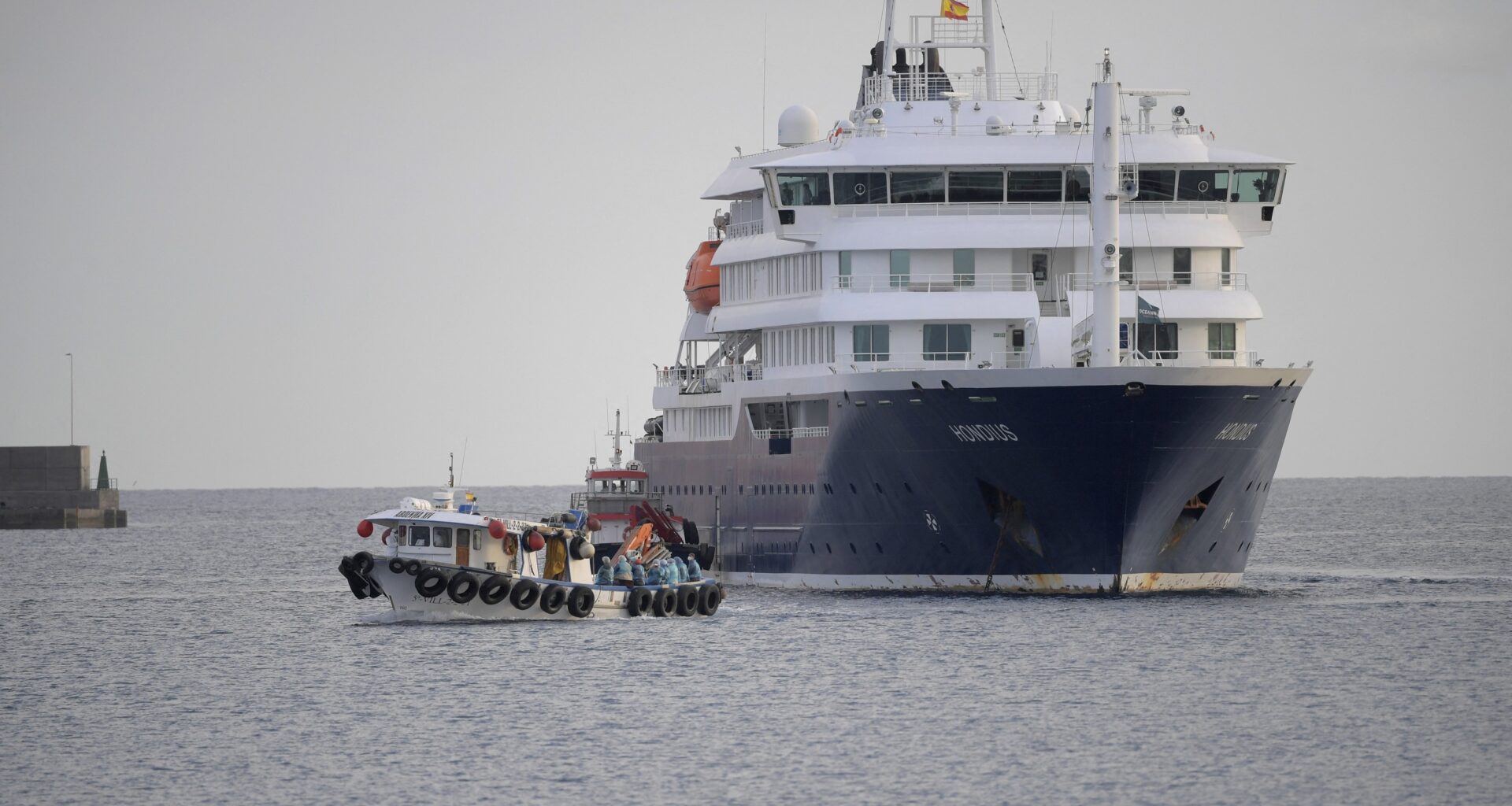
Four Canadians who had been stranded on the MV Hondius, a cruise ship hit by an outbreak of the Andes strain of hantavirus, landed in B.C. Sunday evening after a stopover in Bagotville, Que. They will self-isolate for a total of at least 21 days.
Canada had chartered an aircraft to repatriate the Canadians from Tenerife, Spain. A consular official with Global Affairs Canada (GAC) and a public health officer from the Public Health Agency of Canada (PHAC) had been in Tenerife since Thursday and in contact with the Canadian passengers, according to a joint statement on Sunday from GAC and PHAC. All had followed strict isolation protocols on board since May 4 and all were asymptomatic.
B.C. provincial health officer Bonnie Henry said that some of the four travellers “have connections with British Columbia,” which is why B.C. was chosen for their repatriation.
The four Canadians were among the roughly 130 asymptomatic passengers on board the MV Hondius when it reached port Sunday morning.
The cruise ship arrived in the Canary Islands on Sunday and public health officials conducted a final assessment of each passenger before they disembarked. They were ferried ashore on small vessels, with distancing between passengers maintained, and taken on sealed buses directly to the airport. Before boarding the bus, Spanish medical personnel conducted a further screening. All four Canadians were assessed by a PHAC officer as asymptomatic upon boarding.
Public health measures on the flight included masking and physical distancing; the PHAC officer was also on board, the statement said. PHAC is co-ordinating all health procedures and will work with relevant provincial and local public health authorities in Canada, the statement said.
On arriving in B.C., the travellers were expected to be assessed by local public health before leaving the airport for “a pre-determined location,” which was not disclosed, “to self-isolate for a minimum of 21 days.” That time frame dates back to May 6, the final day a confirmed case was on board the ship.
At the end of the 21-day period, public health officials in B.C. will decide, based on their assessment and guidance from the World Health Organization, if it is necessary to extend the self-isolation period to a maximum of 42 days since the last possible exposure on the ship.
The minister of national defence authorized the Canadian Armed Forces (CAF) to assist GAC and PHAC in repatriating the Canadian citizens.
“The CAF assistance is limited to short‑term logistics support and temporary facility access, facilitating the transfer of the repatriating Canadians on a chartered return and their transfer from PHAC to provincial health authorities at the destination,” said the statement.
The statement said the health of the travellers will be assessed regularly and that they have access to medical care and mental health and psychological support, and also to testing if they develop any symptoms.
The assessment of PHAC, consistent with that of the World Health Organization, continues to be that the overall risk in Canada to the general population from the hantavirus cluster linked to the MV Hondius remains low.
“While transmission between people can occur, this is very rare and requires close, prolonged contact with someone who is sick,” the statement said.
Presse Canadienne contributed to this report.
Editor’s Picks