
From Iron Man to the F-35 and the quiet art of designing trust at 30,000ft, MARTI ROMANCES, co-founder and Creative Director at Territory Studio, San Francisco, discusses how Hollywood continues to influence the cockpit of the future.
Science fiction has long served as an informal R&D department for real-world interfaces. Films, such as The Martian, Dune, Ready Player One and Blade Runner 2049 invite us into imagined cockpits filled with holographic overlays, spatial data and futuristic systems that anticipate human intent before a button is pressed.
From the analogue switchboards and blinking control rooms of early Cold War films to vector graphics of the 1980s and spatial, gesture-driven interfaces of the last few decades, cinema has developed its own visual language of future interaction.
Audiences see spectacle but, to designers, these cinematic displays predict what technology can do by simply imagining what is possible. Now that processing power has finally caught up with our imagination, ideas once confined to Hollywood are now becoming reality. Sensors have shrunk, displays have flattened and software responds in real time.
What started as a cinematic thought experiment is becoming the blueprint for systems that fly aircraft, drive cars and safely move people through the world.
Clarity is not style; it is survival
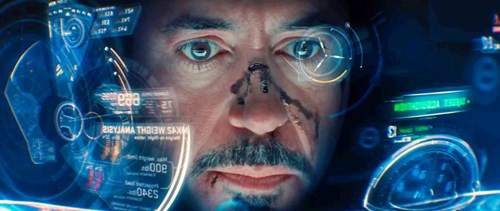
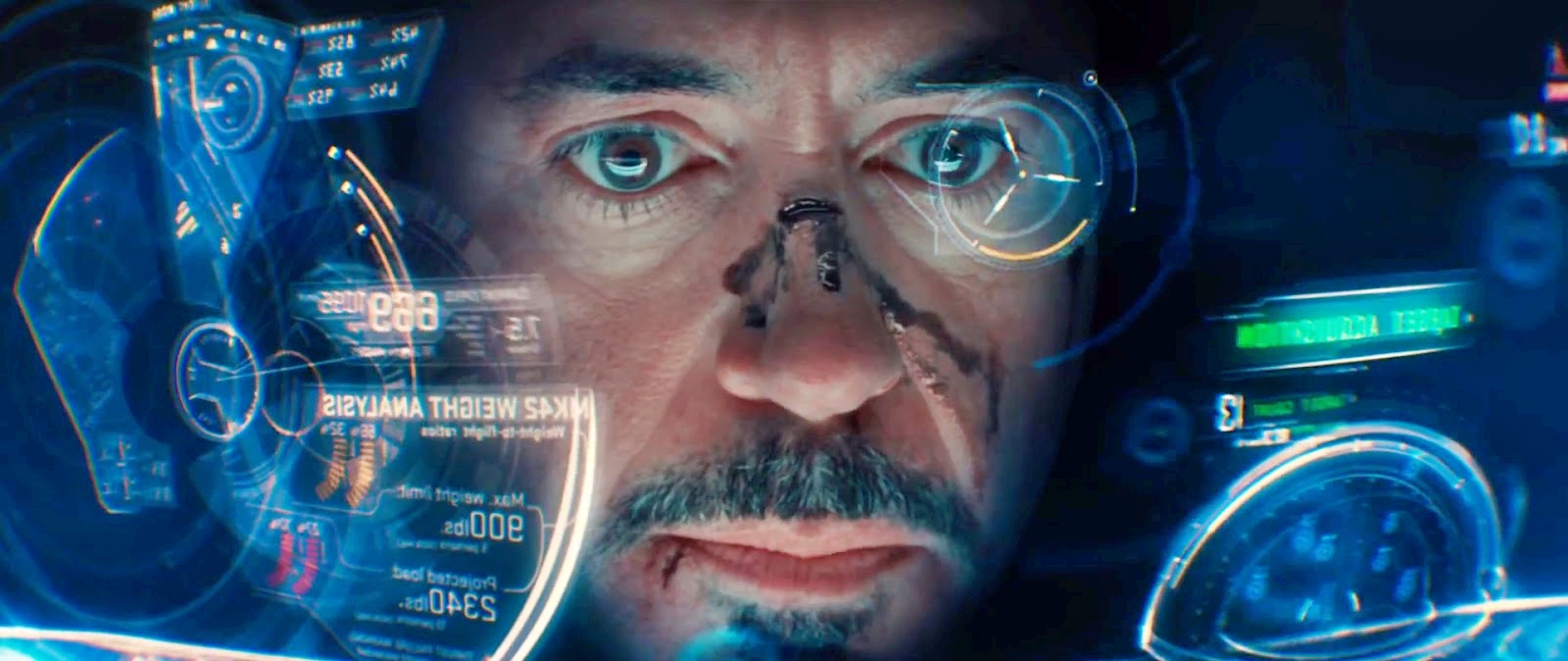
The iconic Iron Man helmet HUD interface. This work is one of the most recognised HUDs in cinema, defining the visual language of Tony Stark’s POV across the Marvel Cinematic Universe. (Territory Studio)
When it comes to designing human interaction for brands, products and IPs, one lesson has remained consistent over the years: if people cannot read an operating system, they cannot trust it – and if they cannot trust it, they cannot operate it. Humans instinctively trust a visual language that is legible and predictable, that behaves in ways that are easily understood.
Cinematic interfaces are created under unusually demanding constraints. They must be understood instantly by an audience with no training, no manuals and only moments of screen time. Every scene serves to clarify plot points and guide the audience along. A film needs to communicate intent, revealing information only when it supports the storyline.
Similar constraints exist, though far more brutally, in the aerospace industry. Automation has expanded its capabilities faster than human cognition can absorb them. In a software-defined aircraft where information is as critical as aerodynamics, pilots are never short on information. During flight, communication needs to be swift, legible and trustworthy, with zero margin for error.
Speed of update
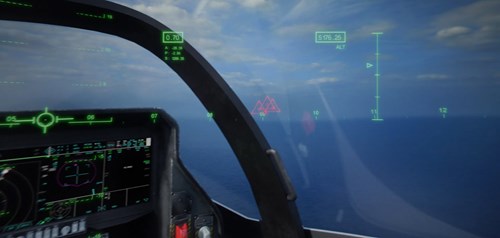
The F-35 HMD (Helmet Mounted Display) fuses information and data to give 3D situational awareness to the pilot, even allowing them to ‘look through’ the airframe. (SpazSinbad/YouTube)
No aircraft embodies this more clearly than Lockheed Martin’s fifth-generation F-35 Lightning II. While earlier generations of fighters were born from aerodynamics, with avionics retrofitted later as the technology advanced, the F-35 inverted this logic. Designed from the outset as a software platform, mission systems and sensors are integrated into its airframe. Its behaviour, limits and performance are defined as much in code as in metal.
This technological shift has also changed how pilots connect to the cockpit and in the skies. For decades, the head-up display (HUD) defined modern cockpits with a fixed sheet of glass aligned with the pilot’s forward view. Look straight ahead and the information is there but look away and valuable data is left behind. The F-35 Helmet Mounted Display (HMD) takes a decisive break from this mode of communication. Built to boost situational awareness during missions, the ‘see-through’ helmet continuously presents data that supports pilot cognition. Airspeed, heading, altitude and targeting information are all displayed on a visor rather than an external screen. Threats and hazards are locked to the pilot’s gaze and layered contextually onto the skies outside.
This generational leap from traditional to software-centric might be compared to the difference between driving a 1990s’ Volkswagen and a 2025 Tesla. You travel through the same physical world but the experience feels smoother, quieter and safer because interaction and feedback have now rethought the relationship between human and machine.
The effect of the F-35’s HMD on situational awareness is profound but, then again, so is the risk if data is not curated. When data can be shown everywhere at once, discipline becomes essential. Effective communication lies in restraint, presenting only what is critical and nothing more.
This distinction can be illustrated by Iron Man. Tony Stark’s HUD may look fun on the big screen, flying around with dynamic, information-dense graphics. However, it would be catastrophic in real life because it ignores many of the constraints that govern aviation: too much motion, too much data and endless distractions. In aviation, every visual element must justify its presence, while motion must be restrained to present information only when necessary.
Yet even as systems grow more capable, some aspects remain deliberately human. Pre-flight rituals and system checks are all done by hand. These are not inefficiencies waiting to be automated away, but rather a way for pilots to build trust with their machine before it carries them (and passengers) safely into the sky.
Spectacle vs survival
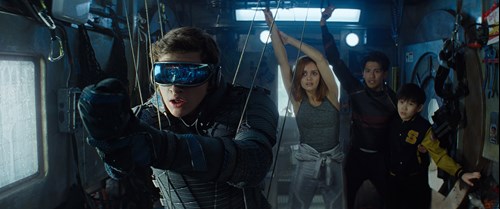
Released in 2018, Ready Player One was set in dystopian 2045. The film has, subsequently, drawn comparisons to Meta’s investments in the metaverse in the 2020s. The Apple Vision Pro mixed reality headset, which was released in 2023, is also strikingly similar to the device used by the character Wade Watts in the movie. (Territory Studio)
As systems become calmer, more predictive and more capable, they also carry a quiet risk: automation bias. When systems work too well, humans tend to monitor them less, creating a false sense of security. Pilots can lose situational awareness in critical moments, while unused skills decay over time.
This is why technology must actively work against its own smoothness. Bad systems mask complexity, while good systems make the uncertain visible. History shows that the most dangerous failures are rarely loud or dramatic but unfold silently while systems appear normal and crews assume everything is under control.
This is why, during high-demand phases, such as approach or emergency procedures, interfaces need to be simplified and decluttered to reduce cognitive overload. During calmer phases, menus can expand to provide a richer situational palette.
Beyond the eye
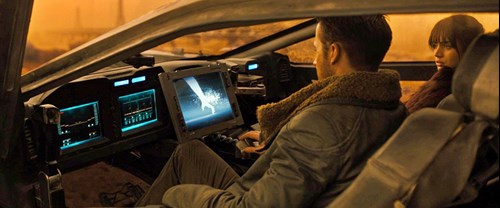
Territory Studio created screen graphics for the Blade Runner 2049 movie. (Territory Studio)
For more than a century, vision has carried the primary burden of cockpit communication. Pilots see their way through complexity, but vision can quickly reach overload.
Multisensory feedback offers a different approach that reinforces human actions, such as nudging a pilot away from flight envelope limits or signalling urgency without demanding visual attention. Research shows haptics, lighting and audio cues restore confidence. Leveraging this technology enables a more holistic experience beyond visual interaction, providing meaningful and intuitive feedback.
Emerging technologies, such as augmented reality, AI assistance, voice and gesture control, biometric sensing and high-speed connectivity are reshaping how interaction feels. Automakers are rethinking what information can be shown, where it lives and how it is presented, looking to transform journeys into personalised, seamless experiences. As autonomy reduces the need for drivers to take control, the more time they have to interact with on-board technology.
HUD vs HMD
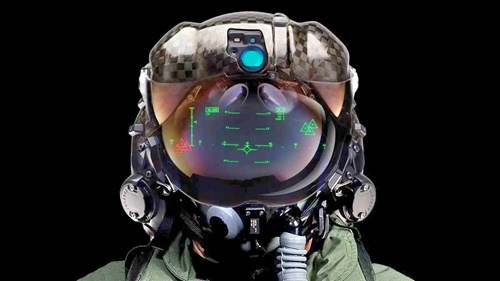
From HUD to HMS. (RTX)
The transition from Head-Up Displays (HUDs) to Helmet-Mounted Displays (HMDs) reflects a deeper design shift moving from instrument-centric to perception-centric, where information now follows the pilot.
HUDs project critical flight data onto a fixed optical surface aligned with the pilot’s frontal view, minimising head-down time, working best in stable, forward-oriented flight scenarios.
HMDs remove this display from the cockpit entirely. Information is locked to the pilot’s gaze and fused with sensor data, allowing awareness to persist regardless of where the pilot looks.
The F-35 Gen III Helmet-Mounted Display System (HMDS), one of the most advanced fighter-pilot HMDs, costs around $400,000 per unit. It supports high-agility, high-workload environments where threats, navigation cues and target data span a full 360 degrees.
When the interface becomes the environment
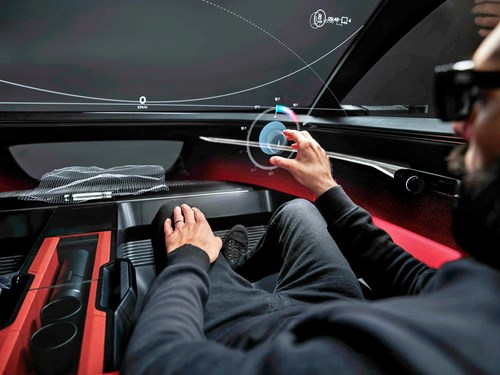
Territory Studio’s automotive HUD concept design for the Audi Activesphere vehicle. This project bridges screen graphics expertise from film into the automotive sector, showcasing how cinematic interface design translates into next-generation vehicle cockpit experiences. (Audi)
Territory Studio created screen graphics for the Blade Runner 2049 movie. The Wallace Corp limo (left) represents the company’s wealth and power, whereas the pure, minimal and geometric black and white user interfaces in the state-of-the-art vehicle stand in sharp contrast to the basic technology seen elsewhere in the film, particularly in K’s dilapidated and glitchy vehicle spinner (right). This reflects K’s low status as replicant and blade runner and reminds the audience of a polarised world.
Designing motion for the modern car is a balancing act. The interface has to guide without pulling focus, reassure without demanding attention and remain readable when required. Good automotive design understands that cognition has limits and that motion is not decoration. Just like aviation, the real challenge is not adding more intelligence; it is deciding how that intelligence shows up.
EXtended reality (XR) is bringing context into the cabin. Audi has designed a distinctly curated space that engages the senses with its Activesphere concept car, using augmented reality to reshape the in-car experience. Driver and passenger interaction is achieved through gaze, gesture and spatial awareness that pins information to things, such as road geometry, terrain, traction and hidden hazards. All this is delivered effortlessly without ever isolating the occupants. It is a compelling glimpse into the transformative power of XR, hinting at a future where the interface connects us to the outside world.
In the more immediate sense, physical touch remains the most honest form of feedback. This is why we are seeing the development of adaptive interiors where sculptural surfaces dynamically adapt their form. By using advanced materials, these surfaces respond to user preferences, ergonomics and environmental conditions. This mode of communication enables the vehicle to literally adjust itself in real time to the driver’s needs.
Machine learning (ML) and AI will continue to play crucial roles in extracting value from data, allowing for more personalised and seamless user experiences. We are just scratching the surface of how these technologies will revolutionise human interaction in both the digital and physical worlds.
Who’s really in control?
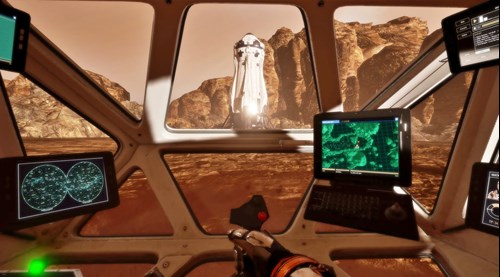
The cockpit of Mark Watney’s Rover 2 in the 2015 film, The Martian. (Territory Studio)
Cinema screens, flight decks and dashboard technology advance rapidly, but human psychology refuses to evolve at F-35 speed. Eyes still get tired and attention still wanders. Trust still needs to be earned and no amount of code can ever change that. Technology does not win by shouting louder or glowing brighter. It works when it understands us well enough to stay out of the way. The best systems do not bark commands or drown us in data.
The cockpit of the future should not feel like a machine, but a conversation that adapts to context, changes under pressure and understands that sometimes the smartest move is to fade into the background and let the pilot fly. Furthermore, in the future, not every interaction will be digital. For many everyday actions, a well-placed knob or physical button you can feel without looking will still beat the prettiest menus buried in glass.
In the end, the future will be decided by technology that makes humans feel oriented, capable and unmistakably in control. In a world where we are quietly handing over more decisions to machines, designing systems that protect human judgement might be the most radical choice left.