

Israeli strikes on southern Lebanon killed at least nine people on Friday, including a child and six rescuers from organizations linked to Hezbollah and its Shiite ally Amal, according to the Lebanese health ministry.
At the same time, multiple sirens sounded in northern Israel throughout the day due to Hezbollah drone attacks that caused no injuries.
Beirut said an Israeli strike on the town of Hannouiyeh killed four rescuers from the Hezbollah-linked Islamic Health Committee. The health ministry does not distinguish in its reports between combatants and civilians.
It said a later strike on Deir Qanun al-Nahr killed a Syrian girl, as well as two rescuers from the Amal-linked Risala Scouts association, one of whom was also working as a freelance photographer.
Separately, the Israel Defense Forces said surveillance operators overnight identified two armed terror operatives approaching the northern border from the direction of the southern Lebanese village of Yaroun. Within minutes, an Israeli Air Force fighter jet struck the suspects under the direction of forces on the ground. After movement was detected in the area following the initial strike, the pair was targeted again and killed.
Get The Times of Israel’s Daily Edition
by email and never miss our top stories
By signing up, you agree to the terms
Local security squads in the nearby communities of Dovev, Matat, and Baram were dispatched to their communities’ entrances during the incident.

Smoke rises from the site of an Israeli airstrike on the southern Lebanese village of al-Haniyya on May 21, 2026. (KAWANT HAJU / AFP)
The military also reported on Friday that troops operating in southern Lebanon had killed five Hezbollah operatives the previous day after spotting them entering a command center belonging to the terror group north of the Israeli-held area in southern Lebanon.
צפו בתיעוד: כוחות חטיבה 551 זיהו מחבלי חיזבאללה נכנסים למפקדה של הארגון וחיסלו אותם
כוחות צוות הקרב של חטיבה 551 בפיקוד אוגדה 146 זיהו אתמול, חמישה מחבלי חיזבאללה שנכנסו למפקדה של ארגון הטרור, צפונית לקו ההגנה הקדמי בדרום לבנון. בסגירת מעגל מהירה, הכווינו את חיל האוויר שתקף את… pic.twitter.com/l8wNnRsXto
— צבא ההגנה לישראל (@idfonline) May 22, 2026
The IDF added that troops had also struck Hezbollah weapons depots and other terror infrastructure in Lebanon, while additional operatives deemed a threat were also killed.
Sirens across northern Israel
Sirens blared across northern Israel throughout the day on Friday.
In the morning, the IDF said it lost contact with two “suspicious aerial targets” that set off sirens warning of drone infiltration in the Rosh Hanikra area, near the border with Lebanon.
According to the military, contact with the targets was lost before they crossed into Israeli airspace. The incidents concluded, and no injuries were reported.

An explosive drone launched by Hezbollah is seen near the Israeli border with Lebanon during a Hezbollah attack in northern Israel, May 19, 2026. (Ayal Margolin/Flash90)
On Friday afternoon, sirens rang once more, warning of drone infiltrations on Netua, Shtula and Zarit, as well as in Misgav Am and Margaliot.
The IDF said it intercepted two “suspicious aerial targets” launched from Lebanon at Israel. Additionally, several impacts were identified along the Lebanese border, within Israeli territory. The IDF said the details were under review.
Lebanon affirms soldiers’ loyalty after US sanctions
Lebanon’s military said Friday its soldiers were loyal to the institution after the US announced sanctions that included an officer accused of sharing information with Hezbollah.
The army said that “all officers and members of the military institution are performing their national duties with utmost professionalism, responsibility, and discipline.”

This picture show a view of blue tents set up by the Lebanese government for people who fled their homes and villages in Beirut’s southern suburbs and southern Lebanon, on May 22, 2026. (Anwar AMRO/AFP)
It emphasized that “the loyalty of military personnel is solely to the military institution and the nation, and that they are committed to fulfilling their national duties without any other considerations or pressures.”
The sanctions came after the US hosted three rounds of direct talks between Lebanon and Israel — the neighboring enemy states’ highest-level contact in decades — aimed at ending the war that began after Hezbollah dragged Lebanon into the broader regional war on March 2.
Lebanon is forming a military delegation for security talks with Israel at the Pentagon on May 29, a step that was agreed in the latest round of direct talks earlier this month.
A fourth round of negotiations is planned for June.

A woman holds a portrait of assassinated Hezbollah leader Hassan Nasrallah, as the Iran-backed terror group’s supporters demonstrate in Beirut to protest Lebanese authorities decision to engage in direct negotiations with Israel, on April 10, 2026. (Fadel Itani/AFP)
The talks have so far failed to bring the conflict to a close, with Lebanon demanding an Israeli withdrawal and Israel demanding that Hezbollah be disarmed. The Iran-backed terror group itself rejects direct talks with Israel and says its arms are not up for discussion.
Among those sanctioned were Iran’s ambassador to Lebanon, three Hezbollah lawmakers, a former minister, and two figures from the Amal movement.
They also targeted army colonel Samir Hamadi and Khattar Nasser Eldin, a general security officer, marking the first time officers were sanctioned in Lebanon.
The Lebanese army said that it was not informed of the sanctions beforehand. In a statement, it affirmed its trust in its personnel, adding that if any “employee is found to have leaked any information outside the institution… they will be subject to fair legal and judicial accountability.”
US Treasury Secretary Scott Bessent said on Thursday that Washington “will continue to take action against officials who have infiltrated the Lebanese government,” insisting Hezbollah must be “disarmed.”
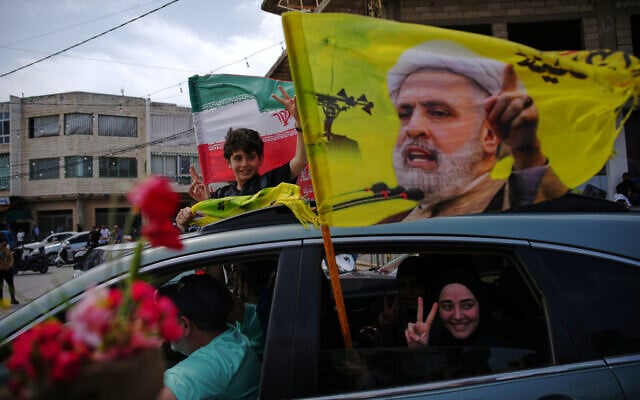
Displaced residents wave a flag with the image of Hezbollah leader Naim Qassem as they return to their villages following a ceasefire between Israel and Hezbollah, in Zefta, southern Lebanon, April 17, 2026. (AP Photo/Hassan Ammar)
Hezbollah called the sanctions “an attempt to intimidate the free Lebanese people to bolster the Zionist aggression against our country.”
Hezbollah lawmakers said the sanctions “will have no practical effect,” though the group faces internal pressure following two wars with Israel that caused widespread destruction and pushed Lebanon to negotiate with Israel.
“The sanctions are a continuation of the tightening of the noose around Hezbollah, an attempt to separate it from the state after it managed, over the past 20 years… to embed many elements” in it, military expert Riad Kahwaji told AFP.
“These sanctions show today that no party is immune, regardless of whether it is inside or outside state institutions.”
You’re a dedicated reader

That’s why we started the Times of Israel – to provide discerning readers like you with must-read coverage of Israel and the Jewish world.
So now we have a request. Unlike other news outlets, we haven’t put up a paywall. But as the journalism we do is costly, we invite readers for whom The Times of Israel has become important to help support our work by joining The Times of Israel Community.
For as little as $6 a month you can help support our quality journalism while enjoying The Times of Israel AD-FREE, as well as accessing exclusive content available only to Times of Israel Community members.
Thank you,
David Horovitz, Founding Editor of The Times of Israel