
Two Paradise residents say flooding issues on their property are causing a deluge of anxiety — and they aren’t getting answers from the town.
Dave Morris and his family have lived in a house on Archibald Street for decades. Originally, Morris said, his house was surrounded by trees, and he frequently saw animals like rabbits, squirrels and even moose in his backyard.
That changed a few years ago, when the trees at the rear of his backyard were replaced by a new subdivision, with new houses running along a new road, Gallants Street.
He said the flooding started in July 2024, after a heavy rainfall. He said the water was streaming from the building lots on Gallants Street into his backyard.
“All of a sudden this area in my garden was a pond,” Morris said in an interview with CBC News.
He said ever since, heavy precipitation leads to flooding in his yard. During the spring, melting snow exacerbates the issue — he said this past March, the water was within six feet of the door to his basement.
“Anxiety level goes through the roof. Stress level goes through the roof,” he said.
WATCH | Two Paradise residents want answers from the town and developer: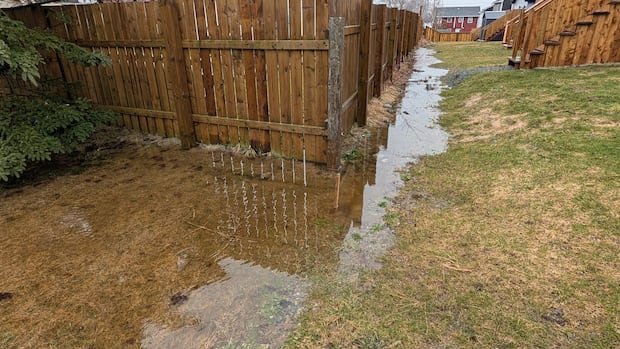
Paradise residents sick of seeing water, water everywhere
Two residents of a Paradise neighbourhood say development up the hill is causing flooding on their properties.
Last month, while tracing the stream of water through neighbouring backyards, Morris met Ian Saunders. They realized they had been having similar experiences.
Saunders moved onto Gallants Street about three years ago after coming home from Alberta. Saunders said his home was one of the first in the area to be built. He, too, has been dealing with flooding in his backyard.
No comment from town, developer
Both Saunders and Morris blame the flooding issues on the building lots up the hill from Saunders’ home. Stonemount Enterprises cleared the land and developed the lots, known as Willowbanks Subdivision Phase 3A.
“As they were grading the area and putting in the houses, […] when we would have moderate to significant rain, the water would come down through everyone’s backyards and flood the lower properties,” Saunders said.
The neighbours say they’ve contacted both the town of Paradise and Stonemount Enterprises to complain about the issue, but it hasn’t been resolved.
Paradise spokesperson Diane Keough declined an interview request.
“The issue on Gallants Street is related to an ongoing legal matter between the town and a developer in the area and as such, we can’t speak to it at this time,” Keough said. She declined to provide further details.
Stonemount is just one of multiple developers involved in the multi-phase development, and Keough did not indicate which developer is involved in the legal dispute.
CBC News asked Stonemount Enterprises for comment. David Williams, a lawyer with O’Dea Earle Law, declined comment on behalf of the developer and said the issue is being misrepresented. Williams also noted that Stonemount does not build the homes on the lots it develops.
On its website, Stonemount Enterprises indicates that building lots up the road from Saunders’ home have sold out.
Less trees mean more runoff: engineer
Joseph Daraio, an associate professor in civil engineering at Memorial University, said trees play a big role in flood mitigation, and removing them means more runoff.
“Pulling out the roots, pulling out the soil — all that holds the water,” he said. “By removing that and clearing the lots, you now have much, much more water that’s going to run off your site that would have been either caught in the trees or absorbed into the ground or held in the soil.”
Documents obtained through an access to information request shows Stonemount Enterprises did commission a drainage plan for the area.
Daraio hasn’t visited the site, but said based on the plan, it looks like the engineers did their due diligence, and even included a rock sump drain to mitigate potential flooding. According to Daraio, it can be very difficult to predict flooding issues in a new development.
He said the water could be originating from a number of sources, including underground and sites upstream from the development.
Still, he said the plans do show that some of the building lots are graded in the direction of Morris’ and Saunders’ properties.
“It’s clear from what I saw, based on the grading, the slopes, the direction, that there’s a real potential that that grading may have increased the amount of runoff heading into that area.”
Morris has set up a pump to keep the water away from his home. While this is happening, he’s been dealing with a health issue that affects his mobility.
“I might be up 10, 12, 14 hours keeping an eye on this pump and the hoses and stuff. Make sure it keeps operating. Trying to keep the water away from our house,” he said. “It’s a very, very stressful situation.”
Saunders is worried the water issues will impact the value of his property.
“We’re going to have a hard time selling these properties. We’re going to have to disclose there’s a water issue from up the hill that the developer hasn’t dealt with. And so it kind of puts us all in a bind here,” he said.
Morris and Saunders say they’re both at a loss for what to do next, and are looking for the town or the developer to find a solution.
Download our free CBC News app to sign up for push alerts for CBC Newfoundland and Labrador. Sign up for our daily headlines newsletter here. Click here to visit our landing page.