
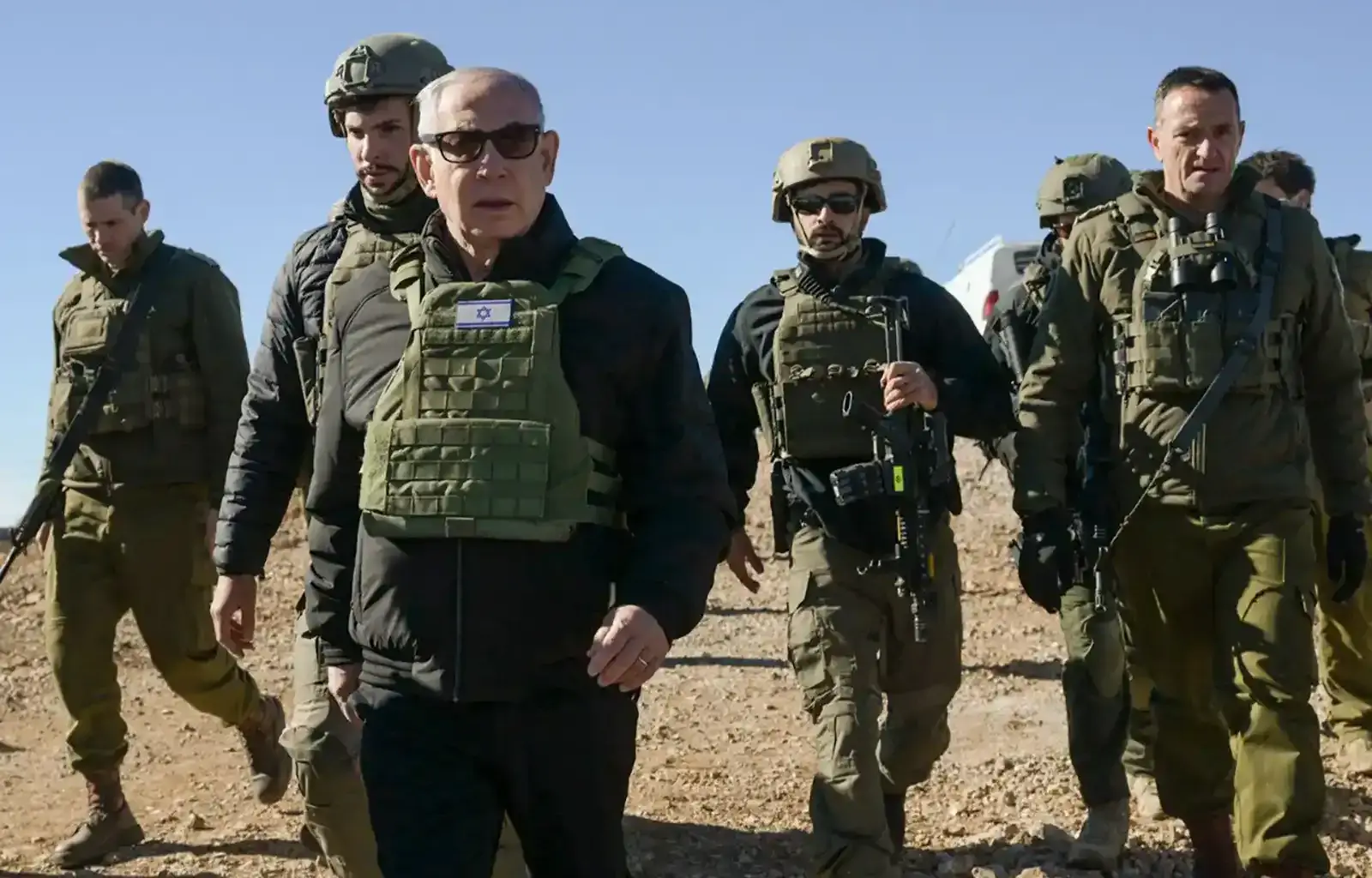
Settlement and military activity has concentrated on strategically sensitive points, such as the eastern slopes of Mount Hermon and the Yarmouk Basin, a borderland rich in water resources and agricultural land. Israel has transformed military positions into semi-permanent outposts, just as it previously did across the Occupied Palestinian Territory. This deployment, coupled with settler incursions, reflects Israel’s effort to transform the buffer zone into new settlement depth that imposes different geographic and demographic realities, especially as Israeli officials continue to call for a long-term security belt extending into Syrian territory to prevent any return of hostile forces.
These developments raise questions about the relationship between unofficial settlement initiatives and Israeli state policy. While the army occasionally evacuates some settlers, the broader political environment reveals implicit support from influential figures in the government, such as Bezalel Smotrich and Itamar Ben-Gvir, who openly endorse the idea of a “Greater Israel” extending well beyond its current borders. This support signals to the movement’s activists that their actions fall within a long-term strategic project aimed at raising territorial demands that will later be imposed in any future settlement between Israel and Syria.
On the Syrian side, the transitional administration faces a difficult equation. It seeks international legitimacy while simultaneously confronting ongoing violations of its sovereignty from a neighbor that rarely faces repercussions due to its relationship with the United States. Under Israeli military pressure and American “mediation,” Damascus entered indirect talks that produced a security and intelligence coordination mechanism to reduce tensions. Despite official Syrian insistence on sovereignty, these arrangements effectively amount to a tacit acceptance of an expanding Israeli presence on Syrian territory, exchanged for Israel’s promise to halt military expansion and work toward a more equitable and stable security pact.
The implications of this project do not stop at the boundaries of the conventional conflict. They extend to the reconfiguration of the political geography established by the Sykes–Picot order. The emerging landscape is one of flexible borders governed by military force and demographic advantage, raising the prospect of a form of “geographic apartheid” in southern Syria, where settlements enjoy protection and services while Syrian villages suffer marginalization and isolation. Such a reality would create a permanent zone of tension, likely to generate new waves of forced displacement and cross-border conflict.
Halutzei HaBashan represents a model of how historical rupture can be exploited to re-engineer place and population according to a specific ideological vision. The project is not limited to building new settlements; it seeks to redraw maps and impose realities that will be difficult to reverse. Without the restoration of Syrian sovereignty or effective international pressure to curb this expansion, the land of Bashan could move from a historical concept to a new geopolitical reality, negatively reshaping southern Syria and the wider region.
The views and positions expressed in this article are those of the author(s) and do not necessarily reflect the views of DAWN.