

For N.H. and Y.D., moving to Quebec’s North Shore wasn’t their first choice — but it was the promise of a better future for their family.
Originally from West Africa, the couple arrived in Sept-Îles in 2022 at the height of the COVID-19 pandemic with the intention of setting down roots in the community.
CBC has agreed to keep the names of the family confidential.
“I felt it was the kind of place where I wanted to be because it is so small and people are really caring and loving,” said Y.D. “We’ve been to other places where we didn’t feel accepted as we were, but Sept-Îles has really been open to us.”
Their daughters, aged three and two months, have since joined the family.
But despite their growing attachment to the region, living in Sept-Îles could soon become a memory.
The city’s high cost of living is forcing the couple to rethink their plans, and consider moving to a more affordable area.
“We can really feel it with groceries, housing and transportation,” Y.D. said. “We constantly struggle with our budget.”
Sept-Îles tops list of expensive cities
According to the Institut de recherche et d’informations socioéconomiques (IRIS), Sept-Îles has been Quebec’s most expensive city to live in for nine out of the past 10 years.
Since 2015, the group has published a yearly cost-of-living study for seven cities across the province: Montreal, Quebec City, Sherbrooke, Gatineau, Trois-Rivières, Saguenay and Sept-Îles.
The study determines how much a person, or a family, needs to earn to have a livable income.
According to the think tank, a two parent household with two young children like N.H. and Y.D., would need to earn $88,266 a year to live with dignity.
That’s just slightly below Montreal, which tops this year’s list at $88,812.
The family is living on a single income that falls below the threshold for a family of four.
Affordable housing at a premium
The couple met as graduate students while earning their masters in agricultural economics at Université Laval in Quebec City.
But after graduating in 2020, they both decided to make a career change: they answered the province’s call for more front-line health-care workers during the COVID-19 pandemic.
They completed their training as nursing assistants and turned their sights to the province’s outlying regions, where health-care workers were most in demand. They both got a job at the Sept-Îles Regional Health Centre.
Now, as costs continue to rise and with two young daughters at home, the family is struggling to stay afloat.
Paul Lavoie, general manager for Développement économique Sept-Îles, the city’s non-profit economic development agency, says several factors come into play in terms of the high cost of living: the region’s geographical location, the rising price of oil and the city’s main economic driver, the mining industry.
Many employers also still rely on the fly-in, fly-out model, which has an impact on rental market prices.
 Paul Lavoie says that local businesses in the service industry, like restaurants and stores, are closing because people are leaving jobs in that sector due to the high cost of living. (Brianne Fequet/CBC)
Lavoie says landlords are taking their rentals off the market to offer them to temporary workers.
“When someone is leaving their apartment, instead of renting it to a local, the people tend to just take it back and rent it on a weekly basis or a monthly basis at a very, very high rate,” said Lavoie.
“And then the locals, the ones with average incomes, have more and more difficulty finding places to live, and at some point, they have no choice but to just go live elsewhere.”
For N.H. and Y.D., the limited number of daycare spots available in the city has also been an issue.
Their three-year-old daughter has been on a waiting list since birth.
Y.D. says that’s forced her to work part time, depriving her household of a much-needed, full-time second income.
Non-profit seeing more families in need
For many Sept-Îles families who are struggling to get by, the answer has been local non-profit L’Envol, Maison de la Famille.
It provides support, resources and activities for parents and children from pregnancy through adolescence, including services like a low-cost drop-in daycare service, a prenatal clinic and a community kitchen.
Early childhood educator Geneviève Poirier says that requests for aid from her organization have increased tenfold since 2021, with more than 70 per cent of L’Envol’s clients being newcomers.
Poirier says it’s difficult to see so many families in need.
Daycare educator Nadine Thériault says many newcomers rely on the organization’s drop-in service because it’s less expensive than a permanent spot at a public daycare service.
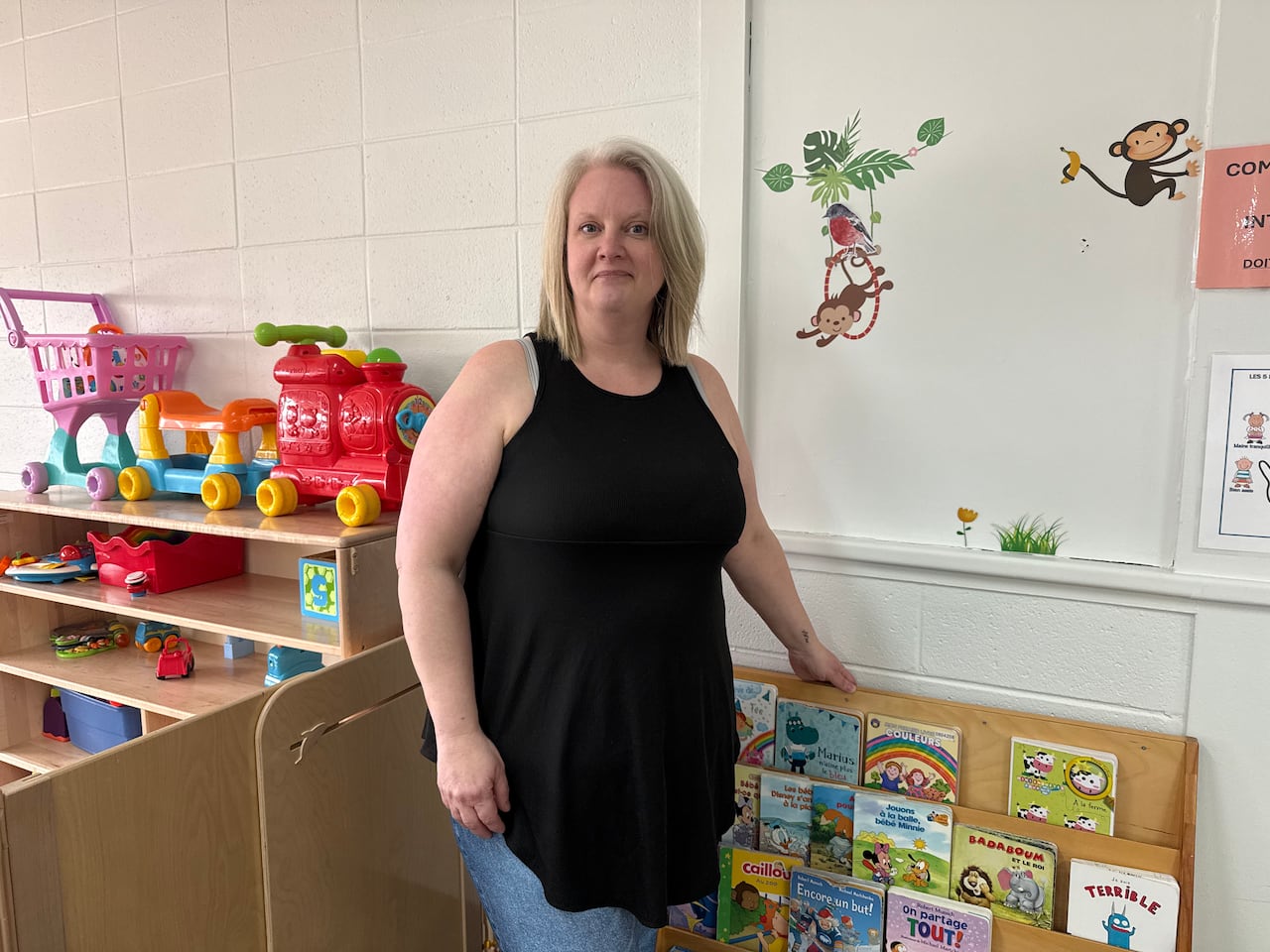 Daycare worker Nadine Thériault says between 70-80 families in Sept-Îles use L’Envol’s drop-in daycare service. (Brianne Fequet/CBC)
She says some parents call her in tears, pleading for a spot for their child — but her hands are tied due to government-imposed ratios.
“We can’t. We’d like to, but we can’t take everybody in.”
Thériault says the distress these families are experiencing is having an impact on L’Envol’s employees as well.
“[The newcomers] become attached to the workers. They become attached to the other families who come here, the kids… but they can’t make a go of it. And then they’re faced with this decision where they have to go. I find that so hard.”
Determined to stay
N.H. and Y.D. are categorical: L’Envol has been a “game changer” when it comes to their family staying in Sept-Îles — at least in the short term. In the longer term, they would need to see an improvement in the cost of living and services available to families, including affordable daycare.
Lavoie agrees: the solution to preventing more families, especially newcomers, from leaving means better housing and child care.
“If we can manage to have this, we will have solved at least the first problem,” Lavoie said.
Despite the challenges, Y.D. is firm in her commitment to finding ways to stay.
“The day we settled here, we told ourselves: ‘This is the place where we want to be,'” she said.
“If things change, if we really have a place where we can leave our children and go to work, Sept-Îles is the best place for us.”