
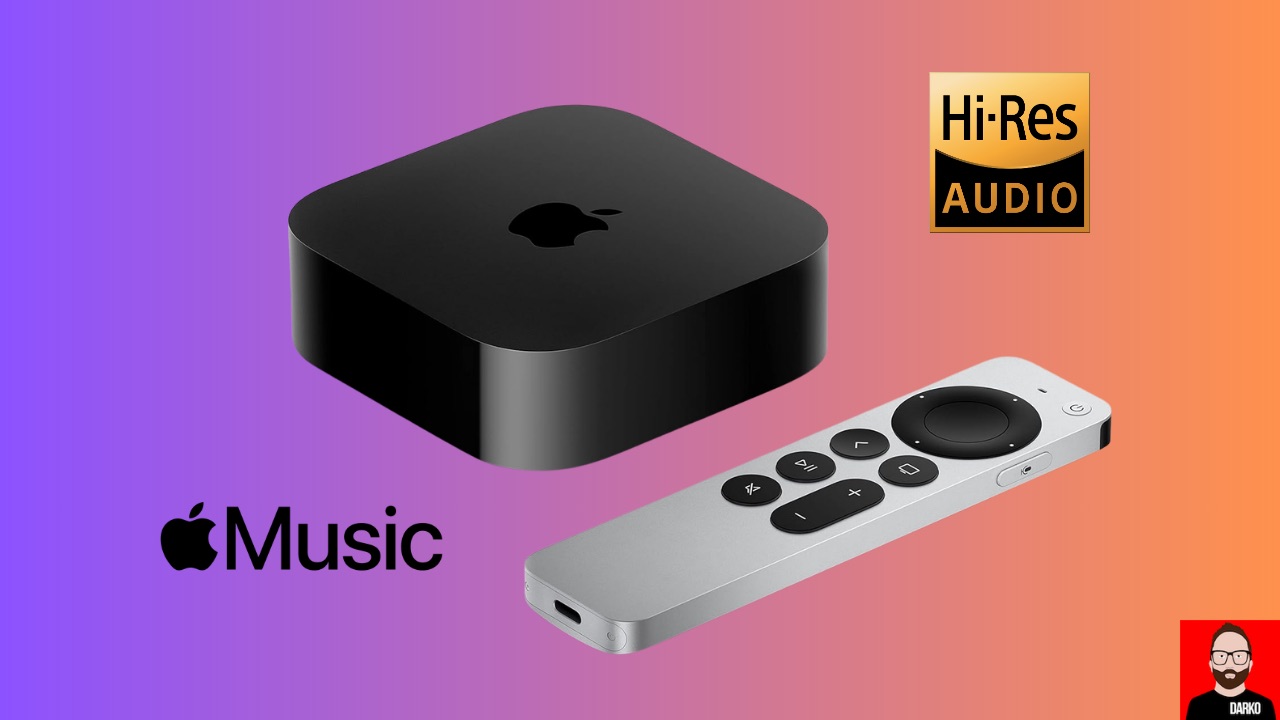
Apple will extend Apple Music’s hi-res lossless support to the Apple TV via tvOS 27, due later this year. MacRumors has the story. Currently, tvOS 26 caps Apple Music playback possibilities at 48kHz. The forthcoming update will push that ceiling to 192kHz, bringing the Apple TV in line with iOS and iPadOS’s bit-perfect behaviour.
Hi-res fans, rejoice?
Not so fast.
The news is real. But whether it changes anything for your hi-fi setup comes down to two questions: how does your Apple TV connect to your amplifier, and, secondarily, what make and model of TV do you have?

If you use an AV receiver
Direct HDMI from Apple TV into an AV receiver, receiver out to the television. That’s the home theatre way. In that chain, the AV receiver intercepts the audio stream, processes it, and sends the video on to the TV. Apple TV talks to the AV receiver; the AV receiver talks to the TV. The audio never goes near the television’s operating system, so its make and model are irrelevant. The signal chain looks like this:
Apple TV → AV receiver → TV
In that chain, 192kHz is 192kHz. Job done.
AV receivers are the bedrock of multi-channel home theatre, though. Not two-channel hi-fi. If you’re reading this, there’s a fair chance you’re not using one.

If you use HDMI ARC
HDMI ARC (or eARC) is far more common in hi-fi circles. ARC (audio return channel) lets your amplifier or DAC connect directly to your television, with the Apple TV feeding the television over a separate HDMI cable. The TV handles volume control via a protocol called CEC, then passes the audio onward to your hi-fi component. One remote, fewer boxes.
The signal chain now looks like this:
Apple TV → TV → hi-fi component (amplifier or DAC with HDMI ARC)
The Apple TV sends both audio and video to the television. The TV takes the video for itself and forwards the audio over HDMI ARC to your amplifier or DAC. Fine in principle. Less fine once you consider what most televisions do to audio before forwarding it.
Many TV operating systems resample all incoming digital audio to 48kHz, regardless of the original sample rate. Playing a 96kHz stream from Apple Music? Your TV catches it, resamples it to 48kHz, and then sends it to your amplifier. The tvOS 27 update removes Apple’s 48kHz ceiling on the Apple TV side of the chain. It does nothing about your TV’s resampling.

Why do TVs resample PCM audio?
PCM is uncompressed audio, so TV operating systems (Tizen, webOS, Android/Google TV) route it through their internal system mixers. TVs are built primarily for video, and the standard audio sample rate for video content is 48kHz. So that’s what their firmware targets. Any incoming stereo PCM stream at 96kHz or 192kHz gets pulled down to 48kHz before going out over the ARC or eARC pipeline.

Can you check whether your TV does this?
Sometimes. Not always. Few manufacturers publish details on the audio resampling behaviour of their televisions’ operating systems.
Some newer TVs support HDMI passthrough, which is designed to take the audio signal from an input source (like a Blu-ray player, games console, streaming box or Apple TV), run it through the TV, and send it out to an external audio device (like an AV receiver or soundbar) via HDMI eARC or ARC without altering it. At least, that’s the idea. In reality, the TV’s operating system might still resample all PCM audio to 48kHz. And you won’t know for sure until your HDMI ARC-connected amplifier or DAC tells you what sample rate is coming out of the TV.
If you have a WiiM DAC Ultra (or AMP Ultra), its front-panel display and Home app show the sample rate of the incoming audio stream, including over HDMI ARC. If it refuses to budge from 48kHz regardless of source, the TV is almost certainly to blame.

The workaround nobody loves
Place an HDMI audio extractor between the Apple TV and the television. It peels off the audio portion of the signal via TOSLINK before it ever reaches the TV and its resampling operating system.
The signal chain here:
Apple TV → HDMI extractor → TV
↓
hi-fi component (via TOSLINK)
You get hi-res Apple Music. But you lose HDMI ARC. Your audio now enters the amplifier or DAC over TOSLINK rather than HDMI ARC, which means losing the ability to control volume with your TV remote or the Apple TV remote. An HDMI extractor solves one problem and creates another. It’s a kludge, not a solution.
Reality check
For home theatre users with an AV receiver in the chain, tvOS 27 should deliver exactly what it promises. For hi-fi systems built around HDMI ARC, your TV’s operating system may be the bottleneck. In other words, the Apple Music x Apple TV relationship remains ‘complicated’. And Apple can do nothing about that from Cupertino.
Further information: MacRumors