
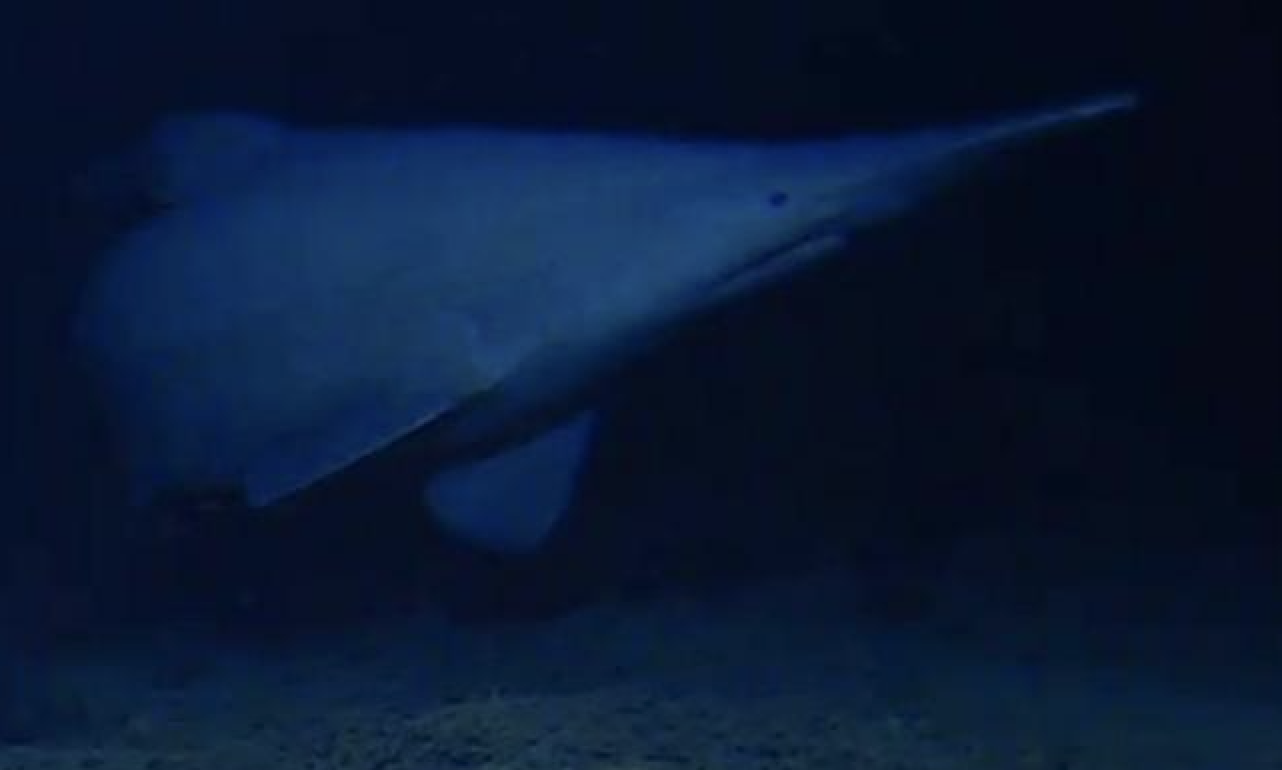
Professor Alan Jamieson, Director of the Minderoo-UWA Deep-Sea Research Centre and co-author of the study, was aboard the 2024 expedition when the footage was captured.
“The goblin shark is a deep-sea charismatic animal, and I never thought we’d see one alive,” he said. “It’s not only seeing it alive that was fascinating, but also the fact the Tonga Trench goblin shark was 700 metres deeper than previously known, making it the deepest-known white shark. On that expedition we filmed over 50 days of continuous footage between depths of 800 and 10,800 metres and this observation was a little over 20 seconds long – which is testament to how elusive this species is, and how special it is to have two observations in the same study.”
The goblin shark is sometimes described as a living fossil – the sole surviving member of a family whose lineage stretches back nearly 125 million years. Its range was previously thought to be limited to narrow coastal regions off western America, Australia and Japan in the Pacific, alongside isolated populations in the Atlantic and Indian Oceans. Both new sightings in the Central Pacific represent a substantial expansion of that known range.
Lead author Aaron Judah, from the Deep-Sea Fish Ecology Lab and Deep-Sea Animal Research Center at the University of Hawaii, said the findings have practical implications beyond the scientific record. “New discoveries like this demonstrate that there is still so much to explore in our deep ocean home. Given the newly expanded geographic range of the goblin shark, this species can be included in regional management and a nation’s biodiversity list.”
The study adds to a growing body of evidence that the deep ocean continues to yield fundamental surprises – and that the species thought to be well-mapped may be far more widespread, and far more mysterious, than previously understood.