
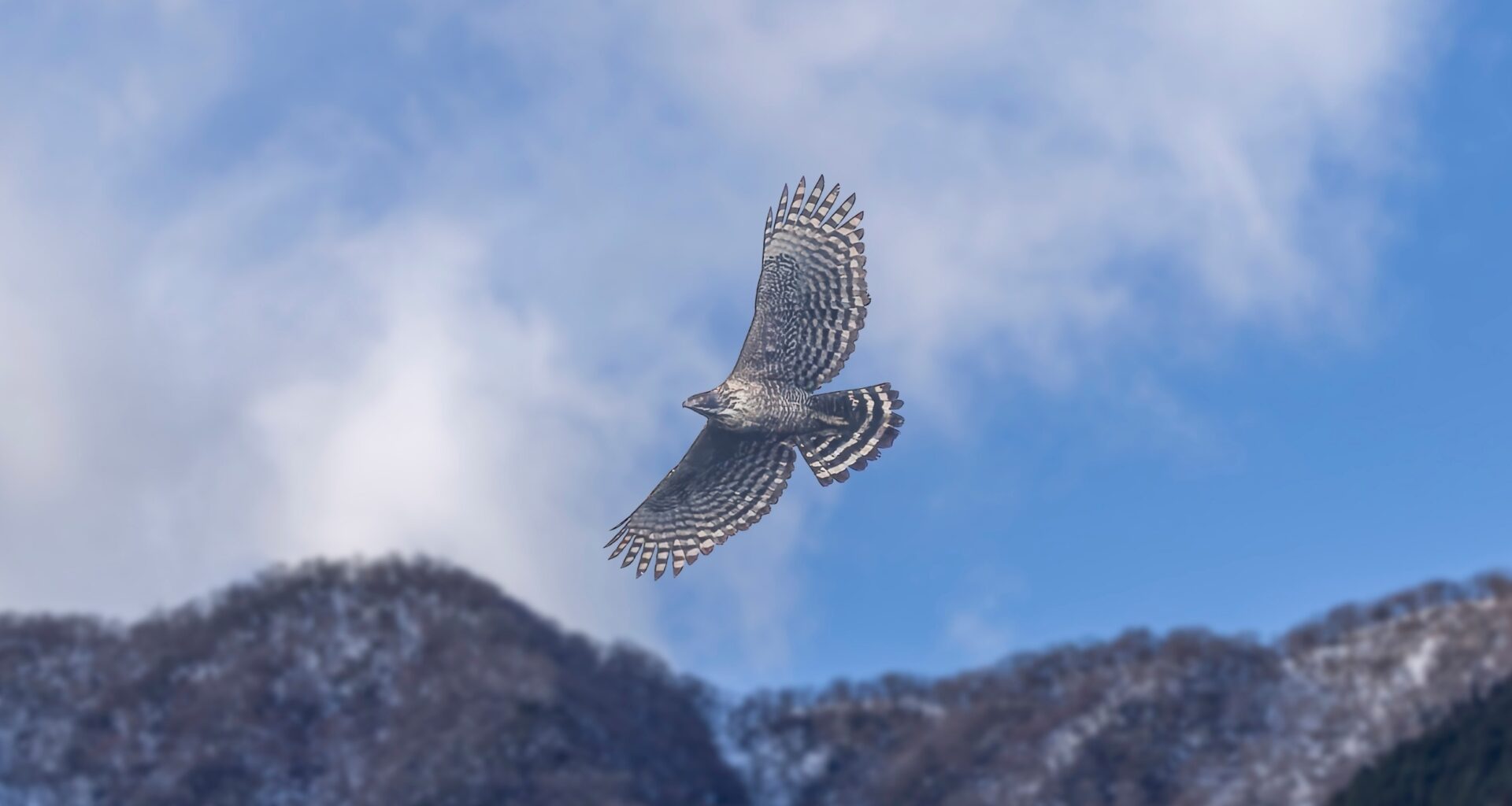
A migratory predator can cross whole continents in a single season. It carries no luggage, yet something invisible rides along with it.
That cargo is learned caution. One dangerous meal can teach a hunter to shun a whole category of prey.

A new study argues that this portable fear does something surprising. It may bind together the evolution of species that will never share a map.
Predators carry fear with them
The research was led by doctoral student Akiva Topper, Dr. Yotam Ben-Oren, and Dr. Oren Kolodny at the Hebrew University of Jerusalem.
The team’s target was a rule most biologists take for granted. Species, the thinking goes, must live side by side to evolve in response to each other.
This assumption runs deep through the field. When scientists ask why a creature looks or behaves the way it does, they study its habitat, its ancestors, and the neighbors it meets every day.
Predators tend to unsettle that neat arrangement. A great many of them migrate, hauling learned habits across thousands of miles.
When a hunter avoids a toxic or venomous animal in one place, that aversion does not stay behind. It travels wherever the hunter travels, ready to shape encounters in a distant land.
How warning signals work
The reason begins with how defended prey stay alive. Many poisonous or venomous animals advertise the fact rather than hide it.
They wear loud colors, sharp patterns, or unmistakable sounds. These signals tell a predator that an easy-looking meal will hurt.
Predators learn to read this language through hard experience. A young bird that bites a brightly banded snake and survives rarely repeats the mistake.
Over time, that lesson spreads through a predator population. Prey wearing the warning gain real safety, and the signal becomes a shared code between hunter and hunted.
Mimicry grows out of this code. When several defended species settle on one warning pattern, each reinforces the lesson for the others, an arrangement known as Müllerian mimicry.
One predator links two places
A migrating predator sits at the center of this system. The bird learns to fear a warning signal in its summer range, then flies thousands of kilometers to winter somewhere else.
It brings the lesson along. Prey in the wintering grounds, wearing a similar signal, suddenly benefit from a fear they never instilled themselves.
The two prey populations have never met. They may sit on different continents, divided by seas they could never cross.
Their only thread of contact is the predator overhead. That single traveler carries selective pressure from one ecosystem into another.
Strangers evolving to match
Across many generations, that imported pressure can mold both groups. Each population faces predators already primed to avoid a particular look.
So natural selection nudges both toward the same warning signal. The outcome resembles ordinary mimicry, except the participants live oceans apart.
Biologists long assumed such matching demanded shared ground. The new work argues that a moving predator can supply the missing link.
Testing the idea with models
Topper and his colleagues tested the notion with computer models. They built two separate populations of well-defended prey, connected only by predators that moved between them.
A model suited the question well. Nobody can watch warning signals evolve across continents in real time, so simulated generations had to stand in for millennia.
The prey never crossed paths in the model. Even so, both populations evolved toward matching warning signals over simulated time.
“Our findings suggest that species do not necessarily have to coexist geographically in order to coevolve,” the authors said.
“Migratory agents that travel between locations may effectively connect distant ecosystems, allowing evolutionary interactions to occur across large geographic scales.”
Where the link snaps
The same simulations mapped the boundaries of the effect. Strong local predation can drown out the faint pressure arriving from far away.
Timing proved just as decisive. If predators begin migrating before warning signals take hold, the long-distance bond may never form at all.
When the conditions align, though, migration can carry Müllerian mimicry across ranges that never overlap. The researchers treat this as the clearest case, while suspecting the principle reaches much further.
Snakes, monarchs, and viruses
Several real systems might already show this hidden wiring. Venomous snakes and migratory birds of prey sit near the top of the list.
Monarch butterflies and their milkweed make another promising candidate. So do viruses that travel inside migratory hosts, along with the vectors that ferry them between regions.
These examples stretch the idea beyond color and pattern. A plant defending itself against an herbivore, or a host resisting a pathogen, may feel pressure routed in from a faraway place.
A new map of kinship
The reach of the argument runs well past warning signals. Plant and herbivore arms races could span continents, as could the long contests between hosts and the pathogens that hound them.
“Migration is a major ecological process that moves vast numbers of animals and their effects between distant ecosystems,” said the authors. “Our work suggests that it may also play an underappreciated role in shaping evolution across entire continents.”
Two species an ocean apart, then, may steer each other’s future without a single meeting. The web of evolutionary relationships could be far larger than local maps suggest.
The authors hope their work sends researchers hunting for these long-distance ties in the wild. Hidden partnerships may be waiting in plain sight, written into the colors and venoms of animals across the globe.
The study is published in the journal Proceedings of the National Academy of Sciences.
—–
Like what you read? Subscribe to our newsletter for engaging articles, exclusive content, and the latest updates.
Check us out on EarthSnap, a free app brought to you by Eric Ralls and Earth.com.
—–