
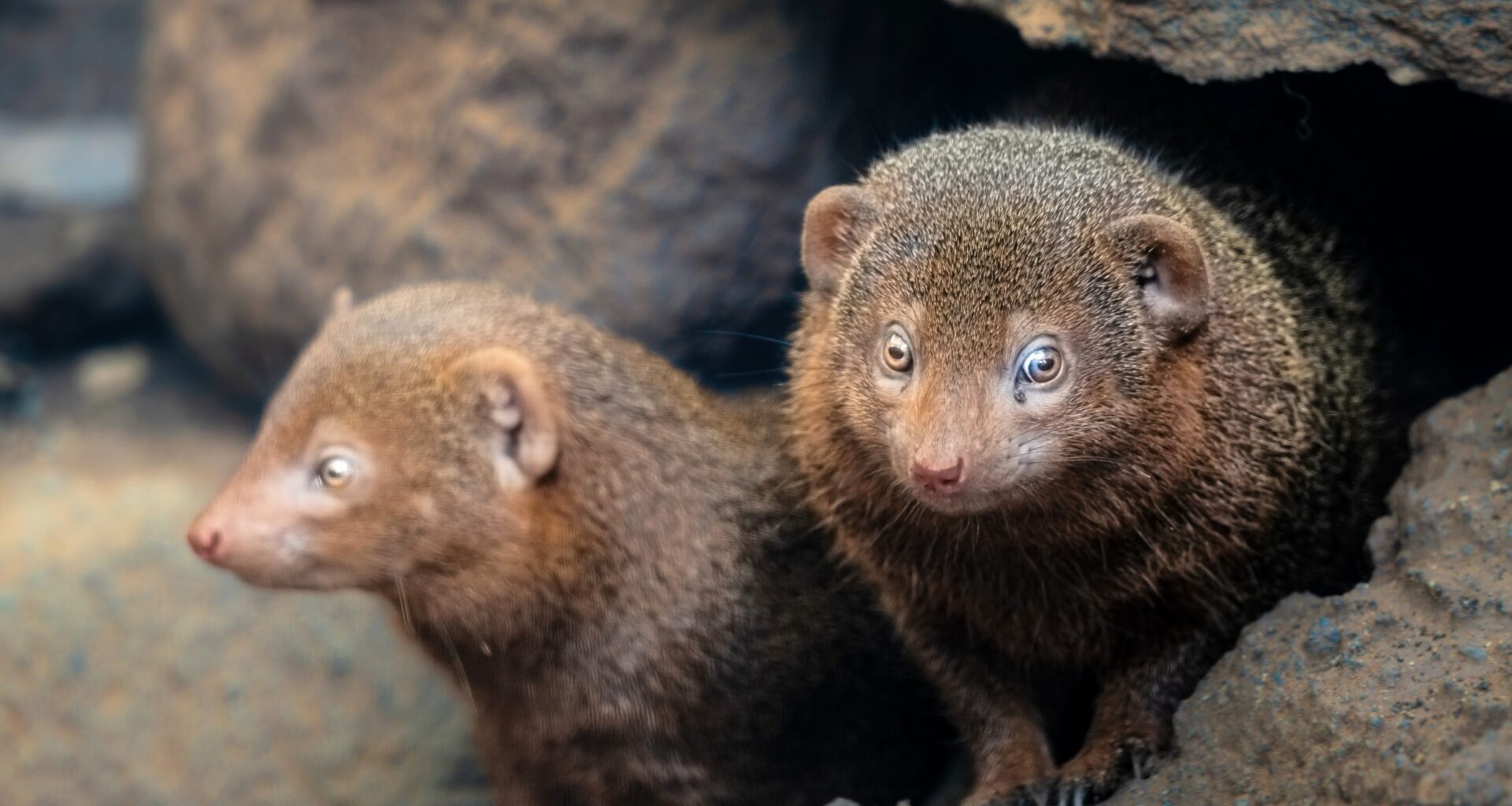
Conflict rarely arrives without warning. Animals that share a landscape with rivals often read the danger long before any clash actually begins.
New research shows that dwarf mongooses do exactly this.

Dwarf mongooses change how they move, communicate, and guard their territory in places where a fight feels likely – even when no rival is anywhere in sight.
The study, led by researchers at the University of Bristol, draws on a decade of close observation of wild groups in South Africa.
War starts before the fight
Scientists have long described a “landscape of fear” for prey animals dodging predators. This study stretches that idea toward rivals of the same species.
Groups of mongooses face threats from neighboring groups, not only from hawks or snakes. Those threats shape everyday decisions across the whole territory.
“Not only are the mongooses keeping track of where their enemies might be, but they’re factoring in the relative size of different groups. They can then tailor their pre-emptive behavior accordingly,” said Dr. Josh Arbon, who led the study.
That second point is the heart of the work. Most earlier studies asked only where danger sat, never who the enemy actually was.
Africa’s smallest carnivore
Dwarf mongooses are the smallest carnivore on the continent. They live in groups of five to 30 and defend a shared territory together.
Fights between groups break out often. These clashes can cause injury and sometimes death.
The team followed 12 wild groups across roughly 10 years. They logged more than 1,600 daily movement tracks, 16,000 guarding observations and 2,000 returns to sleeping burrows.
Crucially, the researchers studied calm stretches rather than active battles. Almost all the data came from days with no rival encounter at all.
Mongooses size up their rivals
Every group sits beside several neighbors at once. Some are larger, some smaller, some evenly matched.
Bigger groups usually win contests, so they carry the heaviest physical risk. Yet evenly matched groups bring a different danger, because fights with them tend to drag on and escalate.
The mongooses seem to track these differences. When a group entered the home range of a neighbor, that neighbor’s relative size shaped its next moves.
Louder calls for bigger rivals
Mongooses take turns acting as sentinels, climbing to a high spot to scan for danger. A sentinel often announces itself with a soft surveillance call.
Those announcements grew more frequent when the nearby rival group was larger. Each doubling of relative size lifted the chance of a call by around eight percent.
“We know that battles between groups can be very dangerous for participants. What we’ve shown now is that there are constant behavioral changes to mitigate these risks and enhance the likelihood of future contest success,” said Professor Andrew Radford, who supervised the project.
Better communication keeps the whole group coordinated. It also lets foragers ease their own watching once a trusted lookout speaks up.
Mongooses sleep away from rivals
Sleeping sites told a different story. Here the strongest reaction came against evenly matched rivals.
Groups grew least willing to sleep inside a similar-sized neighbor’s range. Around a quarter of all clashes happen at burrows, where escape can be hard.
Retreating to safer ground at night looks like sensible risk management. The cost of an ambush in a burrow is simply too high against a serious competitor.
The researchers also tested an old assumption that territory edges are always riskier than the core. The picture there turned out to be messy.
Groups did return to their burrows later when sleeping near an edge. But sentinels actually watched less at the edges, the opposite of what pure threat would predict.
Food, scent-marking duties and exposure all blur the meaning of a boundary. So spatial position by itself makes a poor guide to real danger.
How small mongooses survive rivals
The study formed part of the long-term Dwarf Mongoose Research Project, pioneered by Dr. Julie Kern and Dr. Amy Morris-Drake. Years of patient observation made these subtle choices visible.
“The dwarf mongooses are an ideal model species. Both because their lives are strongly affected by intergroup conflict and because we could observe them so closely in natural conditions,” said Dr. Kern.
“Conflict between groups is rife throughout the natural world. We have shown that animals are continuously making decisions in a landscape of conflict, not just when they actually encounter rivals,” added Dr. Morris-Drake.
According to Dr. Arbon, this work provides insight into how smaller groups are able to survive, and even thrive, amongst more powerful enemies by strategically moving through space and communicating about potential dangers.
The study is published in the journal Nature Ecology & Evolution.
—–
Like what you read? Subscribe to our newsletter for engaging articles, exclusive content, and the latest updates.
Check us out on EarthSnap, a free app brought to you by Eric Ralls and Earth.com.
—–