
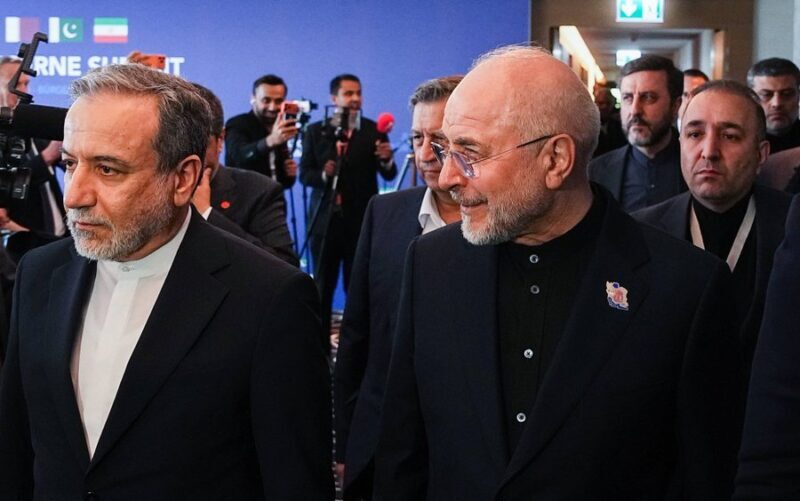
Iranian Foreign Minister Abbas Araghchi and Parliament Speaker Mohammad Bagher Ghalibaf arrive for talks with Trump officials in Switzerland, June 21, 2026
US-Israel Wars, Day 115 — Israel Attacks Break Brief Ceasefire With Hezbollah
Iranian Foreign Ministry spokesman Esmaeil Baghaei says Tehran did not negotiate on its nuclear programme and did not accept any new commitments in talks with the US.
He said interaction with the International Atomic Energy Agency will continue in accordance with current procedures, subject to the approval of Iran’s Parliament and decisions of the Supreme National Security Council.
Parliament speaker Mohammad Bagher Ghalibaf and Foreign Minister Abbas Araghchi are en route to Oman to discuss arrangements for oversight of the Strait of Hormuz.
Transit through the Strait of Hormuz has returned to the level of last Thursday through Saturday, following a drop on Sunday when Iran said it had again closed the waterway.
As of 1:30 p.m. (1100 GMT), 15 vessels had passed the Strait, on pace for the almost 30 crossings each on Thursday and Saturday.
At least five other ships appeared to have transited, according to AIS signals.
The Trump Administration is lifting sanctions on Iran’s production, sale, and delivery of crude oil and related products until August 21.
Treasury Secretary Scott Bessent cited Iran’s commitment in ongoing negotiations to “free and open transit” in the Strait of Hormuz and the return of International Atomic Energy Agency inspectors, following Israel’s 12-day war in June 2025.
The Israeli military lifted safety restrictions in eight communities near the Lebanese border from 6 a.m. on Monday.
A senior Lebanese security official said adherence to the ceasefire has been “almost total” since Saturday evening. An Israeli tank fired shells towards a village near the coastal city of Tyre and Israeli forces fired sound grenades in two other locations on Monday.
Israel’s war in southern Lebanon has caused around $1.38 billion in direct damage to buildings, estimates the UN Development Program and a Lebanese research center.
”In total, 11,095 buildings were completely destroyed, impacting 17,891 housing units, while 2,242 buildings sustained partial damage…and 9,311 buildings incurred minor damage,” said the UNDP and the National Council for Scientific Research.
US Vice President J.D. Vance, leading the US delegation in Switzerland, has hailed a process to reopen the Strait of Hormuz and a mechanism for “deconfliction” in Lebanon.
Vance also welcomed inspection of Iranian nuclear facilities by the International Atomic Energy Agency.
Iran’s negotiators have left Switzerland. The technical team, led by Deputy Foreign Minister Kazem Gharibabadi, will continue technical negotiations with the US, as well as Qatari and Pakistani mediators, on implementation of the Memorandum of Understanding.
Reconfirming Israel’s occupation of southern Lebanon, Israeli Defense Minister Israel Katz says there is no intention of withdrawing from the historic and strategic Beaufort Castle.
Katz claimed the medieval castle is “an integral part of the security zone in Lebanon and essential for the defense of the Galilee settlements and IDF forces”.
He emphasized, “As Prime Minister Netanyahu and I have clarified — Israel will not withdraw from the security zone in Lebanon.”
Israel occupied the castle as a base during its occupation of southern Lebanon between 1982 and 2000.
Transit of the Strait of Hormuz has again fallen after Iran’s announcement that it has closed the waterway over Israel’s attacks on Lebanon.
Only 12 vessels crossed the Strait on Sunday, down from 35 on Saturday, reported maritime intelligence company Windward.
Five of eight vessels entering the Strait had their Automatic Identification Systems turned off.
Iranian negotiators walked out in protest after Donald Trump threatened on social media, “Iran must immediately stop their highly paid PROXIES in Lebanon from causing trouble. If they don’t, we’ll hit Iran very hard again, just like we did last week, only harder!”
He followed up with a series of warnings on Fox TV, including “We may take over the Strait [of Hormuz] if we have to. I’ll blow the shit out of them”. He said he might order the kidnapping of the Iranian negotiators.
Trump threats to occupy Iran: “President Trump tells Fox News he spoke with Iranian officials overnight and said, ‘You close the strait and you won’t have a country.’ He went on to tell these officials, ‘You won’t even make it back to your f**king country…we’ll take over the rest of the country.'”
— Aaron Rupar (@atrupar.com) June 21, 2026 at 2:26 PM
Iran Parliament Speaker Mohammad Bagher Ghalibaf, leading Tehran’s delegation, responded:
Don’t they think that if their threats had any effect, they would not have reached today’s state of desperation? We do not take American threats into account.
They would do better to be careful with their statements; our armed forces are ready to respond to them in a different manner. No matter what they say, we are the ones who act.
Before the walkout, the Trump camp and the Iranians had met in an 80-minute session. Iranian State media emphasized that the talks focused on implementation of the Memorandum of Understanding and on Israel’s attacks in Lebanon, with no reference to Tehran’s nuclear program.
“Major Progress” for Iran Despite Opening Stumble
The Iranian delegation met Qatari mediators and then left the negotiating site. However, Pakistan and Qatar said discussion continued until the early morning, with technical talks planned for the rest of the week.
Iran Foreign Minister Abbas Araghchi praised Pakistan and Qatar for their mediation, saying that they “delivered major progress”. A Pakistani-Qatari joint statement said the US and Iran agreed to set up a “communication line” to avoid incidents in the Strait of Hormuz and to set up a “de-confliction cell” with Lebanon’s government to ensure the “adherence of the termination of military operations in Lebanon”.
Araghchi emphasized that the first test will be the deconfliction amid the Israeli attacks and Hezbollah’s response in Lebanon.
He pointed to achievements for Tehran such as lifting of US sanctions on Iranian oil and petrochemical exports, removal of the American naval blockade on Iranian ports, the release of some of Iran’s frozen assets, and the launch of the construction and development plan.