
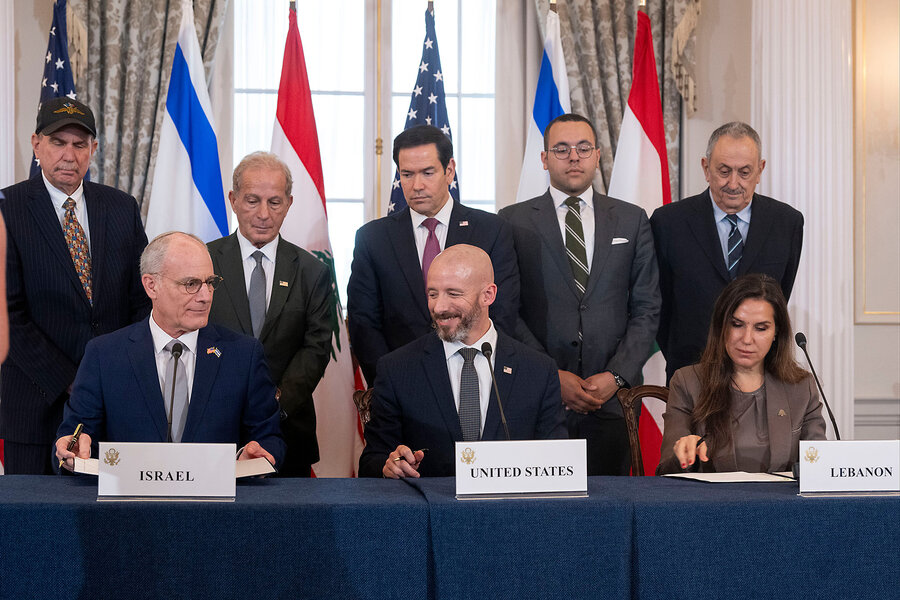
All but lost in the high-stakes drama over the fragile memorandum of understanding drafted to end the war with Iran, the Trump administration late last week took steps toward resolving another intractable conflict in the Middle East.
But with a very different approach.
It relied on the painstaking negotiation, careful drafting, explicit agreement on shared goals, and detailed provisions for implementation that have long defined traditional diplomacy.
Why We Wrote This
As a peace-builder, President Donald Trump has typically been short on the details of diplomacy and lofty with his stated goals. But with Lebanon and Israel, his administration is taking a more traditional approach to U.S. policy.
The Trilateral Framework announced last Friday alongside envoys from Lebanon and Israel – neighboring states entangled for decades in on-again, off-again fighting – still faces enormous obstacles to its ambitious aim: to “end the conflict” and achieve “lasting peace.”
In another hallmark of traditional diplomacy, U.S. Secretary of State Marco Rubio acknowledged this in remarks to reporters after the signing. The framework, he said, was merely the “beginning of the beginning.”
A “long road of work” lay ahead, Mr. Rubio added.
But the document itself represents a dramatic departure from President Donald Trump’s other diplomatic forays since returning to the White House for a second term.
The Iran MoU was just as advertised: a 2 1/2-page memorandum of bullet points, not a fully worked-out agreement, and open to very different interpretations by the United States and Iran.
In conflicts elsewhere, Mr. Trump has intervened by meeting with rival leaders and being quick to announce he had achieved “peace” – but again, without any formally negotiated terms – and then left the warring parties to sort out a workable, long-term understanding.
His most ambitious Middle East diplomatic initiative before the Iran memorandum was a 20-point plan from last September to end the war in Gaza.
That agreement did include provisions for Israeli pullbacks in phases. It envisaged demilitarization of the Palestinian territory, a group of “technocratic, apolitical” Palestinians to run Gaza’s affairs, an international force to maintain security, and a “Trump economic development plan to rebuild and energize” the enclave.
Only weeks later, flanked by the leaders of Egypt, Qatar and Turkey, the U.S. president proclaimed it a success.
Mr. Trump welcomed “the truly historic commitment and implementation by all parties to the Trump Peace agreement” for Gaza and the “opening of a new chapter for the region defined by hope, security and a shared vision for peace and prosperity.”

A Palestinian girl sits inside a house damaged during the Israel-Hamas war in Khan Yunis, in the southern Gaza Strip, July 1, 2026.
However, there was no detailed plan for how to ensure all of this was going to happen.
Even before the U.S. and Israel launched their war against Iran at the end of February, the Gaza “peace” had run aground. Hamas has not been comprehensively defeated and remains in control of much of the Gaza Strip. Israeli forces, rather than starting to pull back, have expanded operations and now occupy nearly 70% of the territory.
There’s been no sign of demilitarization of the “international stabilization force” that was due to deploy “immediately,” or of the economic development plan for the Palestinian enclave.
The U.S. agreement with Lebanon and Israel, by contrast, sets out a detailed, step-by-step plan for the “long road of work” Mr. Rubio anticipated if the two countries are going to end their conflict.
The core issue that the U.S.-brokered agreement seeks to address is Hezbollah. Though the Shiite militia’s leadership and capabilities have been severely weakened by Israel, it remains Lebanon’s most powerful armed force, with renewed support from Iranian leaders emboldened by the recent war.
The Israelis have moved troops and armor back into parts of southern Lebanon – an area they briefly occupied in 1978, invaded outright in 1982, and from which they finally withdrew more than 25 years ago.
The starting point of the accord between Israel and Lebanon is that both countries want Hezbollah to stop operating as a “non-state armed group.” The Lebanese government wants its national army to be in charge of security. And Israel is determined to end the threat of Hezbollah missile and drone fire on its civilians.

Municipal workers dismantle tents used by Lebanese people displaced by Israeli strikes, in Beirut, June 30, 2026. Many of the residents have returned to their homes.
The plan is for a “reciprocal, sequenced process” under which Lebanon’s army will take control; Hezbollah troops, weaponry, and infrastructure will be cleared out; and Israel will begin a phased withdrawal.
Two potential roadblocks loom especially large.
Lebanon’s army is nowhere near strong enough to impose its will on Hezbollah by force. It has good reason to avoid such a showdown anyway, in favor of bringing political pressure on the militia to pull out: the fear of a return to civil war.
Israel, for its part, is so far showing no readiness to pull out of Lebanon.
Prime Minister Benjamin Netanyahu paid a visit to troops there this week and reiterated his determination to stay put until Hezbollah was fully defeated, a vow he’ll be particularly reluctant to back down from in light of the Israeli election coming up later this year.
Still, the underlying assumption – or, at least, the hope – behind the tripartite framework is that by creating a gradual process, and demonstrating that each small step forward can work, both sides will have an interest in going further.
Yet that will depend not just on decisions taken in Beirut or Jerusalem.
Washington will matter critically.
The agreement lays out a number of important roles for the U.S.: upgrading the Lebanese army, securing humanitarian and wider economic assistance for Lebanon, and working closely with both countries to verify and support the process.
Ultimately, any progress might hinge on Mr. Rubio’s ability to deliver on a commitment he made in a formal statement, representing another significant change from earlier Trump administration diplomacy: “The United States,” he said, “will remain fully engaged.”