
HBO’s “The Pitt” mirrors doctors for entertainment, but a real-life Pittsburgh physician’s video game recently proved successful in asking peers to gaze into the mirror to improve health outcomes.
University of Pittsburgh researchers have found that an emergency room mobile video game called “Night Shift” has been found to improve treatment decisions for severely injured older patients, according to a study recently published in the Journal of the American Medical Association.
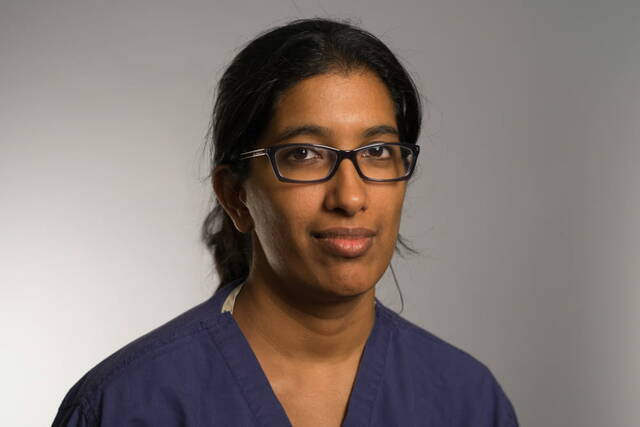
It was devised by Pitt associate professor of surgery and critical care medicine Dr. Deepika Mohan and crafted by Station Square-based Schell Games.
The clinical trial followed 800 emergency room physicians who, when exposed to the game, under-triaged patients they served in real life at a lower rate (49%) than those who did not play the game (57%). Outcomes improved by 13% for those who had played the game within 30 days. The study tasked participants with playing the game during an initial two-hour session and 20-minute sessions each quarter.
“Night Shift” sees the player become a young ER physician planning patient care and solving puzzles in 90 seconds amid a story set in a high-stakes trauma center.
Mohan hopes the game can be a better alternative to typical continuing education courses like Advanced Trauma Life Support, (the No. 1 trauma triage program in the U.S.) and prove the value of video games in rewiring behavior.
“[ATLS is] massively supported by the American College of Surgeons, but there is zero evidence that it actually changes behavior in the real world,” said Mohan, lamenting the system being propped up solely by pre- and post-test scores and noting the U.S. spends $2 billion to $3 billion on continuing medical education a year.
“That’s really the big innovation here … to show that by systematically going after mechanisms of behavior, we could change performance,” she added.
She’s now focusing on finding a formula that pushes beyond that time-sensitive 13% improvement result, aiming to double the effect size.
One night in ‘The Pitt’
Long before the game was conceptualized, Mohan had seen the problem firsthand. A night in 2008 that might have made the “The Pitt” cast blush served as the game’s first spark.
“When you’re on call at night at [UPMC Presbyterian], it’s like a non-stop onslaught,” Mohan said. “You’re just getting pounded. What I observed was that there were a bunch of people who came and we would get activated, and I would be thinking to myself, ‘Why in God’s name? Why am I here? This patient doesn’t have any injuries.’”
First, a young girl was flown in from Washington Hospital after totaling her father’s SUV.
“American cars in general now are built so that they crumple on impact — the car is totaled, but the person is safe,” Mohan said. “But our intuition about how bad an injury is is in large part driven by visual impressions.”
The physician at Washington found no injuries but transported the patient via helicopter to Presby without imaging.
“We can’t just take it for granted that he has done a complete evaluation,” said Mohan, tallying a snowballing cost of transport and treatment of “a couple hundred thousand dollars” that was “all because we just assumed that she was badly hurt when she wasn’t.”
That same night, an elderly woman was rear-ended while sitting at a stop sign and was admitted to a hospital complaining of stomach pain.
“[The physician] thinks to himself … the airbags didn’t deploy. She’s not screaming in pain,” Mohan said. When her imaging came in six to eight hours later, he found free fluid in her belly and transferred her via ambulance.
“By the time she arrives, she’s really sick. … We rush her to the operating room,” Mohan said. “And it turns out that the seat belts had torn the fat around the bowel.
“Now she’s septic and she’s sick, and she ends up on dialysis and she has this really protracted course. Now, it’s not a great injury to begin with, but it’s worsened by the fact that the diagnosis was delayed and it took her time to get into the operating room.
“Some of her outcome could have been improved if we had just made the diagnosis more quickly.”
The next morning, she vented to a mentor. He encouraged the behaviorally focused Mohan— then a research novice looking for a topic — to pull hospital records and begin analyzing.
“I didn’t know any of the strategies or the methods,” Mohan said.
Why gaming?
Dissatisfied with the results and medical literature, acting on a peer’s advice, she shifted to pedagogical literature. Together, she and Baruch Fischhoff, a Carnegie Mellon University Department of Engineering and Public Policy professor, measured the influence of intuition and heuristics (problem solving techniques or methods) on ER decisions.
With no history in video games, Mohan chose them as her vessel and enlisted Schell in 2016.
“I grew up in a generation where we didn’t really play video games. My parents wouldn’t have approved, I don’t think,” said Mohan with a laugh. “I was looking for a strategy that could be delivered to a lot of people with not a lot of effort. And I wanted something that physicians would find fun and engaging.”
She drew inspiration from Pokemon Go, a game that had led users to lose weight; a paper in Nature about using video games to improve cognitive control in older adults, and from her mother’s work as a chemistry teacher.
“My mom could hold her room. I know that because I was in her class for a couple of years, and these kids who were not super academically motivated would pay attention to her,” Mohan said.
Narrative was important.
“I read, and I think that books and movies do change behavior through narrative. That was what I found compelling,” said Mohan, noting some have responded better to the narrative element and others to puzzles.
Schell Games jumped on the yearlong grant project with a six-person team.
“If a doctor makes a decision, A versus decision B, this person gets the care they need or they get missed and then they die,” recalled Schell principal engineer Rob Gordon. “That’s a level of seriousness we’re not quite used to in what we make here at Schell.”
But their ethos aligned.
“I am somewhat regularly pushing against the sentiment of games being mostly a waste of time, something for kids or something you do when you’re out of better things to do with yourself,” said project manager Michal Ksiazkiewicz. “So every time I get any kind of validation of — it’s an important medium that can do important things — it’s very gratifying.”
Beyond industry norms and next steps
Mohan believes many healthcare industry woes can be traced back to the Institute of Medicine’s 1998 report “To Err is Human,” which led to much subsequent research focusing on designing systems around “the person who’s the problem.”
“If people are making mistakes, let’s think about what we can do to make them better at what they do,” Mohan said. “Most people want to come to work and make a change. They want to do meaningful work. They want to be better than they were yesterday. But too often we also don’t have the strategies in place to make that possible.”
She hopes to examine other areas of healthcare, posing: “So we’ve done it in trauma, but does it work in other spaces?”