
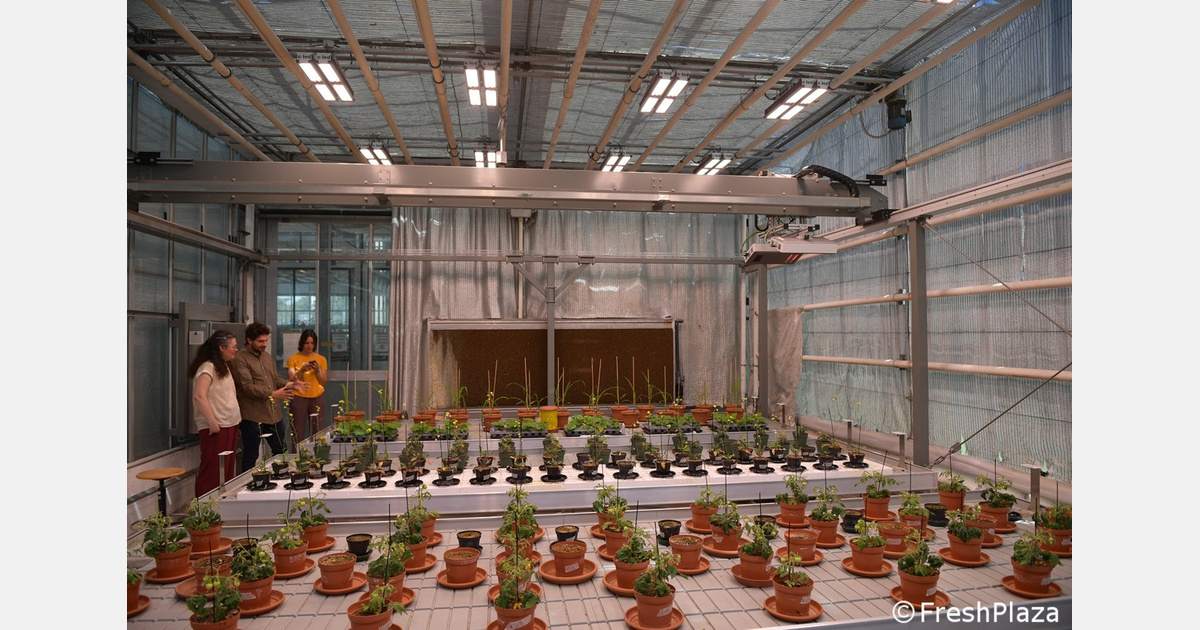
Resilience to stress and adaptation to changing climatic conditions, as well as responses to biostimulants and to different nutritional conditions and water availability. At the Department of Biotechnology at the University of Verona, research is bearing fruit thanks to the work of researchers and lecturers who devote their time and resources to horticultural and fruit crops.
In the Department’s greenhouse, recently fitted with new C-LED lamps supplied by the Orlandelli Organisation, the focus in recent weeks has been on tomatoes, rocket, maize and grapevines. Researcher Elisa Fasani and Professor Anita Zamboni explain: “Our research in the field of plant science is focused on studying the underlying mechanisms – that is, the genetic characterisation of physiological processes, such as photosynthesis, and the mechanisms of response to abiotic stress or pathogens.”
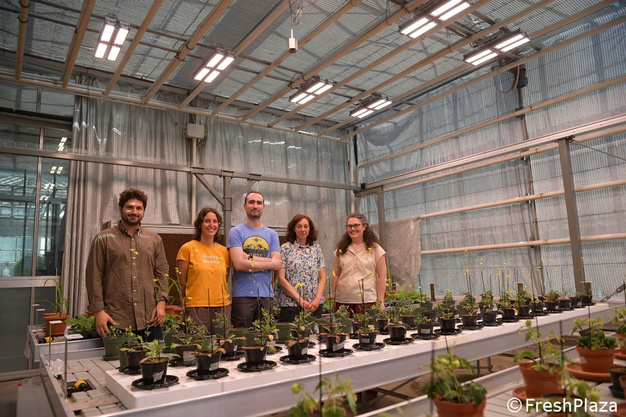 © Cristiano Riciputi | FreshPlaza.comCristian D’Elia, Emma Ribul Moro, Mauro Maver, Anita Zamboni, Elisa Fasani
There is no shortage of links with the business community, as Fasani clearly describes. “We develop a whole range of interactions with companies where applied research is carried out, such as on the efficiency and nutritional properties of fertilisers or biostimulants, or studies into the potential for responding to nutritional, abiotic or biotic stresses.”
A question that almost all entrepreneurs ask is how to help plants adapt to a climate that is no longer what one would expect. “Research is also moving in this direction. For example, we are increasingly observing a shift in the phenological phase associated with the rise in average temperature, so we are trying, amongst other research, to identify natural compounds to slow down the ripening process.”
“At the Department of Biotechnology, we have been studying the dynamics of ripening for many years now, in order to understand how these processes might be regulated. Plant genetics plays an important role, which is why we also carry out genetic research to select genetic lines in which these physiological mechanisms are improved, seeking to meet the needs of the agricultural sector.”
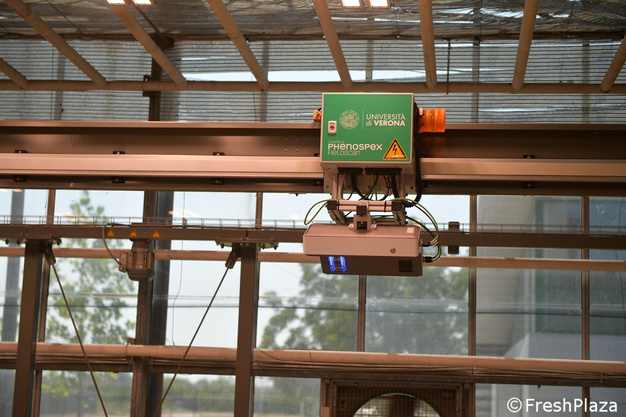 © Cristiano Riciputi | FreshPlaza.comThe phenotyper
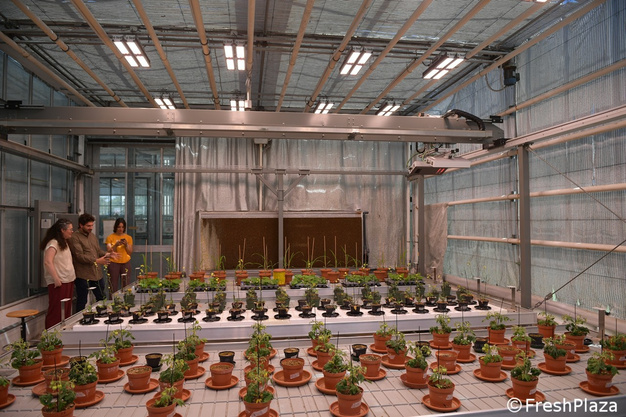
The research greenhouses, the first of which were established by this Department at the University of Verona over 25 years ago. In recent months, the lighting has been upgraded to C-LED lamps to increase efficiency. “In our greenhouse,” continues Fasani, “lighting is used as a supplement (in three out of four rooms), and we have noticed significant differences. In our case, artificial light kicks in when the amount of photosynthetically active light falls below a certain level, or when we need to maintain specific photoperiods in response to seasonal changes.”
“In the case of the fourth room, where the phenotyper is located, light becomes essential because the system is based on the principle of reflectance of wavelengths in the visible and near-infrared ranges. Variations in light also affect the instrument’s measurement capabilities. We therefore need stable and constant lighting.”
 © Cristiano Riciputi | FreshPlaza.com
One piece of equipment recently acquired by the Department of Biotechnology is the “phenotyper”. The sensor it is fitted with moves above the plants. It is equipped with a light source and a detector. The scanner, as it passes over the plants, essentially produces a ‘point cloud’ – a 3D image of the plant – which is converted on the computer into precise measurements, enabling the assessment of every stage of the plants’ growth. The platform allows us to characterise the parameters of plants improved for agronomic traits using methods ranging from traditional cross-breeding to modern techniques such as genome editing,” concludes the researcher.
A partnership for the horticulture of the future
The complete supply of this system is the result of a joint design effort carried out collaboratively by C-LED and Organizzazione Orlandelli. “As the official distributor and partner for our lighting solutions,” explains Raffaello Montanari, C-LED’s sales manager for the horticulture and floriculture sector, “Organizzazione Orlandelli brings expertise and experience to the table. These skills enable us to integrate and precisely apply C-LED lighting systems to professional equipment, such as DC trolleys, vertical farming systems and production facilities, with the aim of optimising space and crop yields to the fullest. These are versatile, bespoke solutions capable of meeting any requirement: from the most advanced scientific research laboratories to intensive greenhouse cultivation.”
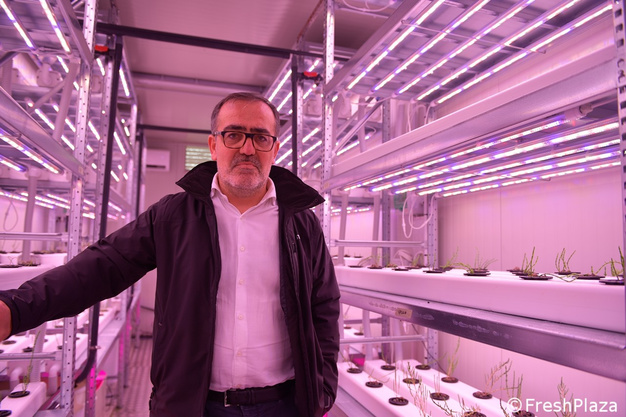 © Cristiano Riciputi | FreshPlaza.comRaffaello Montanari, C-LED’s sales manager for the horticulture and floriculture sector
Operational synergy and division of roles
“For this project to succeed,” says Cristian D’Elia, technical manager, “the collaboration took place on several levels. As C-LED, we handled the site inspections, field surveys and the collection of technical specifications from the researchers. This phase led to the development of a dedicated, bespoke lighting design, tailored to meet the exact agronomic requirements in terms of light spectrum, intensity and the arrangement of the luminaires across all four areas.”
“For its part, Organizzazione Orlandelli, thanks to its in-depth knowledge of the market and its robust structure, managed all commercial aspects and the complex logistics, ensuring seamless integration between the lighting systems and the structural supports.”
“Seeing this technological system in operation today, fully functional and performing to the highest standard, is a source of immense satisfaction for us,” concludes Marco Orlandelli, head of Organizzazione Orlandelli.
For more information
C-LED
Via Gambellara, 34
40026 – Imola (BO) – Italy
+39 0542 654980
[email protected]
www.c-led.it
Organizzazione Orlandelli
Via Lombardi, 26
46010 Curtatone (MN) – Italy
+39 0376 960311
[email protected]
www.orlandelli.it