
Dear readers, faithful companions of the lantern and the basketball,
There are nights when I retrace the path of the centuries. When I do not merely gaze at the sky, but at those who, before us, gazed at it. There are nights when I measure how fortunate we are, you and I, to live in an age when the light of the stars reaches us without being smothered by the hand of censors, inquisitors, or tyrants. At least, not yet.
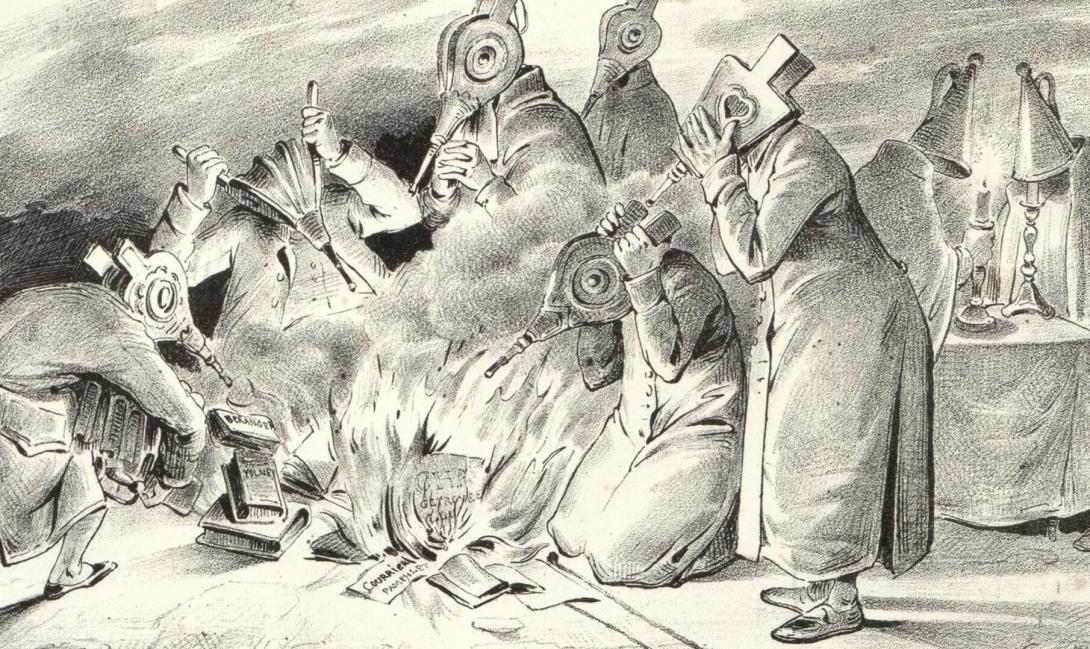
Tonight, I invite you on a journey through time. A long march, from the first sacred terrors of our ancestors to the space telescopes that pierce infinity. A history of astronomy, with its flashes of genius, its tasty anecdotes, its heroes and its heretics. But also a history of obscurantism. For the quest for knowledge has never been a long, quiet river. It has always been a struggle. A struggle against ignorance, against fear, against those who prefer darkness to light.
And as we walk this path, we shall see that the forces that persecuted Galileo have not vanished. They have changed their costume, but not their soul.
1. The First Watchmen: Mesopotamia and Greece
It all began six thousand years ago, in the fertile plains of Mesopotamia. The Sumerians, the Babylonians, the Assyrians lifted their eyes to the sky. They did not practise science in the modern sense, but they observed, they noted, they compiled. The earliest cuneiform tablets record the movements of Venus, lunar eclipses, the cycle of the seasons. The ziggurats were both temples and observatories. The priest-astronomer was an intermediary between the gods and mankind. The sky was a message. It had to be deciphered.
Then came Greece. There, something fundamental changed. The Ionian thinkers, Thales, Anaximander, Anaxagoras, — were no longer content simply to observe. They sought to understand, without resorting to the gods. They wanted natural causes. Anaxagoras, in the fifth century before our era, dared to say that the Sun was not a god, but an incandescent stone. A stone! He was condemned for impiety and had to flee Athens. It was the first trial in the history of astronomy. It would not be the last.
2. The First Measurement of the World: Eratosthenes and Aristarchus
I have already told the story of Eratosthenes, the librarian of Alexandria who measured the circumference of the Earth with a stick and a well. But I wish to return to it, for it is dazzling proof that science needs no advanced technology to perform miracles. Only a sharp mind and a little geometry.
Aristarchus of Samos went further. He proposed, eighteen centuries before Copernicus, that the Earth revolved around the Sun. He measured the distance of the Moon, attempted that of the Sun, and understood that the stars were other suns, incredibly distant. His ideas were so audacious that they were almost forgotten. Geocentrism, championed by Aristotle and Ptolemy, prevailed for centuries. The Earth once again became the motionless centre of the universe. The obscurantism was not yet religious. It was philosophical. But already it was freezing thought.
3. The Medieval Night and the Keepers of the Flame
The Middle Ages have long been spoken of as an era of absolute darkness. That is unjust. It is true that Christian Europe was suspicious of pagan science. But during that time, in the Arab-Muslim world, astronomers were carrying the torch. Al-Battani, Al-Sufi, Al-Tusi, Al-Khwarizmi translated Ptolemy, built observatories, refined astronomical tables, named the stars. Words like “algebra,” “zenith,” “nadir,” “Betelgeuse,” “Aldebaran” come to us from that brilliant age.
 BNF
BNF
In Europe, it was not until the twelfth century that Greek and Arabic texts were rediscovered, translated, and disseminated. Thomas Aquinas attempted a synthesis between Aristotle and Christianity. Universities were born in Bologna, Paris, and Oxford. Curiosity was reawakening, slowly, fragilely.
But obscurantism kept watch. In 1277, the Bishop of Paris condemned two hundred and nineteen philosophical propositions, several of which touched upon astronomy. It was forbidden to teach that the world could be eternal, or that the heavens could have multiple centres. Thought was under surveillance.
4. The Broken Revolution: Copernicus, Bruno, Galileo
Then came the Renaissance. Copernicus, a Polish canon, published his De revolutionibus orbium coelestium in 1543. In it, he set the Earth back in motion, the Sun at the centre. But he did so with prudence, almost with regret, knowing the scandal it would provoke. He died the very year of its publication.
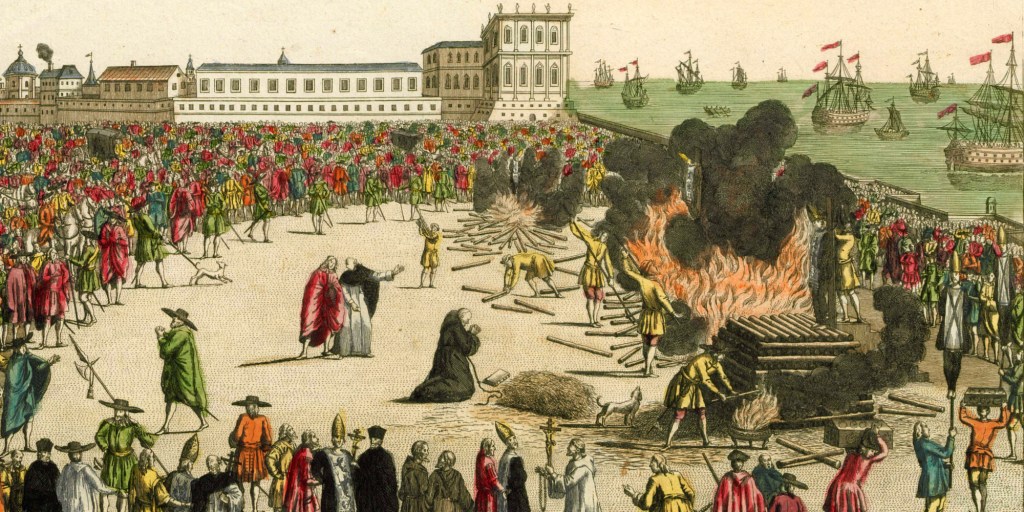
Giordano Bruno was less fortunate. A Dominican monk and philosopher, he took up Copernican ideas and pushed them further. He imagined an infinite universe, populated by an infinity of inhabited worlds. This, the Church could not tolerate. He was arrested, tried, and burned alive on 17 February 1600, on the Campo de’ Fiori, in Rome. Legend has it that he replied to his judges: “You feel more fear in pronouncing my sentence than I do in enduring it.”
And then came Galileo. The father of modern science. The one who pointed a telescope at the sky and saw the mountains of the Moon, the phases of Venus, the satellites of Jupiter, sunspots. He brought proof that the cosmos was not perfect, that the Earth was not the centre, that the universe did not revolve around us.
The Church summoned him. The trial of 1633 is one of the darkest moments in the history of thought. He was threatened with torture. He was forced to recant. He was placed under house arrest until his death. Legend has it that he murmured, as he left the court: “Eppur si muove” , “And yet it moves.” The phrase is probably apocryphal. But the spirit is true.
This is what obscurantism does. It burns, it threatens, it gags. It cannot bear for the universe to be larger than its dogmas.
5. The Parallel with Our Own Time
Dear readers, allow me a moment of cold anger.
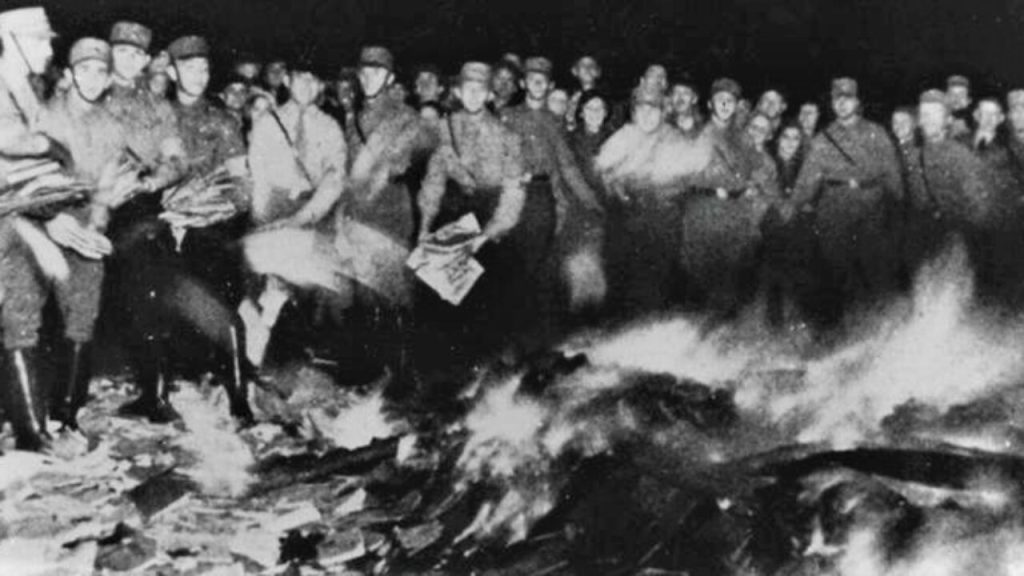
When I look at what is happening today in the United States, I see the same mechanisms at work. The same defiance toward science, the same will to bend it to political interests, the same contempt for truth. The Trumpist movement, that blend of populism, nationalism, and hatred of intellectual elites, bears an uncanny resemblance to the forces that, in 1600, lit the pyre of Giordano Bruno.
They no longer burn bodies, certainly. But they burn research budgets. They censor climate reports. They remove the words “climate change” from government websites. They appoint oil lobbyists, merchants of doubt, and lawyers of ignorance to head scientific agencies. They call journalists enemies of the people and scientists corrupt elites. They create their own reality, populated by “alternative facts,” where truth is whatever the leader says it is.
 Magasine l’Illustré
It is the same mechanics. The same fear. The same arrogance. Yesterday, the Inquisition refused to look through Galileo’s telescope. Today, the Trump administration refuses to look at CO₂ curves, ice cores, satellite measurements. Yesterday, heliocentrism was condemned in the name of the Bible. Today, climatology is condemned in the name of profit.
We have changed eras, but not the struggle. The lantern I hold is the same as Galileo’s. It is fragile. A gust of wind can blow it out. But as long as hands pass it on, it shines.
6. The Enlightenment and the Classical Age
Fortunately, the lantern did not go out. Newton, in the seventeenth century, discovered universal gravitation. The same force that makes the apple fall holds the Moon around the Earth and the planets around the Sun. The universe became a great clockwork, governed by mathematical laws.
Halley, Newton’s contemporary, predicted the return of the comet that bears his name. When it reappeared in 1758, as foretold, it was a triumph. Science no longer merely described. It predicted.
Herschel, a musician turned astronomer, discovered Uranus in 1781. For the first time since antiquity, a new planet appeared in the sky. The universe was growing larger.
7. The Nineteenth Century: The Birth of Astrophysics
The nineteenth century was that of spectroscopy. Frauenhofer, in Germany, broke down the light of the Sun and discovered dark lines within it. Each chemical element, each atom, thus leaves its fingerprint in light. We could now know the composition of stars without ever touching them.
It was a woman, Henrietta Swan Leavitt, who discovered the period-luminosity relationship of Cepheids, that key which later allowed Hubble to measure the distances of galaxies. Another woman, Cecilia Payne, discovered that stars are mainly composed of hydrogen. These Harvard “computers,” long forgotten, are today recognised as pioneers.
8. The Twentieth Century: The Expanding Universe
Edwin Hubble, in 1923, observed Cepheids in the Andromeda Nebula. He proved that it was a galaxy outside our own, millions of light-years away. The universe had just grown in an instant.
A few years later, he discovered that galaxies were moving away from us. The further they were, the faster they fled. The universe was expanding. This discovery led to the Big Bang theory, bolstered in 1965 by the discovery of the cosmic microwave background, the fossil murmur of the primordial universe.
Radio astronomy, infrared astronomy, X-rays, gravitational waves: each new window opened onto the sky revealed a richer, more violent, more mysterious universe. Black holes, theorised by general relativity, became real objects, detected, weighed, photographed.
9. The Watchman’s Lesson
Dear readers, we have now reached the end of this road. You have seen the pyres and the telescopes, the condemnations and the discoveries. You have seen that obscurantism is a hydra. One head is cut off, and another grows back. Galileo won, but Bruno died. Copernicus triumphed, but centuries after his death. Today, science is under attack once more. Not by the Church, but by the merchants of doubt, the populists, the autocrats.
 T
T
But you have also seen that light always ends up breaking through. Truth is stubborn. It is patient. It needs no violence to triumph. It needs witnesses, watchmen, citizens who refuse to be silent.
I am an astronomer. I am not a politician. But I know a pyre when I see one. And I know that the best answer to obscurantism is knowledge. The best answer to hatred is beauty. The best answer to lies is the lantern.
I set my lantern down on the table. It flickers. But it burns. As it burned in Samos, in Alexandria, in Florence, in Harvard, in Pasadena, on Cerro Paranal. And I hold it out to you. Take it. Protect it. Pass it on. For the night is long, but the dawn is promised to those who keep watc
François