

Source | Plataine
Plataine (Waltham, Mass., U.S.) will demonstrate its next generation of AI Agents for composites manufacturing at CAMX, built to move beyond dashboards, reports and conversational AI toward software designed to help optimize factory operations in real time.
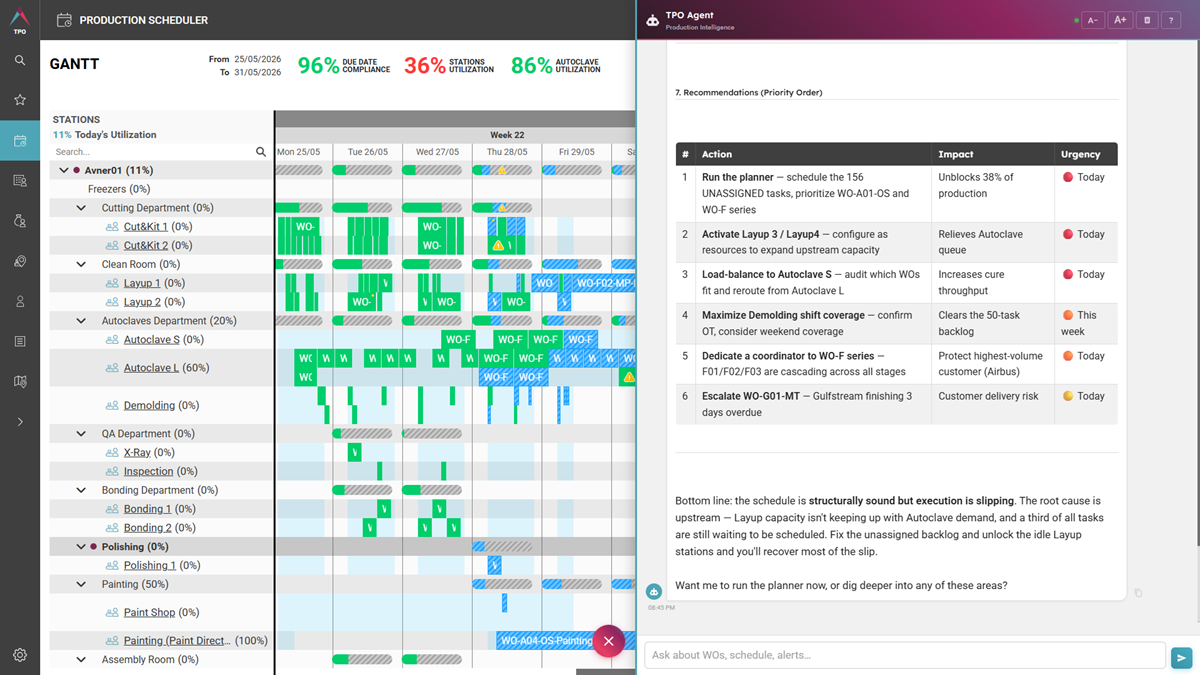
The AI Agents are built to continuously monitor production, material availability, tooling, equipment status, quality constraints and production schedules, with the aim of identifying bottlenecks, predicting risks, recommending actions and, when authorized, automatically executing approved decisions within defined operational boundaries. Where traditional AI assistants are limited to answering questions, Plataine positions its AI Agents as proactive contributors to plant operations: the system is designed to continuously analyze production variables, simulate alternative production scenarios and explain the impact of each option to help planners make decisions with added transparency and auditability.
At CAMX, booth visitors will see live demonstrations of several manufacturing AI Agents. The AI Production Scheduler is designed to dynamically reschedule production in response to changing priorities, machine availability and unexpected disruptions. The Material AI Agent is aimed at helping prevent material shortages, optimize inventory utilization, reduce waste and minimize out-time risk. Additional AI capabilities on display address equipment utilization, tooling management, supplier connectivity and manufacturing execution.
The demonstrations are also intended to show how Plataine’s AI Agents work across manufacturing functions rather than optimizing individual processes in isolation, sharing information between scheduling, materials, tooling, quality and production operations with the goal of improving overall factory performance rather than shifting a problem elsewhere. The company says the AI Agents are built to integrate with existing ERP, MES, PLM and IIoT systems, drawing on operational data already in place without requiring manufacturers to replace current software infrastructure.
According to Plataine, manufacturers using its Agentic AI can expect gains in production throughput and material use, along with reduced planning time, fewer delays and improved on-time delivery performance, supported by recommendations intended to be explainable to engineers and planners.
Plataine frames the offering as a response to rising production complexity, labor shortages and supply chain uncertainty, positioning its AI Agents as software intended to actively support manufacturers’ operational decisions on an ongoing basis.