
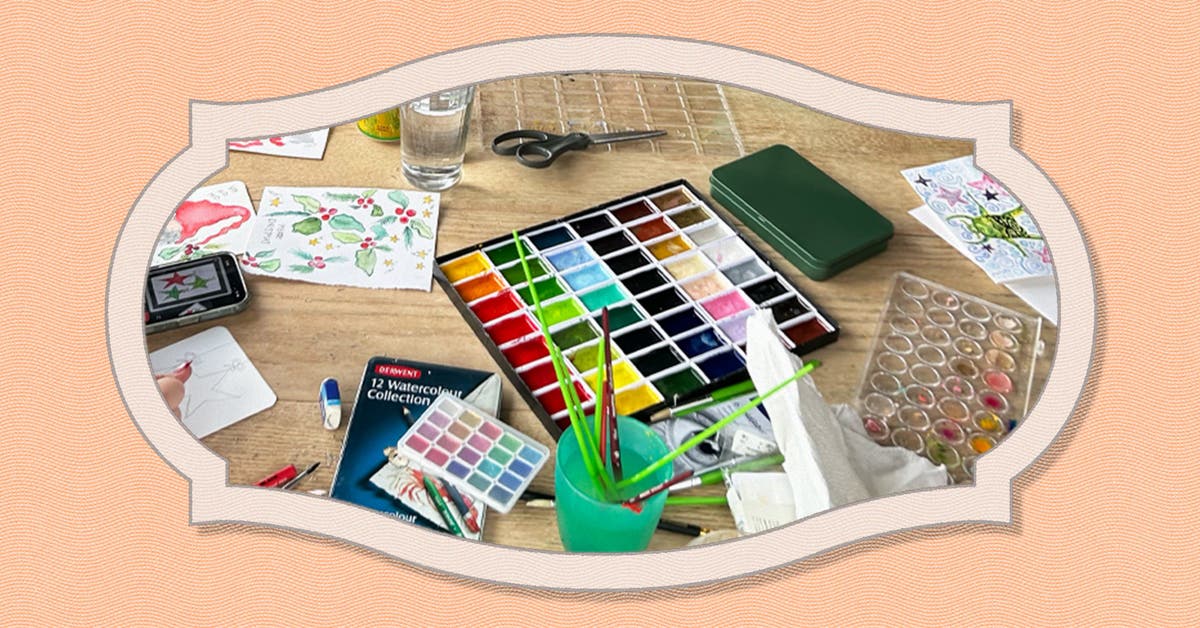
I have always been attracted to art supplies, and I love looking at art. But I do not consider myself a visual artist. Although I’ve taken a few art classes, my talent begins and ends at Pictionary.
At least that’s what I’d thought until a few years ago, when I got my hands on a leaf-green, linen-covered box of paints to test for a Wirecutter gift guide. The box contained a 6-by-8 grid of sumptuous watercolors made by Kuretake, a Japanese calligraphy and sumi (traditional ink wash) maker founded in 1902.
The set was so beautiful that I couldn’t just let it sit there once I was done testing it. Inspired, I signed up for a 30-day drawing challenge with Bay Area–based artist Wendy MacNaughton (whose work I knew from The New York Times).
For the next 30 days, in 15-minute spurts, I experimented with the saturated Kuretake Gansai Tambi Watercolors in the privacy of my own home. It was fabulously liberating to paint without the least bit of pressure to create something that I’d show anyone — and even without the pressure to get better. I didn’t have to become a good artist. I just had to enjoy my paints. And enjoy them I did.
Sometimes a small-yet-beautiful gift is exactly the encouragement you need to take up a new hobby or explore a part of yourself you haven’t before. Now, whenever I open the light green box, I know I’m giving myself the gift of creative joy and discovery. And that’s why I also love presenting this beautiful set to others: It contains all sorts of inspiration and possibilities. For the right person at the right time, these paints could be a gift that keeps on giving in the truest sense.
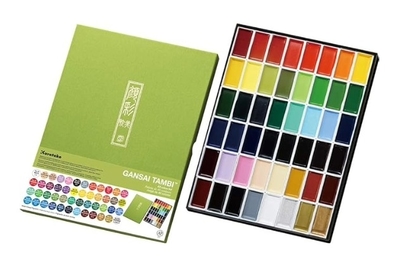
With their unparalleled opacity, pigment, and gloss, these watercolors are the best we’ve found for all kinds of amateur artists.
Gansai tambi are Japanese pan watercolors known for their intense pigment and easy dissolution, and they’re much different from the Crayola watercolor sets you might be familiar with from childhood. The paints themselves are creamy and vivid, and it’s satisfying just putting them to paper. You can create either a dense, opaque look or a more-fluid, transparent watercolor look. If you use a thin enough brush, you can do very detailed work.
These watercolors are also forgiving. If I blob the paint on too thick, I can dab it off with a paper towel. If I get the color wrong, I can add water or mix in another shade. If I mess up the entire thing beyond hope, well, none of it feels too precious to trash and start over. Unlike more-expensive fancy watercolors, like those from legendary British brand Winsor & Newton, Kuratake’s watercolors are affordable enough for the hobbyist or beginner. A year and a half later, I am still on the same set, with lots of life left to go.
Kuratake’s 48-color set contains all of the colors I need, plus a couple of metallics. And I like that even though this is not technically a travel-size set (at 9 by 11.5 inches, the Kuratake set is about the size of a standard notebook), it’s packable enough to take on trips. If you prefer a tiny travel set, Kuretake does make one, as well as sets of 12 to 36 colors. The company also makes special color palettes, like Art Nouveau and Graphite Colors, as well as a 100-color deluxe box set.
Each Kuratake set comes with a color chart (for you to paint in and reference) and a plastic mixing tray, but you’ll have to get your own brushes.
This painting came from my imagination, but I had to look up what a dog looks like. Samantha Schoech/NYT Wirecutter
My friend in Italy requested a donkey, so I copied this asino from a photo.
Samantha Schoech/NYT Wirecutter
This painting came from my imagination, but I had to look up what a dog looks like. Samantha Schoech/NYT Wirecutter
Full disclosure: After the 30-day challenge ended, I did not keep up my daily painting practice, but I did keep painting. It’s something I do to relax while I’m listening to an audiobook or a podcast, or when I’m doing nothing at all. I’ve found out that I am much, much better when I have an image to reference. When I try to paint from my imagination, I completely forget what a tree looks like, or a cup, or a person. And I am still much too uptight to paint good abstracts.
A rainy-day painting session with my daughter and her friends. Samantha Schoech/NYT Wirecutter
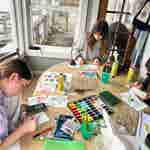
Two years after getting my Kuretake Gansai Tambi Watercolors, I still wouldn’t call myself a visual artist, but I do paint all of my own cards now. I take my paints and a pad of watercolor paper (I love this Fabriano 7-by-10-inch spiral-bound pad) with me on every trip. And I’ve found that I love making visual journals of special days. I’ve also found that painting can be social, and I’ve had wonderful rainy-day sessions with my dad, my daughter, and friends. I’ve even spotted some of my works on a fridge or two.
I have Wendy MacNaughton to thank for my newfound enthusiasm for painting. (If you’re giving these paints to a non-painter, I highly recommend her program, The Grown-Ups Table, for delightful, low-pressure art prompts to help them get started.) But I also, most definitely, thank the paints themselves. They are so beautiful and so beguiling that I simply had to give them a whirl.
This article was edited by Katie Okamoto and Catherine Kast.
Further reading