

Likud’s roughly 4,500-member Central Committee approved a proposal on Monday to significantly expand Prime Minister Benjamin Netanyahu’s control over the party’s Knesset slate, granting him eight reserved slots in the top 29 places on the list ahead of the October 27 election.
The measure gives Netanyahu unprecedented influence over more than a third of the party’s realistic slate, with Likud currently polling at 21-23 seats, after months of delayed negotiations and his failed efforts to cancel primaries and form a committee to select candidates.
The vote came a day after Likud’s internal court struck down Netanyahu’s bid to allow the party to cancel its August 17 primary in the event of a “wartime situation” and instead select candidates through an appointed committee controlled by the premier.
It passed despite rare public dissent from within Likud, led by MK David Bitan, who argued it would push incumbent lawmakers down the list in favor of Netanyahu’s handpicked candidates. There are also concerns that the move could elevate candidates who are highly popular among the Likud base — including MK Tally Gotliv and ministers Shlomo Karhi and May Golan — but who internal party polling suggests are less appealing to moderate right-wing and swing voters whose support could prove decisive in the upcoming national election.
Likud uses a complex primary system to determine much, though not all, of its candidate list, and has long prided itself on its internal democratic processes.
Get The Times of Israel’s Daily Edition
by email and never miss our top stories
By signing up, you agree to the terms
In a video released before the vote on Monday, Bitan urged Central Committee members to reject the proposal, accusing Likud Constitution Committee chairman and minister Haim Katz of “building a faction within a faction” and suggesting that Katz had backed the premier’s proposal, first approved by his committee, in exchange for a reserved slot for himself or an ally.
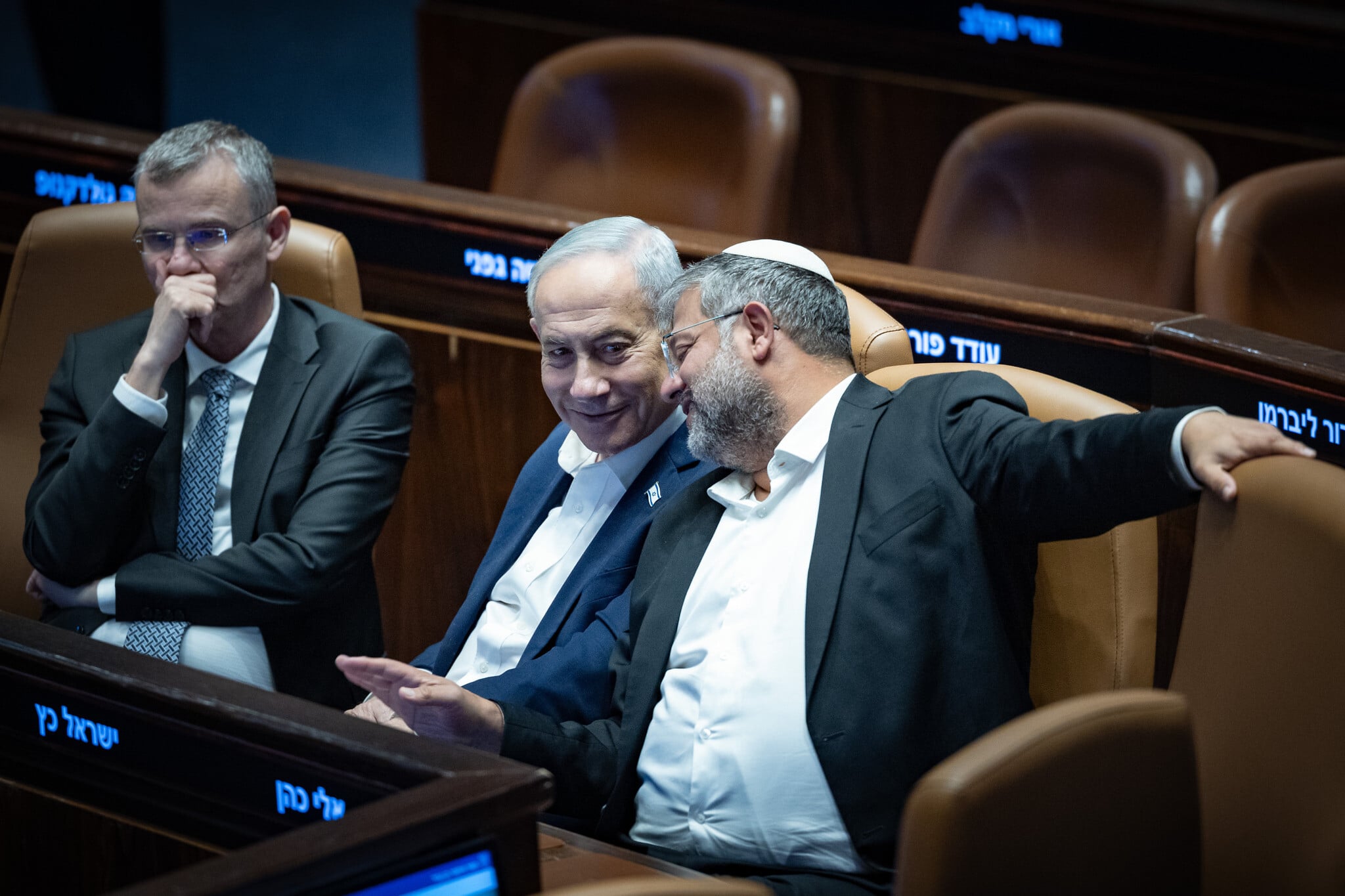
Prime Minister Benjamin Netanyahu and National Security Minister Itamar Ben Gvir attend a vote at the plenum hall of the Knesset in Jerusalem, on July 16, 2026. (Yonatan Sindel/Flash90)
Bitan has said several of the reserved slots are expected to go to politicians outside Likud, including Foreign Minister Gideon Sa’ar, whose New Hope faction merged with Likud last year. Media reports have also suggested New Hope MKs Ze’ev Elkin and Michel Buskila, as well as either Katz or his close ally MK Eti Atiya, could receive reserved spots.
Bitan and others have also speculated that the prime minister intends to use two slots for a member of Finance Minister Bezalel Smotrich’s Religious Zionism and National Security Minister Itamar Ben Gvir’s Otzma Yehudit parties, in a bid to incentivize the two parties to run together on a joint list, since Smotrich’s party has been hovering around the electoral threshold for months.
According to senior Israel Democracy Institute researcher Assaf Shapira, the arrangement would allow Netanyahu to allocate places on Likud’s slate to candidates formally representing allied parties, even though they would not remain part of the Likud faction after the election, which is what they did in the last election in 2021.
“Likud held one place for Ofir Sofer from Religious Zionism and ran as a joint list between Likud and Sofer’s one-man faction, which was formed only for this purpose,” Shapira said of the 2021 election. “Immediately after the election, his ‘party’ split from Likud and Sofer joined Religious Zionism. It was part of a broader political deal intended to convince Smotrich to run on a joint list with Ben Gvir.”
The same mechanism could now allow Netanyahu to reserve realistic places on the Likud slate for candidates from Religious Zionism or Otzma Yehudit. Doing so would strengthen Netanyahu’s prospects of forming a coalition by encouraging Smotrich and Ben Gvir to run together, maximizing the right-wing bloc’s overall seat count and reducing the risk of either party failing to cross the electoral threshold, but further reduce the number of winnable positions available to Likud candidates.
The expectation that many of the reserved slots could go to politicians from outside Likud as part of the prime minister’s efforts to bolster his coalition has fueled anger among some party lawmakers, even as others have sought to curry favor with Netanyahu in hopes of securing one of the few remaining slots on the list.
Communications Minister Shlomo Karhi urged activists in his own video to vote in favor of the proposal and “stand behind the prime minister until victory.” Defense Minister Israel Katz, Transportation Minister Miri Regev, Knesset Speaker Amir Ohana and coalition whip Ofir Katz were among the many others who released videos urging voters to support the measure.
We can’t do this work alone.

The war with Iran has been draining for all of us in Israel. But when I heard about a high casualty incident – ballistic missile impacts in Arad and Dimona that left nearly 200 people wounded – I drank a cup of coffee, packed a bag, and headed south.
There, I spoke with Shilgit, the head of an after-school program for underprivileged youth. Standing outside her destroyed center, Shilgit said it was a miracle that no children were hurt and spoke about the community coming together in the hours since.
As a Times of Israel reporter, I’m committed to telling stories of resilience like Shilgit’s. But my colleagues and I can’t do this alone. If you value work like this, please consider joining our reader support group, The Times of Israel Community. Your financial support is essential to keep real human reporting like this going.
— Stav Levaton, military reporter
Already a member? Sign in to stop seeing this
You’re a dedicated reader

That’s why we started the Times of Israel – to provide discerning readers like you with must-read coverage of Israel and the Jewish world.
So now we have a request. Unlike other news outlets, we haven’t put up a paywall. But as the journalism we do is costly, we invite readers for whom The Times of Israel has become important to help support our work by joining The Times of Israel Community.
For as little as $6 a month you can help support our quality journalism while enjoying The Times of Israel AD-FREE, as well as accessing exclusive content available only to Times of Israel Community members.
Thank you,
David Horovitz, Founding Editor of The Times of Israel