
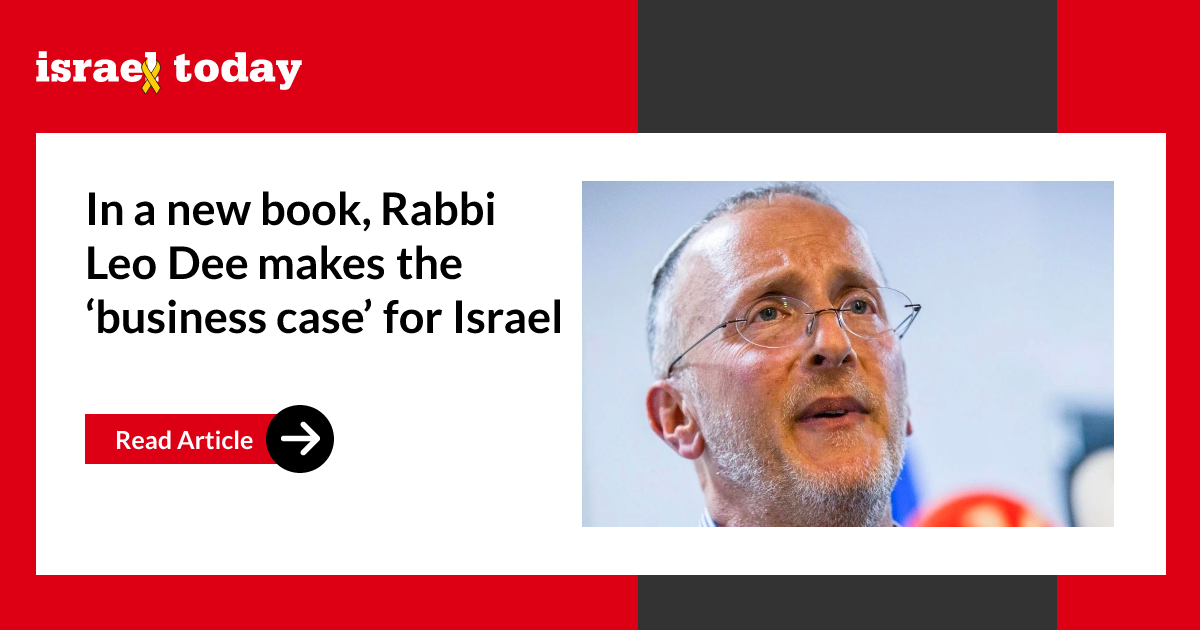

Rabbi Leo Dee holds up a copy of his new book, Aug. 5, 2026. Photo by Steve Linde.
Rather than encouraging investment capital alone, Dee said his goal is to persuade Jews to invest their lives in Israel. He believes many Diaspora Jews continue viewing Israel through an outdated lens dating back to the country’s early decades.
“When we were growing up, Israel was a third-world country,” he said. “Now Israel is really probably the most dynamic country in the world. Our minds are still set in that 1980s and 1990s scenario.”
He recalled arriving at Ben-Gurion Airport decades ago, when visitors disembarked into a modest terminal surrounded by open land before traveling to Jerusalem on a narrow highway. Many Jews abroad, he argued, still picture that Israel, despite its dramatic transformation into a global center of innovation and entrepreneurship.
To illustrate the point, Dee compared Israel’s trajectory to Apple’s rise over Kodak, arguing that investors who cling to outdated assumptions often miss transformational opportunities.
“The old world for Jews—the Americas, Britain, France, Argentina, Canada—those are the Kodaks,” he said. “Israel is Apple.”
Asked whether the Oct. 7 attacks made Israel a riskier place to build a future, Dee argued that they demonstrated precisely the opposite.
“I think the product of a country is its youth,” he said. “What we’re producing here is an incredible next generation.”
He contrasted the willingness of young Israelis to serve in the Israel Defense Forces with the anti-Israel demonstrations that erupted on university campuses across the West after Oct. 7, arguing that Israel’s younger generation has developed an unusually strong sense of national purpose.
“The future of the country depends on product development, which is youth development,” he said. “What you see here is a group of young people who are fighting with their lives for their culture, their religion and their country.”
Drawing on economic data cited in the book, Dee argued that Israel has consistently outperformed many Western markets over the past quarter century in both equities and real estate, while demographic trends point to continued long-term growth.
He said investors should focus less on current headlines and more on long-term trends.
“Great investors spend less time analyzing the past and more time identifying the trends that will shape the future,” he said.
Dee also cited Israel’s entrepreneurial culture as one of its greatest competitive advantages, particularly as artificial intelligence reshapes the global economy.
“The one skill that will matter most in the age of AI is entrepreneurialism,” he said. “The country with the greatest startups per capita is Israel.”
He argued that because Israel has long faced security and economic pressures, its entrepreneurs have learned to create products that solve essential problems rather than merely convenient ones.
“Everything here has to be a must-have,” he said. “We don’t have the luxury of producing things that are merely nice to have.”
‘The Jewish people belong in Israel’
The final chapters of the book return to Dee’s religious roots, arguing that the Hebrew Bible consistently presents the Land of Israel as the natural home of the Jewish people.
“The Bible is simply a book about a people who fall to the lowest level of degradation in Egypt and then come out of Egypt and come home,” he said. “The message is that the Jewish people belong in Israel.”
Dee said that while serving as a rabbi in Britain, he often focused sermons on the Torah’s moral teachings, but he came to realize after moving to Israel that its overarching narrative points to the return of the Jewish people to their homeland.
“If you look at the whole book as a whole, clearly the message is that the Jewish people belong in Israel,” he said. “We are basically the Israeli people in exile. We forgot about it for 2,000 years, but now we’re home.”
He also points to history as evidence that the center of Jewish life has shifted decisively to Israel.
For the first time in nearly 2,000 years, he said, a majority of the world’s Jews live in the Jewish state.
“Fifty percent of Jews are here now,” he said. “Within 20 years it’ll be 60%. Within 50 years it’ll be about 80%.”
Dee traces the movement of the Jewish people over the past 3,500 years—from Egypt to Babylonia, the Roman Empire, Spain and the United States—observing that Jews have historically gravitated toward the world’s leading powers. Today, he noted, that demographic center has shifted to Israel.
He leaves readers with a question rather than a definitive answer: Did Jews settle in those countries because they were already powerful, or did Jewish talent and enterprise help make them great?
“What does that mean now that most Jews are in Israel?” he asked. “Does that mean that Israel will become the new superpower in the next 20 years?”
While acknowledging that readers may reach different conclusions, Dee believes the demographic, economic and cultural trends all point in the same direction.
His message to Diaspora Jews is unequivocal. “There is no future for your children or your grandchildren in the Diaspora,” he said. “Those who are considering moving here—for themselves, for their assets and for their family’s future—should not leave it too late.”
He argued that aliyah will only become more difficult as Israel’s economy continues to strengthen and demand for housing rises.
“The longer you leave it, the more expensive it becomes,” he said. “Property prices here are going through the roof. The shekel has strengthened, and I believe that trend is set to continue.”
For Dee, though, the case for Israel transcends economics. Whether viewed through the lens of venture capital, demographics, Jewish history or the Bible, he believes the same conclusion emerges: The future of the Jewish people is being written in Israel. Overall, the book challenges Jews around the world to reconsider where their family’s future is best served.
“The goal of this book is to help people look at Israel with new eyes,” he concluded.
Want more news from Israel?
Click Here to sign up for our FREE daily email updates